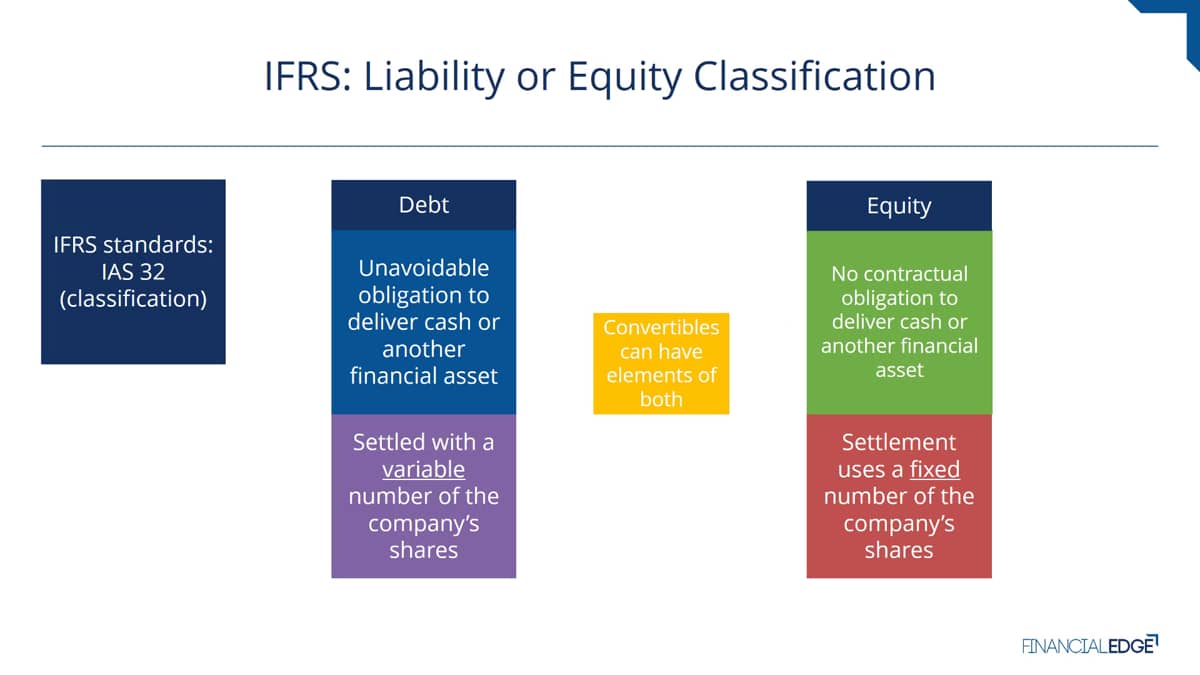
Before we go into the details of the accounting under IFRS, it's worth just taking a step back and looking at the classification between liabilities and equity under the IAS 32 accounting standard.
Let's start with debt.
Now, the clear rule for debt is that it must be an unavoidable obligation to deliver cash or another financial asset.
Now, pretty much this means that if you have a bond in the convertible, which could be redeemed for cash at expiry, in other words, where the convertible holder has a choice of either getting the bond repaid or converting the bond into equity or an equivalent amount of cash, in this case, the debt or the bond would be treated as a liability. Under IFRS accounting, you have some situations where convertibles can be mandatory.
In other words, you have to convert them into equity.
And in that situation, the bond par value would not be treated as debt that would be treated as equity.
However, the cash coupons between the date of issuance and the date of maturity, those would be treated as a liability.
You can see this is not completely straightforward.
However, one big issue here is that if the convertible is settled with a variable number of the company's shares, in other words, it could be an amount that they have to give the investor and they will just issue the number of shares up to that value.
In that case, that would be treated as debt rather than equity.
Now, on the equity side, the definition of equity is that there's no contractual obligation to deliver cash or indeed another financial asset if that was in the agreement.
And if the convertible is settled using a fixed number of the company shares, in other words, you have an know 10 shares for each convertible.
In that case, the option will be treated as an equity tranche.
So you can start to see there's a key difference here between convertibles, which is settled with a variable number of shares up to a kind of value amount versus convertibles, which just convert into a fixed number of shares. And that tends to be the key driver of the accounting difference in IFRS.
So in most situations, the bond is treated as a liability because you can redeem the bond for cash at the end of the convertibles life in most convertible designs.
However, if the convertible is mandatory, that will be treated as equity, but the cash coupons will be treated as liability.
But if the option is settled with variable shares, even the option would be treated as a liability.
But if the option is settled with a fixed number of shares, that would be equity.
As I said before, convertibles are complex and there's no plain finr version of a convertible.
So convertibles can have elements of both debt and equity accounting and in different proportions according to their design.