So we're now going to take a look at the accounting Under US gap with the derivative separation option, but at conversion.
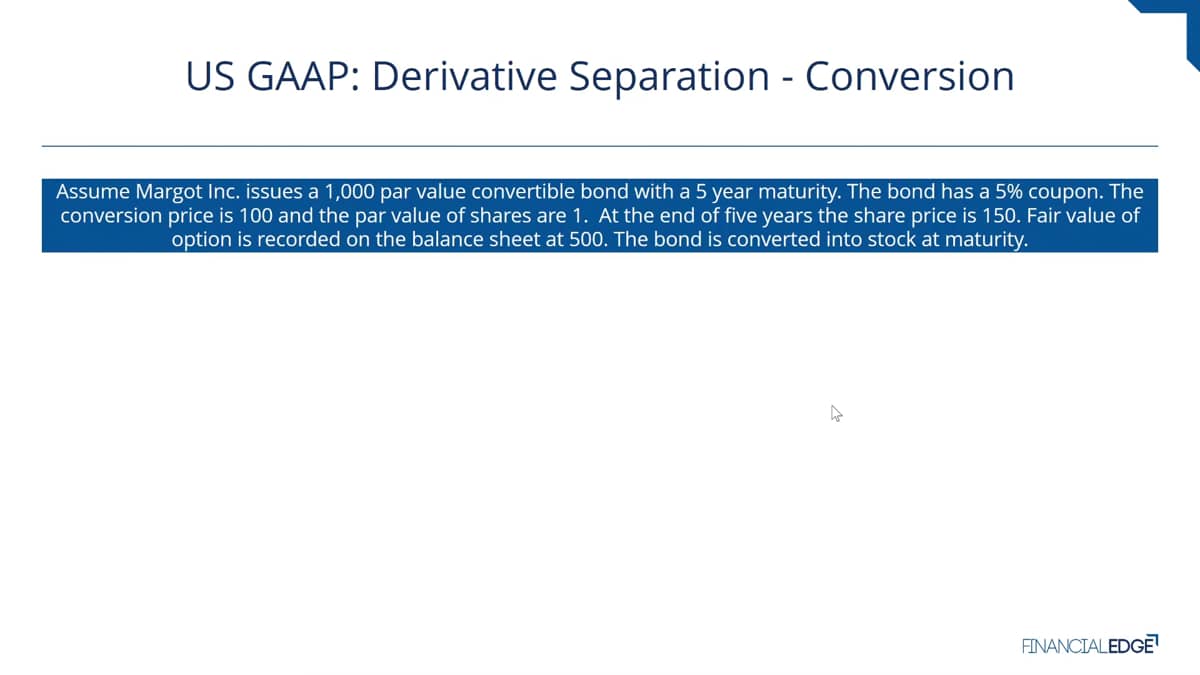
So we've got the bond issued by Margot.
They have a thousand in in proceeds, which is equal to the power value, five in maturity, 5% cash coupon, commercial price of a hundred and a par value of shares of one, and the end of the five year period receiving the share price is 150.
And the fair value of the option is recorded on the balance sheet at 500.
The bond is converted into stock at maturity.
So what happens, we're going to see no impact on the asset side, but the debt liability, which will be 1000 'cause we'll have seen the amortization of the discount.
That will go down the drift of liability on the balance sheet, which is marked to market.
We're also gonna go down by 500.
And then what we'll see is the comm stock of 10. Because remember, we've got 10 shares and that's 1000 divided by 100 times one par value and that equals 10.
And then the remaining amount just goes to additional paid in capital.
So that's all that happens at conversion. Fairly straightforward.
Few things to note if you convert early.
In other words, between year one and year five, the liability should be revalued to reflect the loss of the time value of money, which potentially means you could have some type of gain.
In reality, most convertibles do stay outstanding until the end because the investors want to capture the time value of money.
And if they want to exit, they can just sell it in the market.
If the convertible is paid off using cash and the derivative liability and the bond and the balance sheet is less than the reduction in the cash looks have to expense the difference.
And then lastly, as the convertible bond gets more in the money, the digital liability should be increased and be expensed.
And that's just reiterating the fact that if the derivative liability started out at 100 or 200 and has risen to 500, that difference of 300 is gonna be expensed through the income statement.