Let's take a look at a more complicated example.
This is convertible bond with equity treatment for the option, but with transaction costs.
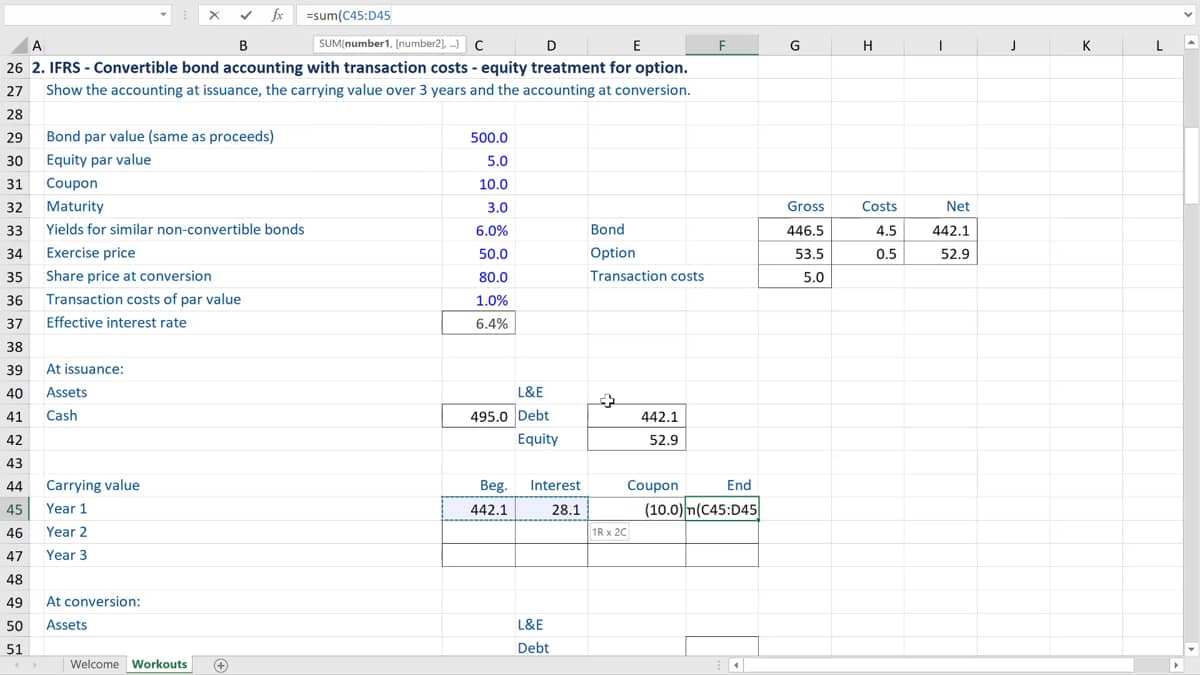
So what we've got here is we've got some key information. Bond value is 500, same as the proceeds.
So that's a par value, but same as the proceeds.
Equity par value of five, cash coupon of 10 Richard to three years yields for similar bonds. Non-convertible are 6%, exercise price of 50, the share price at conversions 80 and transaction costs of par value, which are 1%.
So we've gotta calculate the effective industry, but before we do that, we'll take the gross value of the bond.
And again, this is going to be a present value calculation. So to put minus pv, the rate I'm gonna use is 6%.
The number of periods that we've got is the maturity, the cash coupon is the payment, the future value is the par value of 500, and that will give us the bond value of 4 4 6 0.5.
Then the option value, the option element is the difference between the par value of the bond minus the bond value, which is 53.5.
And then we've got the transaction costs.
And the transaction costs are just 1% of par value.
So I'll take the 1% of 500, which is five, and then that gets spread pro-rata over the bond.
So I'll take the bond divided by the sum of the bond and the option value times the transaction costs.
So part of the transaction costs get allocated to the bond and the remainder will get allocated to the option.
So then we've got the net effects here, which is the gross minus the costs, both the option and the bond there.
Then unfortunately, what we've also got to do is calculate the effective interest rate, including the factoring in of those costs.
So here we're gonna use the rate function, and the number of periods is going to be three years.
The cash payment is going to be 10.
The present value, I'm put minus in front of that is gonna be the 4 4 2 0.1, and the future value is going to be 500.
So you'll see here that the effective interest rate is just slightly higher than the 6% reflecting those transaction costs.
So how do we account for this? So what we'll then see is cash is gonna go up by the par value, but remember you're going to have to take off the transaction cost. So I'll subtract 1% times of 500.
So actually means we'll get 4, 9, 5 debt is gonna go up by the net amount, the 4 42 0.1, and the equity will go up by the 52.9, and you'll see that the balance sheet Will balance at that point.
Then what we've got to do is we've got to do the amortization of the discount, and we can do this in this little grid here.
We've got our beginning amount of 4 4 2 0.1.
The interest is going to be the beginning amount times the effective interest rate. And this is important not the yield for similar bonds, but the effective interest rate. So I'm gonna absolutely reference that and that's my interest expense.
The cash coupon is going to be 10, and I'll subtract that and again, I'm gonna absolutely reference that.
And then the ending amount is just the sum of the beginning balance plus accrued interest minus the cash interest.
And I get four 60.2 and the beginning of next year it's going to equal four 60.2.
The interest is gonna go up slightly because the beginning, beginning balance has risen.
The cash good coupon's gonna stay at 10, and if we copy that down to year three, we'll see like magic, the bond ends up with 500.
So what happens at conversion? Well, what we'll have here is that debt is gonna go down by the 500, and then we've gotta split it between the common stock and the share premium.
All the common stock is just going to be the par value of the debt divided by the conversion price or the exercise price as I've called it here, or 50 times the number of shares, times par value, which in this case is five.
So we've got common stock going up by 50, and then what we'll do is we'll take the share premium, which is just going to be the difference.
So that is the 500 minus the common stock.
So it's pretty straightforward at conversion because the option is treated as equity ad issuance.
So pretty straightforward.

 Convertible Bonds Workout Empty