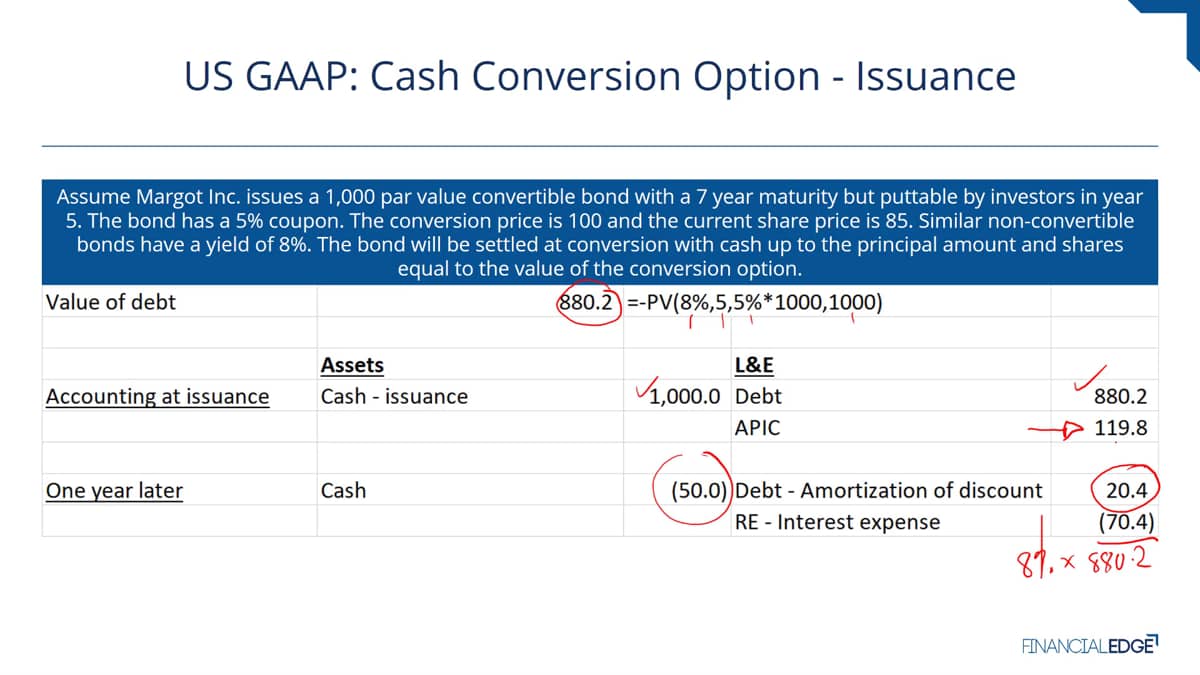
We're now going to take a look at the Accounting Under US Gap for the cash conversion option, but at issuance.
So we'll start with Margo again.
Margo's issued a thousand par value convertible bond, and we'll assume the proceeds are equal to the par value.
For simplicity, it's got a 70 year maturity, but critically it's putable by investors in year five.
So actually the counting will treat this as a five year liability because of that risk. That can be putted. Bonds got a 5% coupon, the conversion price is a hundred, and the share price is 85.
And similar non-convertible bonds have yields of 8%, and we'll assume that at conversion, the bond will be settled by cash up to the par value, and the rest with shares obviously equal to the value of the conversion option.
So let's take a look at the accounting.
The first thing we've got to do is calculate the value of the debt.
We can use the present value formula in Excel.
We've got an 8% yield based on similar non-convertible bonds, a five year maturity, a 5% cash coupon of a thousand and a future value of 1000.
Run it through the calculator and we get eight 80.2.
So unlike the other options where you value the option first, in this case, we value the liability first.
So we've got the cash issuance going up by a thousand.
We've got the bond, and then we can just plug the difference to apic, and that's the value of the convertible option.
119.81 year later, we have to just amortize the discount on the bond, so the interest expense, this 70.4 is calculated by taking the IRR, which is the 8% times the eight 80.2.
That will give us 70.4.
The cash coupon is 50, so we plug the difference, the amortization of the discount and the debt will rise slightly so there's no impact on the convertible option.
Once it's gone to apic, you just leave it alone.
It won't be marked to market.
So this means you won't have the volatility running through the income statement.