We're now going to take a look at IRS accounting for convertibles, including transaction costs, but where we treat the option as a liability rather than equity.
So we want to take a look at the accounting over three years.
We've got some key numbers here.
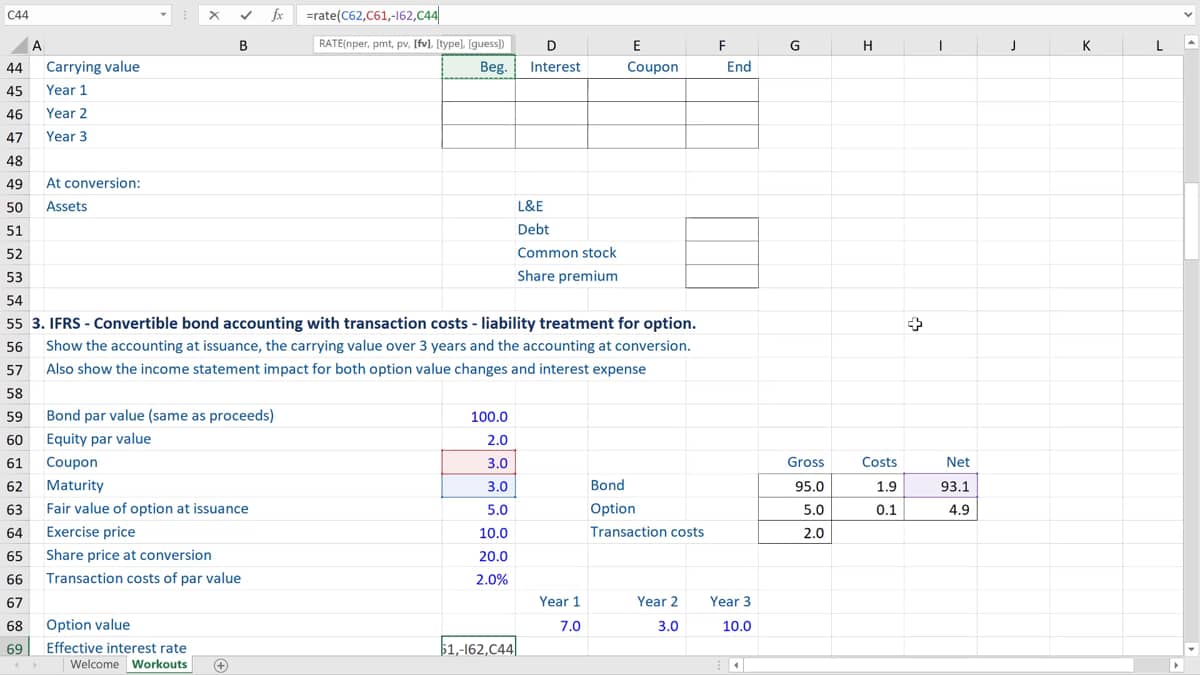
We've got the bonds par value of a hundred, an equity par value for each share of two, a cash coupon of three, maturity of the bond of three years.
The fair value of the option at issuance of five, the excise price of 10, the share price at conversion of 20, and the transaction cost is a percent of par value at 2%.
So let's start by accounting for the bonds.
What we'll do is we've got the option value, which we've given at fair value additions of five.
So this means the bond is going to be just the difference, so it's the proceeds minus the five.
Now we're also told we've got transaction costs.
So we'll take the 2% transaction costs times the par value.
So that's the assumption. And then we've got to spread these on a pro-rata basis.
That two times in the first case, the 95 divided by the sum of the 95 and five, which is the par value.
So that's 1.9.
And then the remaining amount is going to be allocated to the option.
So I'm just gonna take the transaction cost. In total months, we'll put nine and that's allocated to the option.
So then we use the net amounts here, and that's what gets recorded onto the balance sheet.
We also need to recalculate the effective interest rate, including the transaction costs.
So I'm gonna use the rate function, and I'm gonna take the number of periods of the bond, which is three, the payment, which is the cash coupon, the present value, which I'm gonna use, minus as the net amount of the bond.
And then the feature value is the par value, which we're given as 100.
And so the actual true ative interest cost is 5.6% higher than the cash coupon yield because of the transaction costs.
Now, we've also got some information about the fair value of the option over time.
Remember it started out as five, so it goes revalued upwards, then downwards, then upwards again.
So at issuance, how much cash are we going to receive? Well, we've got the bond par value, but we've got to pay the transaction costs.
So actually we'll only receive 98, and that's going to be matched by an increase of debt of 93.1 and an option on the balance sheet 4.9.
Those added together equal 98.
Then the carrying value of the bond is going to be recorded as normal using the amortized cost method.
So the interest rate is calculated using the effective interest rate absolute reference that times the beginning balance of the bond.
The cash coupon is going to equal minus the cash paid absolute reference that, and the ending amount is just going to be the Sum. And then that will carry on for three years. Beginning balance becoming the ending balance, the interest rate going up slightly 'cause the bond has gone up slightly on the balance sheet.
The cash coupon staying the same, get the ending amount. And then if we just move that down to year three, we get 100.
So what is the income statement impact? Well, remember in year one, we've got the interest expense of, I'll make this negative 5.2.
In year two, we've got the interest expense of 5.3.
In year three, we've got the interest expense of 5.4, but we've also got the gains and losses on the option.
So remember, the option on the balance sheet is being recorded at five, but if at the end of year one the option is valued at seven, this means we're going to have a loss of two.
And then in the next year, if the option on the balance sheet is recorded at three, we'll take the prior year's value minus three, which means actually we'll get a gain because the option value has decreased in year two.
And then in year three, we'll have a loss because the option liability has increased.
So then what happens at conversion? Well, remember the debt is going to go down by the full 100 because it's sanitized cost.
And then the common stock is going to go up by the amount of shares that we've got. So it's a hundred divided by the exercise price.
So it's gonna take the exercise price, which is 20, and then I'm going to multiply that by the par value of the shares.
So the equity par value is two, so that gives us the number.
The common stock amount is five shares times two, and then the share premium for the bond, it's just going to be the difference between the debt and the common stock amount.
So that goes up by 90.
Remember, we've got a derivative liability on the balance sheet, which is gonna come off the balance sheet of 10, and that's going to get plugged to the share premium.
So everything will balance at that point.

 Convertible Bonds Workout Empty