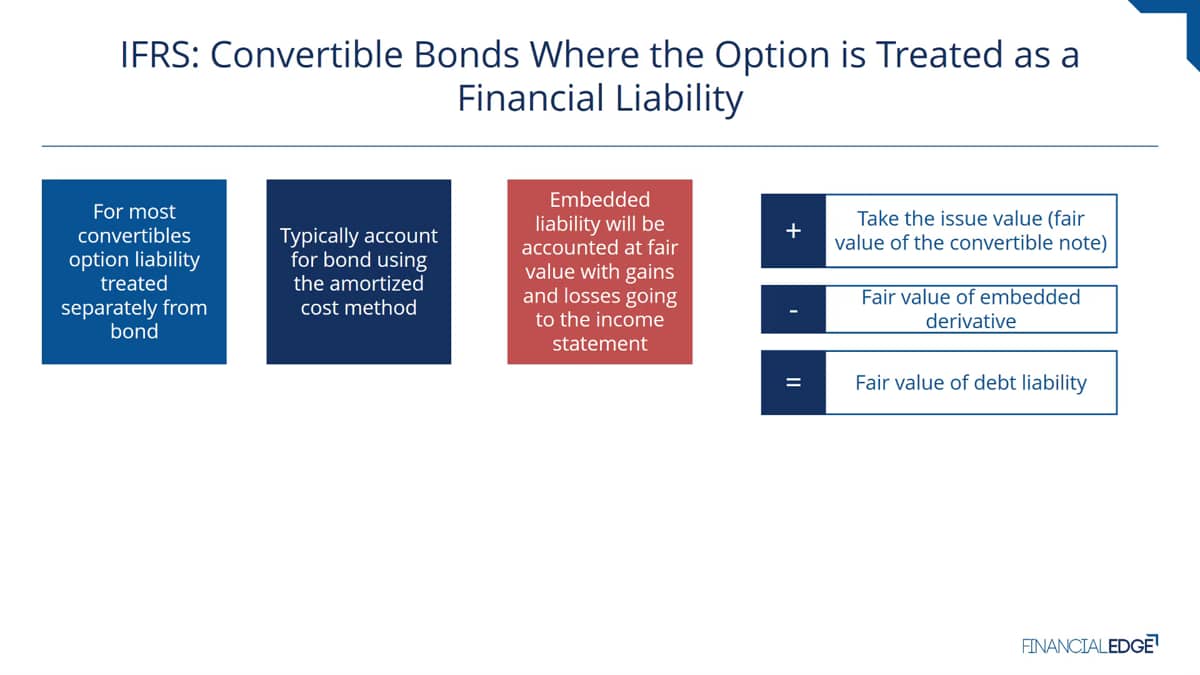
Now let's take a look at the accounting for convertible bonds where we treat the option as a financial liability rather than equity In every case, we can see on IFRS except where we treat the convertible at fair value as a whole, the option is going to be treated separately from the bond.
So this means that it can either be equity or it can be liability.
And in this case, we're assuming that the accounting said the option has got to be treated as a liability.
The bond is gonna be accounted for using the amortized cost method as normal in terms of the accounting on a year, on year basis.
However, how we get to the value of the bond alters slightly in this case, the option because it's liability is going to be accounted for at fair value over the life of the convertible.
Now, this means that the fair value can change, it can go up and it can come down and it will suddenly go up if the convertible becomes in the money.
So this means we're gonna see more gains and losses going through the income statement, which will introduce more volatility through the income statement, which will be a big downside for structuring a convertible where the option is treated as a financial liability rather than an equity item.
So how do we actually calculate the values? Well, in this situation where we're treating the option as a financial liability, we start by taking the fair value of the convertible note, which effectively is the issue value at the start.
Then what we do is we deduct the fair value of the embedded derivative.
So this is slightly different, a slightly different order where we're treating the option as a financial liability versus where we're treating the option as an equity item, and then we solve for the fair value of the debt liability, and that drives the accounting for the amortized cost.
So instead of trying to value the financial liability using a comparative bond, in this case where we're treating the options of financial liability, we'd get the fair value of the embedded derivative and solve for the fair value of the debt liability, and then calculate the effective interest rate using that value.