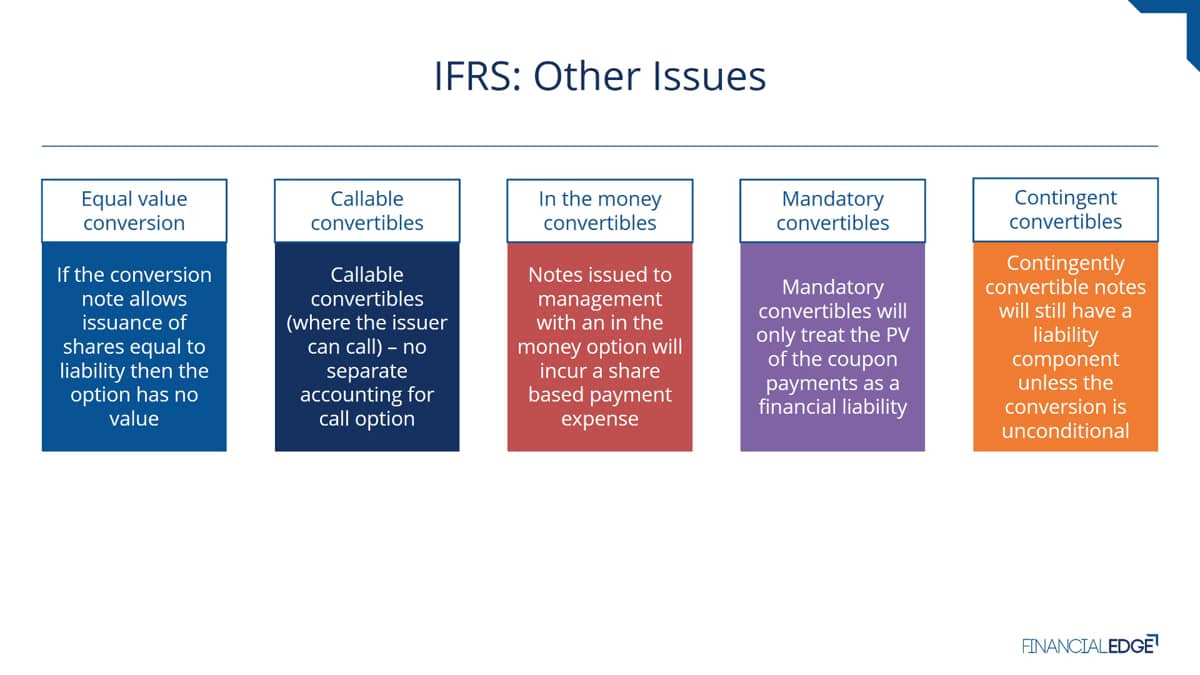
The first is if the conversion or the the terms of the conversion allows the issuance of the shares exactly equal to the liability, then the option has no value.
So, although actually, technically you will have a liability there, it will be a liability of zero value.
If the convertibles are callable, in other words, the issuer can call, then there's going to be no separate accounting for the call option.
That is the benefit of the issuer.
If the convertibles are in the money issued in the money, in other words, at the very beginning of the convertibles life, they're in the money, then that's effectively a benefit.
And this typically happens in private equity transactions where you want to incentivize the management team.
And in this case, what will happen that in the money element will be expensed as a share based payment.
Mandatory convertibles are convertibles, which must be converted to equity.
So in this case, you will treat the option element as equity.
You'll treat the par value as equity.
The only financial liability you will have is the present value of the coupon payments.
So there will be liability, but it will be a small amount 'cause it would just be the present value of the coupon payments.
Lastly, contingent convertibles. So these could be cocoa bonds for banks, for example, where the tier one ratio deteriorates to a certain level and that will trigger the conversion and they will still have a liability amount unless the conversion is unconditional.
So you'll still see a liability initially before the the contingency is actually triggered.