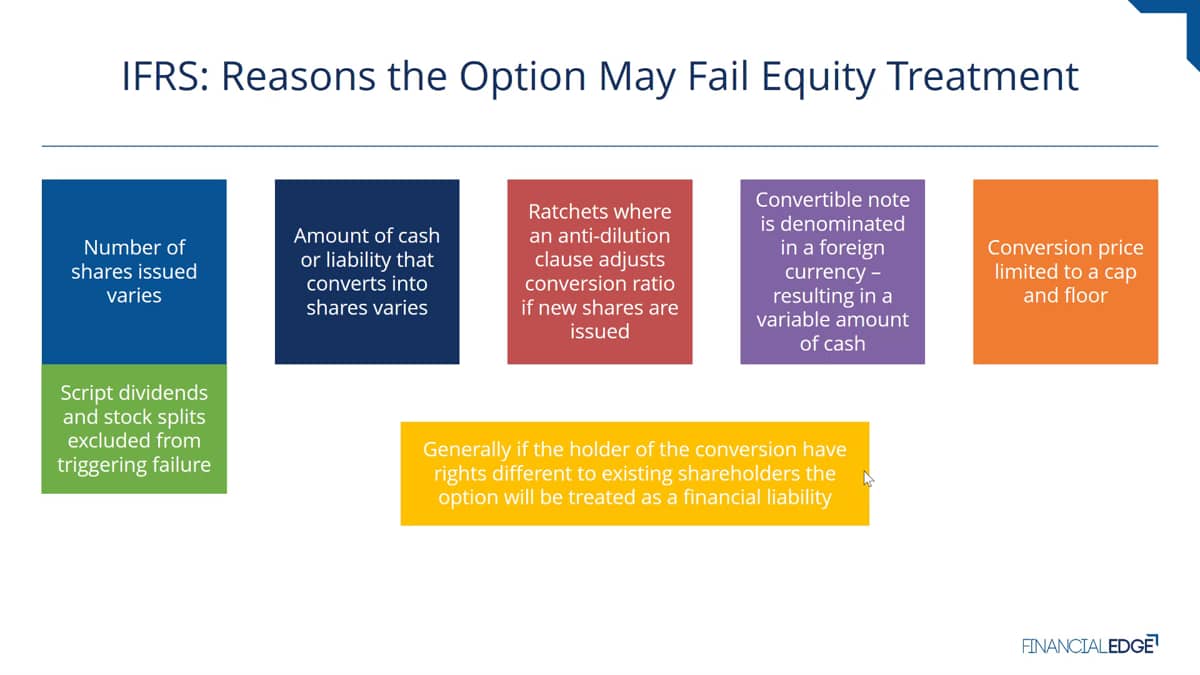
Now let's take a look at the reasons why the convertible option, the embedded option may fail equity accounting. In other words, it will have to be recorded as a liability rather than equity.
Well, we've already seen one big issue is that the number of shares issued at conversion is going to vary, in other words, won't be fixed.
Now, there's some exceptions to this, and that is anything like script dividends, that's a dividend paid in shares or stock splits.
This is excluded from the, um, failure trigger if the amount of cash or liability that converts into shares vary. So again, anything that is going to be a variable consideration at the end of the bond's life.
Any ratchets, and these particularly relate to private companies like private equity deals where there's a kind of ratchet and anti-dilution clause where if there's new shares issued, you don't get dilution.
Anything of those kind of clauses that will require the convertible option to be treated as a liability rather than equity.
If the option is or the convertible is denominated in a foreign currency, in other words, a subsidiary in a foreign currency versus the home currency of the issuer, or whether there's a cap and floor at conversion in other, whether it's the conversion price is limited to kind of a, a, a share price within a kind of range, a kind of cap and a flaw of the share price.
In general, if the holder of convertible are going to have rights, which are exactly the same as shareholders, then it will be treated.
The option element will be treated as equity.
If not, it's going to have to be treated as a financial liability and that kind of makes intuitive sense.