So here we've got little exercise to calculate the counting under RRS for a simple convertible bond.
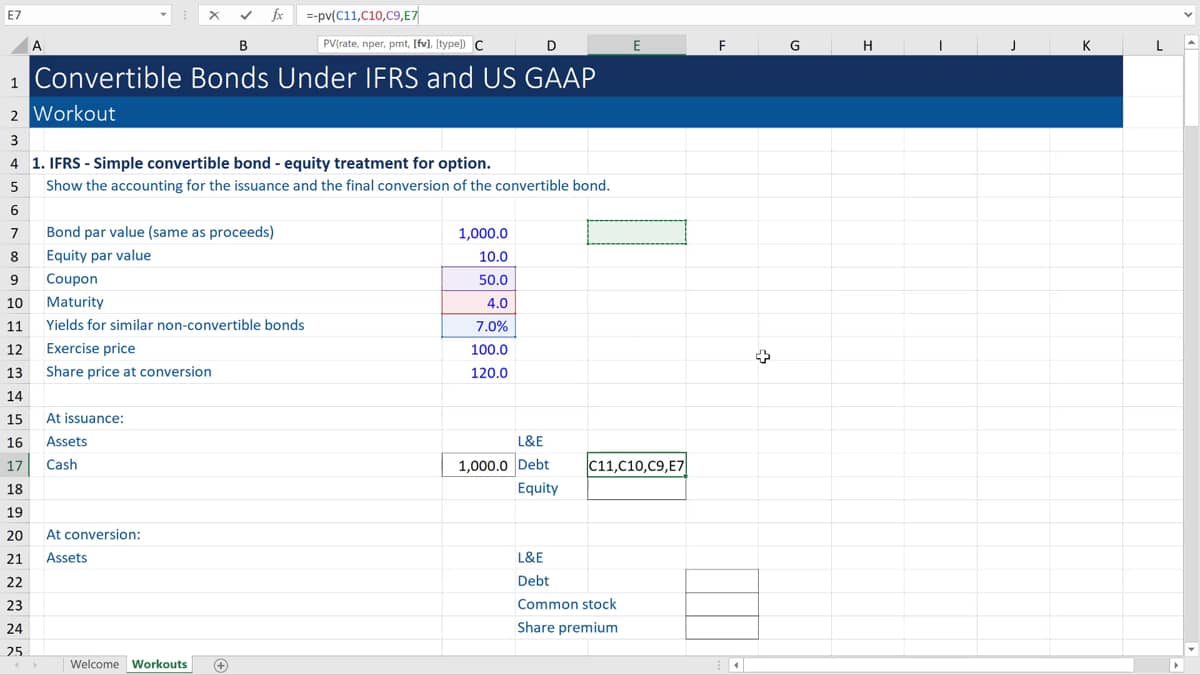
So we've got the par value of a bond at 1000 here, got the equity par value of 10, got a cash coupon of 50 maturity four years yields for similar non convertible bonds at 7% the exercise price of a hundred and the share price at conversion of one 20.
So we'll assume that we get cash proceeds of 1000. So that's the first issue.
Then the second thing we've got to do is we've got to record the amount of the debt element here, and we're assuming equity treatment for option.
So the debt is going to be a present value calculations. So I use the PV function and the rate we'll use for similar non-convertible bonds.
It's the same maturity. The maturity in this case is four years, which we're given the payment.
The cash coupon is going to be 15. We're given that which will just be the coupon rate times the par value, and then the future value is the thousand that we get at the very end.
So this means the value of the bond using a yield of a non-convertible bond with sum maturity is 93.
So the equity element is just going to be a plug, the difference between the proceeds and the debt at maturity 67.7.
Now at conversion, what will happen is the debt obviously is gonna go down and at the time of conversion, what will have happened is that the discount, the difference between 1000 and the nine through two will be amortized.
So actually when the debt is converted, it's going to be a thousand come down.
And then we'll issue the number of shares.
And in this case, what we'll do is we'll calculate the par value of the bond divide by the exercise price, which is 100, and that will give us the number of shares that issue times the par value, which is 10.
And that means the consult will go up by a hundred.
And then what we'll do is just plug the difference between the par value of the bond and the common stock.
So you can see here that we don't take into account the market value at conversion, it's just the par value if we have the equity treatment for the option.

 Convertible Bonds Workout Empty