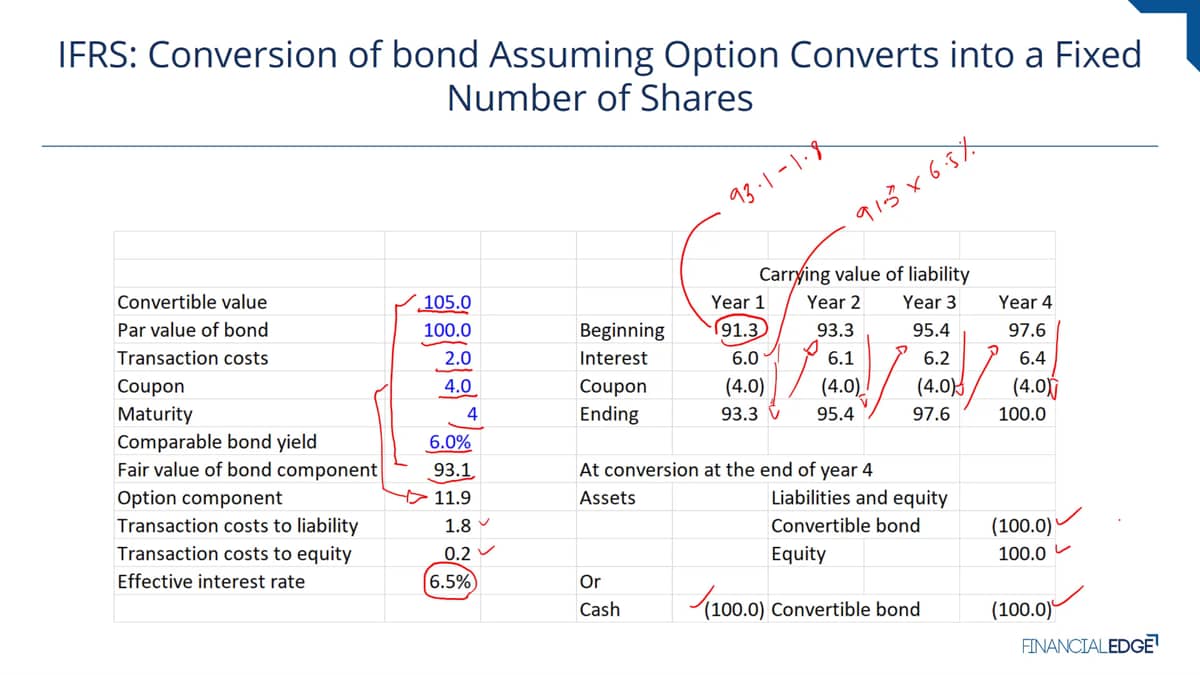
Now let's take a look at what happens to the accounting over the bonds life under IFRS, assuming we are treating the option as equity and the bond as a liability.
What we've got here is we've got some calculations.
The convertible at issuance is being issued at a hundred and fives. That's its kind of fair value.
At issuance, we've got the bond, which is a par value of a hundred transaction costs or issuance costs of two.
We've got a coupon of 4 million a year, which is a 4% rate, a maturity of four years.
And we have got a comparable bonds yield.
And that comparable yield is for a bond without a convertible option and we need that to value the bond.
So we've got the value of the bond of 93.1, which is the present value of the coupon payments of four and the par value of 100.
The option convert component is just the difference between the value of the convertible 105 and the value of the bond.
And that will give us the 11.9.
Now we've got these transaction costs of two and they're going to be allocated on a pro-rata basis between the bond, which is the 1.8, and the option which is 0.2.
And that 0.2 will get expensed immediately.
The 1.8 is going to be amortized over the life of the bond using the effective interest method.
So to do that, what we need to do is we need to calculate the effective interest rate and we start by putting the beginning balance of the bond on the balance sheet, that 91.3.
And that 91.3 is just our valuation of the bond element of 93.1 minus the issuance costs of 1.8.
And that's how we get the 91.3.
Then we plug that into the calculator or Excel, and that's the present value, the cash coupon of four, which is the payment.
The yield is what we're solving for the future value is the par value of a hundred.
We crank that through and we'll get the effective interest rate of 6.5%.
The reason it's 6.5% is that that's incorporating the issuance costs or the transaction costs.
So in the first year, we will take the interest that six is gonna equal 91.3, the beginning balance times the effective interest rate of 6.5%.
So this is kind of standard bond accounting here.
And then the cash coupon is four.
And then we'll get the ending amount just by taking the 6 91 0.3 plus six of interest minus four of the cash coupon to get 93.3.
And then we'll work that again at the beginning balance of year two.
Come down again, go up again, come down again, go up again.
And then like magic, we end up with the par value at the end of year four.
So that's the mechanics of the accounting of the bond over the convertibles life, assuming there's no early conversion or no call or anything like that.
So what happens the end of year four? Well, we've got two options Here. Either the convertible bond is in the money, the equity option is in the money, and we convert the bond into a fixed number of shares or the bonds or the convertible is not in the money and the bond holders don't elect to convert it.
They just want to get redeemed for cash.
So if it's in the money, the bond comes off the balance sheet and we just increase equity by an amount equal to the bond.
And that's even though the convertible is in the money.
So actually the convertible could be worth a lot more than that, but we don't reflect that on the balance sheet.
Alternatively, if the bond gets redeemed for cash, cash is going to fall by a hundred and the convertible bond liability will fall by a hundred.
So you can see under this accounting, if we record the option as equity in words, we just increase equity at the beginning, additional paid in capital, then we won't see that kind of true value of the conversion on the balance sheet at the end of the convertibles life.
'cause all will happen is the bond will come off the balance sheet and either cash will go down if they elect not to convert, or equity goal will go up by the amount exactly equal to the bond.
If they do.