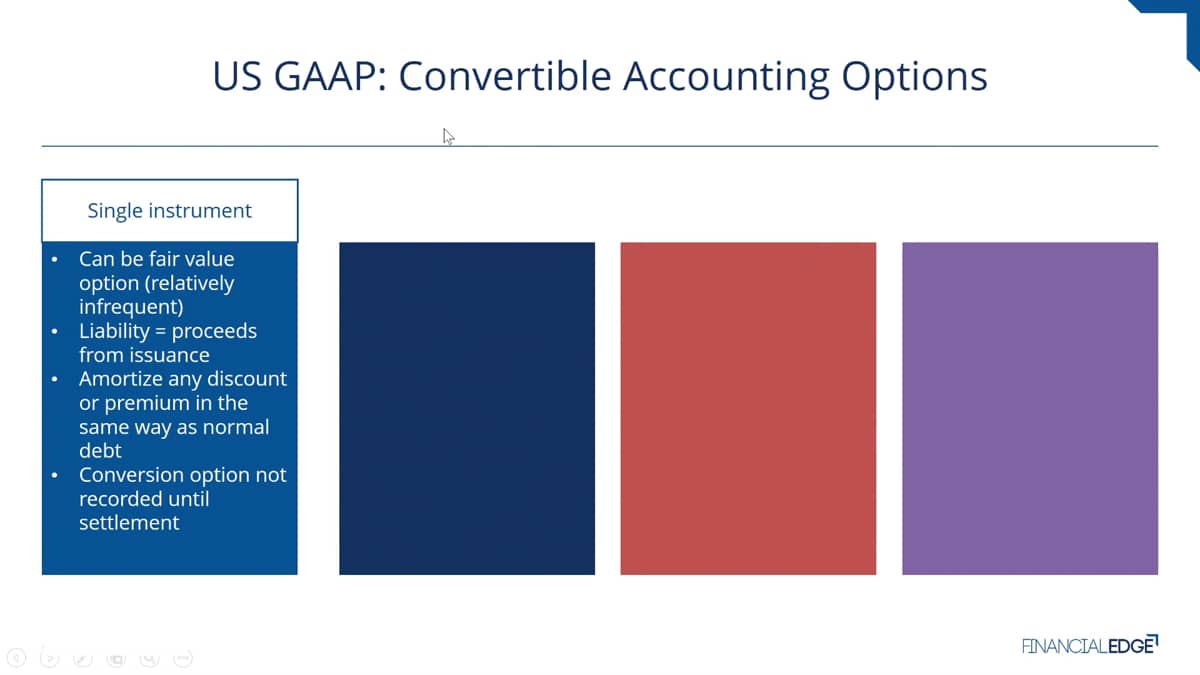
So let's take a look at the convertible accounting options under US gaap.
The first choice, we have to treat the convertible as just a single instrument, a single line on the balance sheet, and we'll do this either because we can't recognize the derivative separately under US GAAP because they're strict rules about that or because we choose the fair value option.
And in this situation, the liability on the balance sheet will just equal the proceeds from issuance and we won't see any kind of conversion until the settlement date and we'll amortize any discount or premium just in the normal way we do with regular debt.
The second option is where we have derivative separation.
So this is where we separate the bond from the derivative element, and we can only do this if the strict rules around recognizing derivatives are met.
If this is the case, the first thing that we'll do is we'll determine the fair value of the embedded option.
Once we've done that, we'll take the fair value changes over time through the income statement, which means that we'll potentially introduce some volatility, volatility into the company's income statement. As a result of this, the remaining liability will be to be treated as regular debt.
So in this case, we'll have one liability, which will be the derivative, another liability, which will be the debt, and the debt will just be amortized as normal and the option will be treated at fair value and gains and losses will go through the income statement.
Another option under US cap is where a significant part of the convertible can be settled in cash, and this is known as the cash conversion option.
In this situation, we'll estimate the fair value of the debt liability first using a comparable yield for a bond without any convertible derivative option.
Once we've done that, then we will take the proceeds less the fair value of the debt, which is essentially the derivative element, and add that to additional pay in capital.
So in this case, we won't see a liability on the balance sheet for the derivative and we won't have the gains and losses in the volatility as consequence of that, and then the remaining liability will just be treated as regular debt.
The fourth option, which is less common, is the beneficial conversion feature.
This is where we issue the convertible in the money, and this probably is because you've got a management team and you want to incentivize them.
So in this case, we've got to estimate the value of that conversion feature and that will get added to additional uh, paid in capital.
So again, you won't have any liability here.
The liability you will have will just be the regular debt and you'll take the proceeds less the value of the in the money option.
Next, it's worth probably going through a kind of flow chart just to kinda decide what accounting method needs to be used for that particular convertible.
And the first thing to Establish is whether the company has elected for fair value accounting.
If they have then just treat the convertible at fair value over time, taking gains and losses through the income statement, and there'll be one liability.
If not, then you need to decide whether the conversion option meets the derivative accounting criteria, which is pretty strict on the US gap.
So this is key difference between US GAP and IFRS.
If it does, then you'll separate the debt and the option as separate liabilities and the option will be treated at fair value.
With gains and losses going through the income statement, the debt will just be amortized over time.
If not, then you need to decide whether the instrument includes a cash conversion feature.
In other words, does some of the convertible settle for cash? If yes, then again, you need to separate it into debt and equity components, the debt being the bond and the equity, which is the additional paying capital, which is the option value.
If not, then you need to test whether the instrument contains this beneficial conversion feature.
In other words, whether convertible is issued in the money.
If it is, again, you need to separate it into debt and equity components with the equity going to additional paying capital.
If not, then you'll just account for the convertible as one single liability in its entirety.