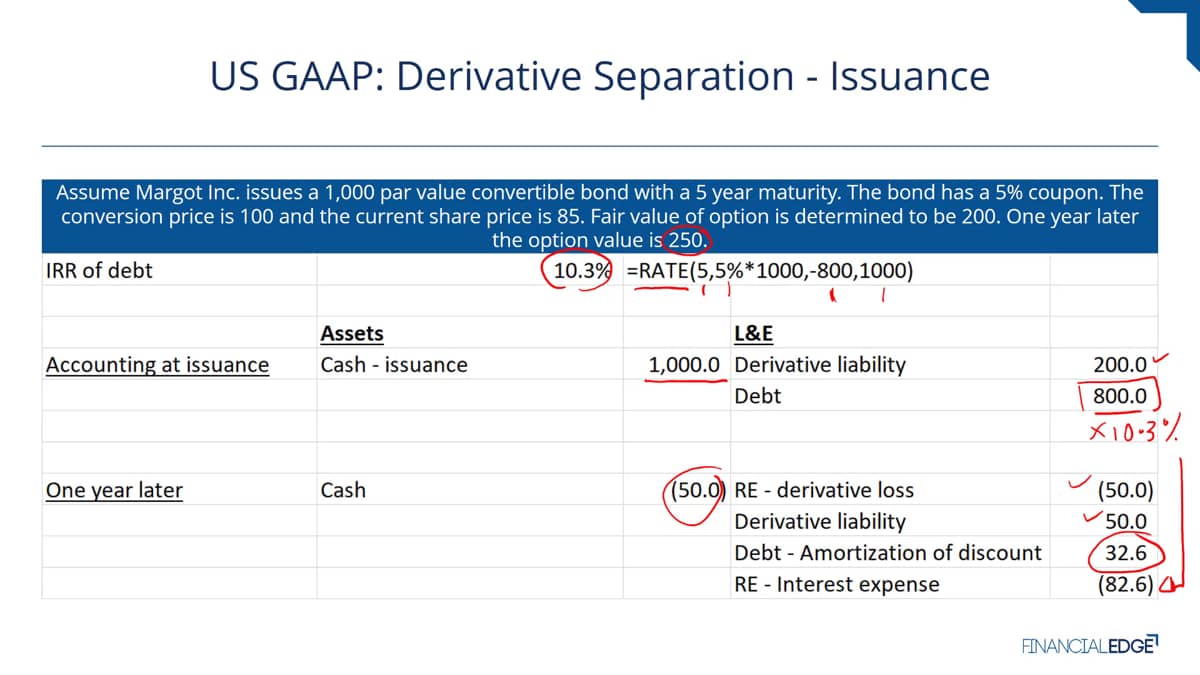
So now let's take a look at the mechanics of the derivative separation accounting under US gap. And we're gonna start with what happens at issuance.
We've got an example here of Margo Incorporated who's issued a thousand par value convertible bond, and we'll assume that the proceeds are gonna equal a thousand as well.
Got a five year maturity with a 5% cash coupon.
So 50 paid in cash each year.
The commercial price is a hundred, which means a thousand divided by a hundred is 10, which means that you'll get 10 shares, and the current share price is 85.
So currently the convertible ad issuance is outta the money, and the fair value of the option is determined to be 200.
One year later. The option value is two 50.
So let's, let's take a look at the mechanics of this.
So the first thing that happens at issuance cash is gonna go up by the proceeds, and at this point, we are assuming the proceeds are a thousand, then we will value the derivative of liability, and we are told that it's 200.
So then number two, we've got the 200.
Then what we'll do is we'll solve for the debt.
So we'll take a thousand minus 200 to get the 800 in debt.
So that's the issue. It's pretty straightforward.
Then as time goes by, we've got to charge interest and we've got to recognize the drivable liability at fair value.
Before we do the drivable liability, we'll need to take the internal rate of return of the debt, and I've used the rate function here in Excel.
We've got a five year maturity, a 5% cash coupon, 5% times a thousand is 50.
We've got the present value of the debt, which is 800, and the par value, which is a thousand.
Running that through the calculator, we get an IRR of 10.3%.
So to calculate interest expense, we'll take the 800 times 10.3%, and that will give us our interest expense of 82.6.
So in this case, retained earnings will fall by 82.6, but remember, the cash coupon is only 50, and the difference, of course, is the amortization of the discount, which means the debt liability will rise by 32.6.
So that's the interest piece, which actually is exactly the same as you would normally do for regular bonds.
So it shouldn't be much of a problem, but the drift of liability gets marked to market.
We're now told that the drift liability is two 50 at the end of year one, which means that we've got to increase the derivative liability from 202 2 50, and that could be because the company's share price has written.
So at that point, the drift of liability will go up by 50, but you'll then have to take a loss in the derivative through the income statement, which will introduce volatility in the income statement.