So now we're going to take a look at US Gap derivative separation accounting, and we've got a little excise here.
We've got the bond par value of a thousand, the equity par value of two on each share basis.
The bond's paying a coupon of 50, and by the way, we're assuming that although the bond par value is a thousand, that's also the same with the issuance.
Received good maturity of five years.
The fair value, the option at issuance is 200, and at the end of one year it's risen to three 80, probably because the convertible has become in the money.
The excise price is a hundred and the share price at issuance is 85 reassuming.
The no transaction costs to make things easy and we need to calculate an effective interest rate.
So at the beginning, what we do is we put on to the balance sheet, obviously the proceeds that we receive and there are no issuance costs.
And then we're gonna put the derivative liability on the balance sheet at fair value, and that was 200 at issuance, which means the debt is just going to be the difference between the two.
Now we can use that to calculate the effective interest rate.
And I'm gonna use the rate function here in Excel.
And I'll start with the number of periods, which is a five year maturity.
We've got a cash payment, the cash coupon of 50, we've got the present value, and I'm gonna put minus the 800, which is the debt on the balance sheet, and the future value is a thousand.
And I'll head enter. And so the effective interest rate is 10.3%, even though the cash coupon is only 5% in this case.
So then what we can do is just take a look at the amortization of this discount over time.
So we start the bond at 800, and then we can calculate interest by taking the effective interest rate.
And I'll absolutely reference that times the original amount of the bond.
The cash coupon is gonna stay fixed at 50, so I'll go and pick up the 50 cash coupon, absolute reference that, and then the ending amount, I'll just sum up the beginning balance plus the interest less the coupon.
And we get 8, 3 2. So the bond climbs in value over time.
So next year, in year two, it will begin with 8 3 2 0.6.
The interest expense will go up slightly, the cash coupon will stay fixed, and the ending balance will go up slightly.
And if we do that for the full five years, we will get two 1000.
And that's just the amortized cost method of accounting for bonds.
Now let's take a look at the impact one year later before conversion.
So here what happens is that one year later we know that the debt has climbed slightly, so the debt will go up.
And that's essentially the amortization of the discount.
It's the difference between the interest cost and the coupon amount that amortization gets added to the debt.
Now we'll also have to expense the interest, which is the 82.6, and we've got to pay The cash coupon, which is 50.
Now if you look at this, you'll see then actually now the balance sheet balances because both sides are being affected equally, however, we've got to mark to market the derivatives. So we're gonna take the value of the three 80 and or the revalued amount, three 80 minus the original amount, which is 200.
So we need to increase the derivative liability by 180, and that's going to be affected by expensing the difference. And this is where we start to see potential volatility flowing through the financial statements.
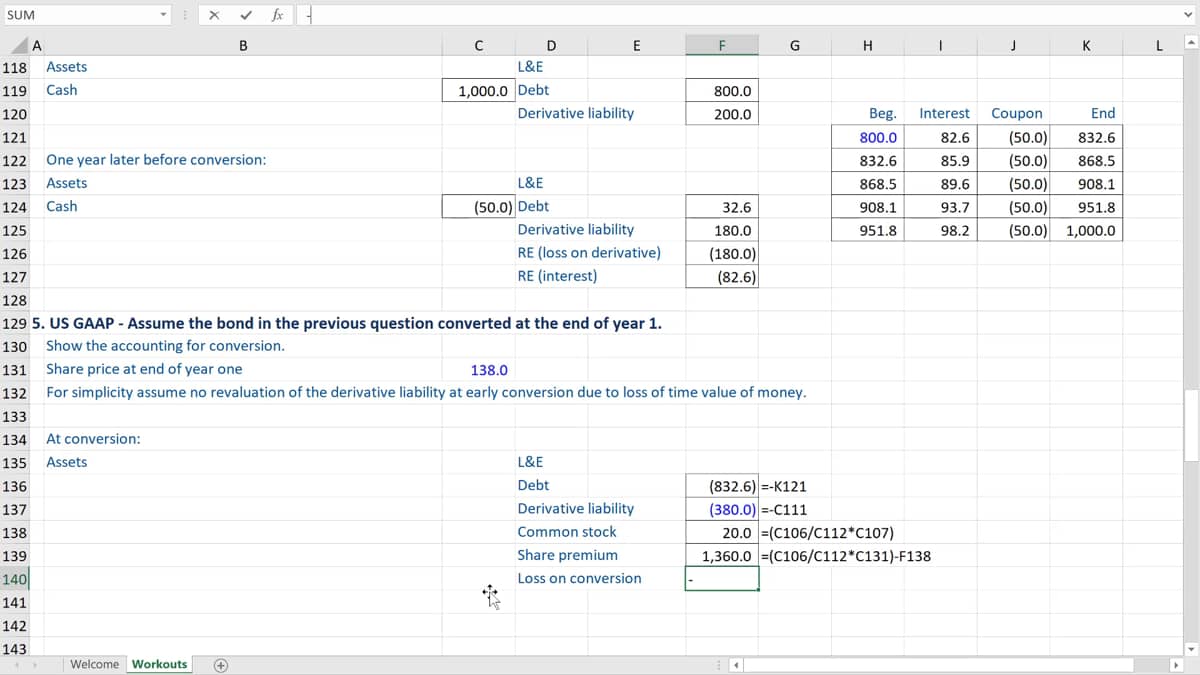
Now, following on from the prior question, we can take a look at what happens at conversion. And we are assuming here that we convert at the end of year one.
So what's gonna happen with the balance sheet or the debt is going to reduce by the balance of the debt that's sitting on the balance sheet.
At that time, the drift of liability, remember it's marked to market, is also going to fall.
So I'm gonna take that out, which is going to be three 80.
So the question is what then happens? Well, common stock's gonna go up by the amount of par value of the shares that are issued.
So we're gonna take the value of the debt, the par value that is 1000 divided by the excess price price of 100 times by the equity par value.
And that would give us the common stock amount, that 20, and then the share premium.
We need to calculate by taking the number of shares that were issued, which again, we take the par value of the bond, which is a thousand, divide by the excess price price, which gives us the number of shares times by the share price.
And we are given the share price now, which is 1 38.
And then what I'm going to do is subtract the Comstock par value so the share premium goes up by that amount. Lemme just show you the formulas there.
Now the interesting thing here is that the balance sheet's actually not going to balance, and you can see here that the sum of that is 167.4.
So this means we've actually got a loss on conversion, and we'll show that just at the bottom here, I'll just do minus the sum of everything.
But so it's effectively a plug here to make the balance sheet balance, and that gives us 167.4.

 Convertible Bonds Workout Empty