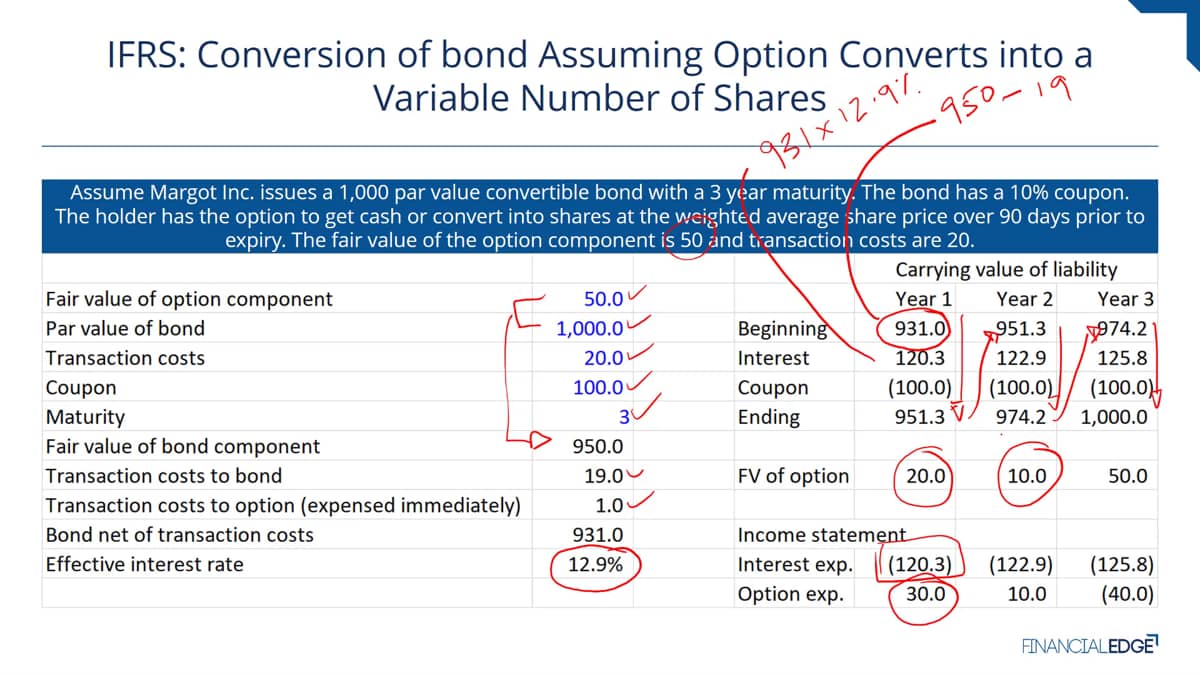
Now let's take a look at the accounting over the bond's life and at conversion for a convertible bond, which is treating the option element as a financial liability rather than a an equity item.
And this is because it's going to convert into a variable number of shares.
So here we've got an example.
Margot Incorporated is issuing a bond with a thousand par value with a three year maturity.
The bond's got a 10% cash coupon and the holder has the option either to get cash, IE option to get the repayment of a thousand at the end of the bond's life or to convert it into a stock.
And if they choose the option to convert into stock, the bond says they'll use the weighted average share price over 90 days prior to conversion.
Now because this means that you're gonna get a variable number of shares, not a fixed number of shares, this means that the option will be treated as a financial liability at the time of issuance.
The option is being valued at 50 and we're assuming that the issuance price is a thousand as well.
So let's take a look at the accounting here.
In this case, the fair value of the option we set was 50.
The par value of the bond is a thousand and that's the issuance price as well.
We've got transaction costs of 20, a coupon of a hundred, which is 10% of a thousand maturity of three years.
So how do we value the bond component? Well, we just take the difference between issuance value and the value of the option and that will give us nine 50.
Now because we've got issuance costs, they need to be allocated on a pro-rata basis between the bond and that's 19 versus the option element which is one.
One will get expensed immediately.
Now this means that the opening value of the bond on the balance sheet is 9 3 1, and that 9 3 1 is just the nine 50 that we saw below, minus the transactional costs of 19, which will give us 9 3 1.
Then what we've got to do is we've gotta calculate the effective interest rate using some financial maths, the present value being 9 3 1, the cash coupon being a hundred, the maturity of three years, the par value or future value of a thousand, run that through the computer and we get an effective interest rate of 12.9%.
So then run through the accounting. This one 20 of interest, it's going to be calculated by taking the beginning balance the 9 3 1 times the effective interest rate of 12.9% and that's how we get the one 20.3.
The cash coupon is a hundred and this means the ending balance of the bond in year one is going to be 9 5 1 0.3.
So we've run through that calculation and then that ending balance becomes the next year's beginning balance.
We run through it again and finally we'll end up with the bond value being equal to the par value.
No problem. We said that at issuance the fair value of the option component is 50 and that will include the time value typically at issuance between the data issuance versus the maturity.
'cause most convertibles are not gonna be issued in the money.
You have some, some exceptions to that, particularly where you're issuing them to management teams, But let's assume they're not in the money.
So the majority of that is time value.
So over time, we would expect the value of the option if it doesn't become in the money to slowly reduce because of that time value element.
And you can see here that if at the end of year one the option is now worth 20, we're gonna see again on the income statement 'cause the liability has fallen in year one, we'll also have the interest cost.
So we'll have some kind of volatility in the income statement here 'cause we're seeing the gain 30, whereas interest cost is 120.3 in year two, we're seeing the value of the option drops again to 10, and this means we'll get another benefit through the income state of 10 because it's dropped from 20 to 10 and you have the interest expense there.
Now in year three, suddenly the convertible has become in the money and this means that the value of the option will go up.
So the liability goes up to 50 in this case and we'll see not just the interest cost of 1 25 running through the income statement, but we'll also see a loss because of the option increasing of 40.
So you can see how the volatility, because of the revaluation of the option is hitting the income statement.