Skip to content
Felix
  • Topics
    • My List
    • Felix Guide
    • Asset Management
    • Coding and Data Analysis
      • AI
      • Data Analysis and Visualization
      • Financial Data Tools
      • Python
      • SQL
    • Credit
      • Credit Analysis
      • Restructuring
    • Financial Literacy Essentials
      • Financial Data Tools
      • Financial Math
      • Foundations of Accounting
    • Industry Specific
      • Banks
      • Chemicals
      • Consumer
      • ESG
      • Industrials
      • Insurance
      • Oil and Gas
      • Pharmaceuticals
      • Project Finance
      • Real Estate
      • Renewable Energy
      • Technology
      • Telecoms
    • Introductory Courses
    • Investment Banking
      • Accounting
      • Financial Modeling
      • M&A and Divestitures
      • Private Debt
      • Private Equity
      • Valuation
      • Venture Capital
    • Markets
      • Economics
      • Equity Markets and Derivatives
      • Fixed Income and Derivatives
      • Introduction to Markets
      • Options and Structured Products
      • Other Capital Markets
      • Securities Services
    • Microsoft Office
      • Excel
      • PowerPoint
      • Word & Outlook
    • Professional Skills
      • Career Development
      • Expert Interviews
      • Interview Skills
    • Risk Management
    • Transaction Banking
    • Felix Live
  • Pathways
    • Investment Banking
    • Asset Management
    • Equity Research
    • Sales and Trading
    • Commercial Banking
    • Engineering
    • Operations
    • Private Equity
    • Credit Analysis
    • Restructuring
    • Venture Capital
    • CFA Institute
  • Certified Courses
  • Ask An Instructor
  • Support
  • Log in
  • Topics
    • My List
    • Felix Guide
    • Asset Management
    • Coding and Data Analysis
      • AI
      • Data Analysis and Visualization
      • Financial Data Tools
      • Python
      • SQL
    • Credit
      • Credit Analysis
      • Restructuring
    • Financial Literacy Essentials
      • Financial Data Tools
      • Financial Math
      • Foundations of Accounting
    • Industry Specific
      • Banks
      • Chemicals
      • Consumer
      • ESG
      • Industrials
      • Insurance
      • Oil and Gas
      • Pharmaceuticals
      • Project Finance
      • Real Estate
      • Renewable Energy
      • Technology
      • Telecoms
    • Introductory Courses
    • Investment Banking
      • Accounting
      • Financial Modeling
      • M&A and Divestitures
      • Private Debt
      • Private Equity
      • Valuation
      • Venture Capital
    • Markets
      • Economics
      • Equity Markets and Derivatives
      • Fixed Income and Derivatives
      • Introduction to Markets
      • Options and Structured Products
      • Other Capital Markets
      • Securities Services
    • Microsoft Office
      • Excel
      • PowerPoint
      • Word & Outlook
    • Professional Skills
      • Career Development
      • Expert Interviews
      • Interview Skills
    • Risk Management
    • Transaction Banking
    • Felix Live
  • Pathways
    • Investment Banking
    • Asset Management
    • Equity Research
    • Sales and Trading
    • Commercial Banking
    • Engineering
    • Operations
    • Private Equity
    • Credit Analysis
    • Restructuring
    • Venture Capital
    • CFA Institute
  • Certified Courses
Felix
  • Data
    • Company Analytics
    • My Filing Annotations
    • Market & Industry Data
    • United States
    • Relative Valuation
    • Discount Rate
    • Building Forecasts
    • Capital Structure Analysis
    • Europe
    • Relative Valuation
    • Discount Rate
    • Building Forecasts
    • Capital Structure Analysis
  • Models
  • Account
    • Edit Profile
    • Manage Account
    • My List
    • Restart Homepage Tour
    • Restart Company Analytics Tour
    • Restart Filings Tour
  • Log in
  • Ask An Instructor
    • Email Our Experts
    • Felix User Guide
    • Contact Support

Healthcare - Analysis and Modeling

Understand the business drivers, key modeling assumptions, and valuation metrics for the healthcare sector.

Unlock Your Certificate   
 
4% Complete

23 Lessons (70m)

Show lesson playlist
  • Description & Objectives

  • 1. Healthcare Companies Overviews and Valuations | Interactive Video

  • 2. What are Healthcare Industries

    01:33
  • 3. What Makes Them Special

    02:55
  • 4. Treatment of R&D Costs

    04:43
  • 5. Forecasting Revenue

    01:48
  • 6. Forecasting Revenue Example - Part 1

    02:57
  • 7. Forecasting Revenue Example Part 2

    03:08
  • 8. Forecasting Pipeline Market Size

    03:18
  • 9. Forecasting Pipeline Revenue by Region EU Part 1

    04:54
  • 10. Forecasting Pipeline Revenue by Region EU Part 2

    02:21
  • 11. Forecasting Pipeline Revenue by Region EU Part 3

    03:12
  • 12. Forecasting Pipeline Revenue by Region EU Part 4

    03:28
  • 13. Forecasting Pipeline Revenue by Region US

    05:20
  • 14. Forecasting Pipeline Revenue - Pulling It All Together

    03:24
  • 15. Accounting for Joint Ventures

    01:12
  • 16. Taxation of Pharmaceutical Companies

    03:27
  • 17. Understanding the Financial Statements Healthcare

    02:35
  • 18. Forecasting Income Statement Revenues and Gross Profit

    03:07
  • 19. Forecasting Income Statement R&D and SG&A Expenses

    03:45
  • 20. Balance Sheet Workings

    02:34
  • 21. Populating the Balance Sheet

    03:31
  • 22. Cash Flow Statement Healthcare

    05:15
  • 23. Finishing off the Income Statement

    02:08

Prev: Quarterly Modeling Next: Telecommunications - Analysis and Modeling

Treatment of R&D Costs

  • Notes
  • Questions
  • Transcript
  • 04:43

Understand the accounting treatment of R&D costs

Downloads

No associated resources to download.

Glossary

Clinical Trials IFRS R&D R&D US GAAP
Back to top
Financial Edge Training

© Financial Edge Training 2026

Topics
Introduction to Finance Accounting Financial Modeling Valuation M&A and Divestitures Private Equity
Venture Capital Project Finance Credit Analysis Transaction Banking Restructuring Capital Markets
Asset Management Risk Management Economics Data Science and System
Request New Content
System Account User Guide Privacy Policy Terms & Conditions Log in
Transcript

Since many pharmaceutical life sciences and biotechnology companies spend substantial amounts of money on research and development, understanding how to account for r and d costs is important to understanding these companies. Financial statements. Firstly, with regards to r and d costs are the cost associated with acquiring research and development assets.

This is where another company has spent money on research and development, and the output of that is acquired.

In such cases, the acquiring company under both US GAP and IFRS should account for that acquisition, the acquired r and d asset, as an asset on their balance sheet. Another way of saying this is that the r and d assets should be capitalized.

The second aspect of research and development costs is with regards to costs incurred by a company directly Here. There is a difference between US GAAP and IFRS, whereby under US Gap, the rules are much more straightforward in that all r and D costs, with the exception of software costs, should be expensed straight into the income statement as they are incurred under IFRS.

It's a bit more complicated.

Firstly, all research costs should be expensed as they are incurred. However, for development costs cost incurred in the development of a product for final sale to customers, those development costs should be capitalized, but only after the feasibility of the product which is being developed be an asset or maybe a pharmaceutical drug has been established.

So the question then becomes how do we determine the feasibility of a particular pharmaceutical drug with the accounting rules, with regards to determining the feasibility of a particular product, depend on a couple of factors.

Firstly, it must be possible to demonstrate that the company that is developing this product is going to be able to complete it to such an extent that they can sell it to somebody else or use it themselves.

Secondly, we also must be able to demonstrate that we can generate some revenue from this, either sale proceeds of the asset that has been developed itself or from actually selling the goods to customers.

With regards to pharmaceutical companies, the feasibility of a drug is quite complicated because there are many clinical trials that pharmaceutical drugs have to get over the hurdles of before it can actually be sold to customers.

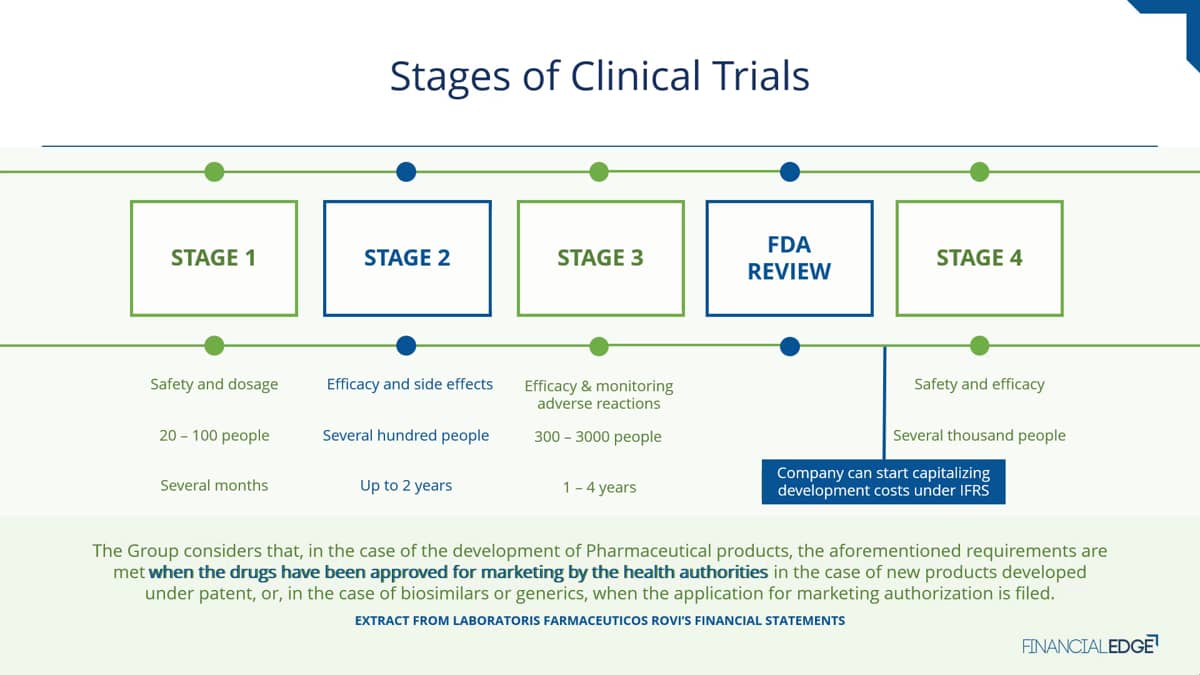
The stages of clinical trials for pharmaceutical drugs tend to fall into four stages.

Stage one is when we are testing the, uh, safety of the product itself, and the necessary level of dosage tends to be relatively small in size, maybe 20 to a hundred people and lasts several months.

Stage two is when we're looking to test the efficacy of the product, so whether it works or not, and if there are any side effects, there's A wider trial over several hundred people and may last up to two years.

Then we move into stage three when again, we're still testing for the efficacy of the product, but also looking more generally for any adverse reactions to taking the drug itself.

This is, again, wider as a trial, 300 to 3000 people and again, takes a longer period of time up to potentially four years.

So getting through these first three stages of clinical trials could take up to six years for a particular product.

And don't forget that the clock is already running with regards to the 20 year patent or license that pharmaceutical companies get with regards to new products.

That license or patent will have been filed before the beginning of the stage one trials.

Once the drug is completed, the stage three clinical trials, it then typically moves forward for regulatory approval.

The FDA is the Food and Drug Administration and are the US regulator once the drug has been approved by the necessary regulator.

We then move on to stage four clinical trials involving many more thousand people, and again, testing for safety and efficacy.

With regards to the capitalization of development costs, the feasibility of new drugs is generally taken to be demonstrated once regulatory approval has been achieved.

If we look at an example from a Spanish pharmaceutical company, laboratories, pharmaceutical costs rovy, the footnotes from their financial statements state that the development costs on pharmaceutical products will be capitalized when the drugs have been approved for marketing by the health authorities.

Content Requests and Questions

You are trying to access premium learning content.

Discover our full catalogue and purchase a course Access all courses with our premium plans or log in to your account
Help

You need an account to contact support.

Create a free account or log in to an existing one

Sorry, you don't have access to that yet!

You are trying to access premium learning content.

Discover our full catalogue and purchase a course Access all courses with our premium plans or log in to your account

You have reached the limit of annotations (10) under our premium subscription. Upgrade to unlock unlimited annotations.

Find out more about our premium plan

You are trying to access content that requires a free account. Sign up or login in seconds!

Create a free account or log in to an existing one

You are trying to access content that requires a premium plan.

Find out more about our premium plan or log in to your account

Only US listed companies are available under our Free and Boost plans. Upgrade to Pro to access over 7,000 global companies across the US, UK, Canada, France, Italy, Germany, Hong Kong and more.

Find out more about our premium plan or log in to your account

A pro account is required for the Excel Add In

Find out more about our premium plan

Congratulations on completing

This field is hidden when viewing the form
Name(Required)
This field is hidden when viewing the form
Rate this course out of 5, where 5 is excellent and 1 is terrible.
Were the stated learning objectives met?(Required)
Were the stated prerequisite requirements appropriate and sufficient?(Required)
Were the program materials, including the qualified assessment, relevant and did they contribute to the achievement of the learning objectives?(Required)
Was the time allotted to the learning activity appropriate?(Required)
Are you happy for us to use your feedback and details in future marketing?(Required)

Thank you for already submitting feedback for this course.

CPE

What is CPE?

CPE stands for Continuing Professional Education, by completing learning activities you earn CPE credits to retain your professional credentials. CPE is required for Certified Public Accountants (CPAs). Financial Edge Training is registered with the National Association of State Boards of Accountancy (NASBA) as a sponsor of continuing professional education on the National Registry of CPE Sponsors.

What are CPE credits?

For self study programs, 1 CPE credit is awarded for every 50 minutes of elearning content, this includes videos, workouts, tryouts, and exams.

CPE Exams

You must complete the CPE exam within 1 year of accessing a related playlist or course to earn CPE credits. To see how long you have left to complete a CPE exam, hover over the locked CPE credits button.

What if I'm not collecting CPE credits?

CPE exams do not count towards your FE certification. You do not need to complete the CPE exam if you are not collecting CPE credits, but you might find it useful for your own revision.


Further Help
  • Felix How to Guide walks you through the key functions and tools of the learning platform.
  • Playlists & Tryouts: Playlists are a collection of videos that teach you a specific skill and are tested with a tryout at the end. A tryout is a quiz that tests your knowledge and understanding of what you have just learned.
  • Exam: If you are collecting CPE points you must pass the relevant CPE exam within 1 year to receive credits.
  • Glossary: A glossary can be found below each video and provides definitions and explanations for terms and concepts. They are organized alphabetically to make it easy for you to find the term you need.
  • Search function: Use the Felix search function on the homepage to find content related to what you want to learn. Find related video content, lessons, and questions people have asked on the topic.
  • Closed Captions & Transcript: Closed captions and transcripts are available on videos. The video transcript can be found next to the closed captions in the video player. The transcript feature allows you to read the transcript of the video and search for key terms within the transcript.
  • Questions: If you have questions about the course content, you will find a section called Ask a Question underneath each video where you can submit questions to our expert instructor team.