Skip to content
Felix
  • Topics
    • My List
    • Felix Guide
    • Asset Management
    • Coding and Data Analysis
      • AI
      • Data Analysis and Visualization
      • Financial Data Tools
      • Python
      • SQL
    • Credit
      • Credit Analysis
      • Restructuring
    • Financial Literacy Essentials
      • Financial Data Tools
      • Financial Math
      • Foundations of Accounting
    • Industry Specific
      • Banks
      • Chemicals
      • Consumer
      • ESG
      • Industrials
      • Insurance
      • Oil and Gas
      • Pharmaceuticals
      • Project Finance
      • Real Estate
      • Renewable Energy
      • Technology
      • Telecoms
    • Introductory Courses
    • Investment Banking
      • Accounting
      • Financial Modeling
      • M&A and Divestitures
      • Private Debt
      • Private Equity
      • Valuation
      • Venture Capital
    • Markets
      • Economics
      • Equity Markets and Derivatives
      • Fixed Income and Derivatives
      • Introduction to Markets
      • Options and Structured Products
      • Other Capital Markets
      • Securities Services
    • Microsoft Office
      • Excel
      • PowerPoint
      • Word & Outlook
    • Professional Skills
      • Career Development
      • Expert Interviews
      • Interview Skills
    • Risk Management
    • Transaction Banking
    • Felix Live
  • Pathways
    • Investment Banking
    • Asset Management
    • Equity Research
    • Sales and Trading
    • Commercial Banking
    • Engineering
    • Operations
    • Private Equity
    • Credit Analysis
    • Restructuring
    • Venture Capital
    • CFA Institute
  • Certified Courses
  • Ask An Instructor
  • Support
  • Log in
  • Topics
    • My List
    • Felix Guide
    • Asset Management
    • Coding and Data Analysis
      • AI
      • Data Analysis and Visualization
      • Financial Data Tools
      • Python
      • SQL
    • Credit
      • Credit Analysis
      • Restructuring
    • Financial Literacy Essentials
      • Financial Data Tools
      • Financial Math
      • Foundations of Accounting
    • Industry Specific
      • Banks
      • Chemicals
      • Consumer
      • ESG
      • Industrials
      • Insurance
      • Oil and Gas
      • Pharmaceuticals
      • Project Finance
      • Real Estate
      • Renewable Energy
      • Technology
      • Telecoms
    • Introductory Courses
    • Investment Banking
      • Accounting
      • Financial Modeling
      • M&A and Divestitures
      • Private Debt
      • Private Equity
      • Valuation
      • Venture Capital
    • Markets
      • Economics
      • Equity Markets and Derivatives
      • Fixed Income and Derivatives
      • Introduction to Markets
      • Options and Structured Products
      • Other Capital Markets
      • Securities Services
    • Microsoft Office
      • Excel
      • PowerPoint
      • Word & Outlook
    • Professional Skills
      • Career Development
      • Expert Interviews
      • Interview Skills
    • Risk Management
    • Transaction Banking
    • Felix Live
  • Pathways
    • Investment Banking
    • Asset Management
    • Equity Research
    • Sales and Trading
    • Commercial Banking
    • Engineering
    • Operations
    • Private Equity
    • Credit Analysis
    • Restructuring
    • Venture Capital
    • CFA Institute
  • Certified Courses
Felix
  • Data
    • Company Analytics
    • My Filing Annotations
    • Market & Industry Data
    • United States
    • Relative Valuation
    • Discount Rate
    • Building Forecasts
    • Capital Structure Analysis
    • Europe
    • Relative Valuation
    • Discount Rate
    • Building Forecasts
    • Capital Structure Analysis
  • Models
  • Account
    • Edit Profile
    • Manage Account
    • My List
    • Restart Homepage Tour
    • Restart Company Analytics Tour
    • Restart Filings Tour
  • Log in
  • Ask An Instructor
    • Email Our Experts
    • Felix User Guide
    • Contact Support

Healthcare - Analysis and Modeling

Understand the business drivers, key modeling assumptions, and valuation metrics for the healthcare sector.

Unlock Your Certificate   
 
4% Complete

23 Lessons (70m)

Show lesson playlist
  • Description & Objectives

  • 1. Healthcare Companies Overviews and Valuations | Interactive Video

  • 2. What are Healthcare Industries

    01:33
  • 3. What Makes Them Special

    02:55
  • 4. Treatment of R&D Costs

    04:43
  • 5. Forecasting Revenue

    01:48
  • 6. Forecasting Revenue Example - Part 1

    02:57
  • 7. Forecasting Revenue Example Part 2

    03:08
  • 8. Forecasting Pipeline Market Size

    03:18
  • 9. Forecasting Pipeline Revenue by Region EU Part 1

    04:54
  • 10. Forecasting Pipeline Revenue by Region EU Part 2

    02:21
  • 11. Forecasting Pipeline Revenue by Region EU Part 3

    03:12
  • 12. Forecasting Pipeline Revenue by Region EU Part 4

    03:28
  • 13. Forecasting Pipeline Revenue by Region US

    05:20
  • 14. Forecasting Pipeline Revenue - Pulling It All Together

    03:24
  • 15. Accounting for Joint Ventures

    01:12
  • 16. Taxation of Pharmaceutical Companies

    03:27
  • 17. Understanding the Financial Statements

    02:35
  • 18. Forecasting Income Statement Revenues and Gross Profit

    03:07
  • 19. Forecasting Income Statement R&D and SG&A Expenses

    03:45
  • 20. Balance Sheet Workings

    02:34
  • 21. Populating the Balance Sheet

    03:31
  • 22. Cash Flow Statement

    05:15
  • 23. Finishing off the Income Statement

    02:08

Prev: Quarterly Modeling Next: Telecommunications - Analysis and Modeling

Forecasting Pipeline Revenue by Region EU Part 3

  • Notes
  • Questions
  • Transcript
  • 03:12

Forecasting pipeline revenue by region EU, understanding gross profit margins and their impact.

Downloads

Forecasting-pipeline-revenue-by-region-Europe-Empty_1Forecasting-pipeline-revenue-by-region-Europe-Full_1

Glossary

Healthcare Model
Back to top
Financial Edge Training

© Financial Edge Training 2025

Topics
Introduction to Finance Accounting Financial Modeling Valuation M&A and Divestitures Private Equity
Venture Capital Project Finance Credit Analysis Transaction Banking Restructuring Capital Markets
Asset Management Risk Management Economics Data Science and System
Request New Content
System Account User Guide Privacy Policy Terms & Conditions Log in
Transcript

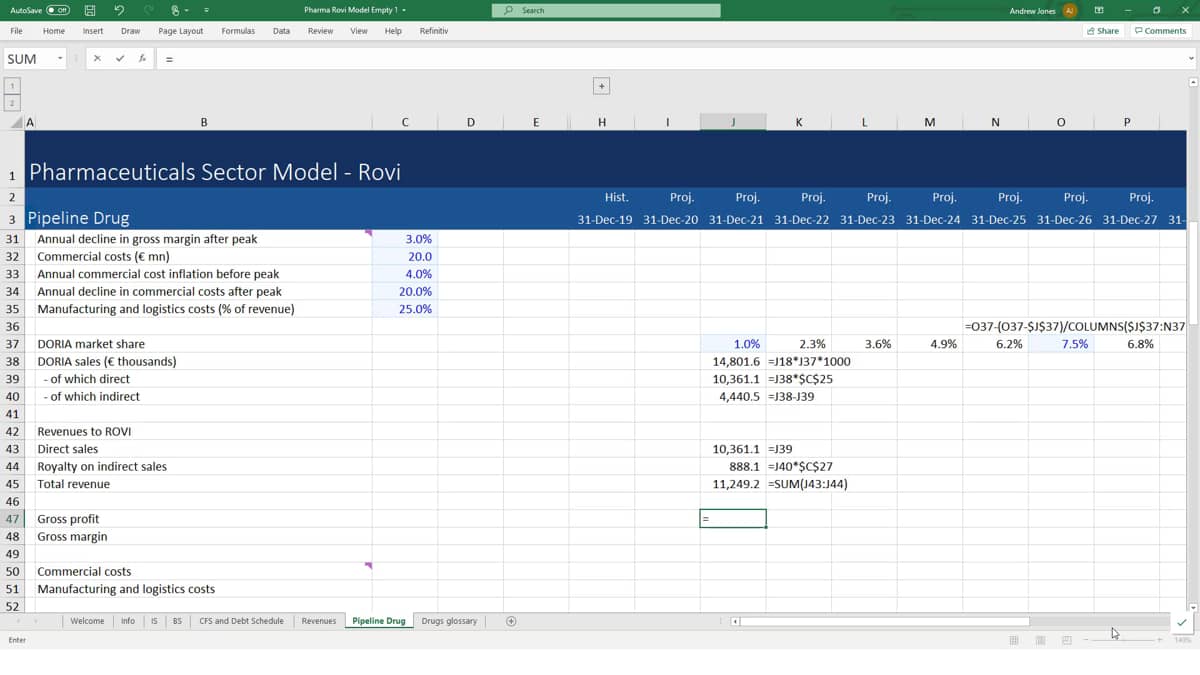
Gross profit is gonna be calculated as, we've gotta be careful here that we have a different profit margin.

So 80% are gross profit margin as a proportion of our direct sales.

But we also have to add on to that our gross profit margin of 95% as a proportion of our indirect sales.

Okay? So this would be our gross profit if we didn't have to worry about this movement in the gross profit margin after the peak year.

But it is something that we're building into our model.

We're assuming that there is cost pressure that comes in after the peak year eroding some of our market share, and to try to offset some of that competition.

We may have to cut our prices, and if we're cutting our prices, we're making a smaller profit for each dollar that we're selling.

We need to build an extra element to this function.

I'm gonna deduct from this and if statement and if statement is gonna say, well, if we are beyond the peak year, so if the year that we're in 31st of December, 2021 in this instance is greater than 31st of December, 2026, then we need this if statement.

Okay? So if that's true, it means we're beyond the peak.

And if we're beyond the peak, then we wanna see a reduction in our profit margin.

So that reduction in our profit margin is gonna be the 3% annual reduction in our profit margin.

I'm going to need to multiply that by the number of years that we are past our peak.

So we're gonna need another function here.

I wanna use the year function.

So the number of the year that we're in, again, up to row three.

And I wanna subtract from that the year of our peak year.

So that's the number of years.

So we've got C 31, which is the reduction in the profit margin times the number of years we are past the peak, but I also need to multiply this by the revenue for that year as well.

Remember that the gross profit margin is a percentage of revenue.

So if we're seeing a reduction in the gross profit margin, we're also gonna see gross profit go down by that percentage of revenue.

If that's not true, so we're not beyond the peak year, I just want nothing in here.

So that doesn't change what happens in the first year, but as we carry this across further to the right, we'll be able to see that there will be a reduction in our profit margins.

So let's just go ahead and do that.

What I wanna be able to demonstrate is the change in the gross profit margin as we get beyond the peak year, while our gross profit margin is calculated by taking our gross profit and dividing it by the total revenue.

And if we copy this to the right up to the peak year 2026, you can see that gross profit margin remains constant.

It's the weighted average of our profit margin on our direct sales of 80%, and the profit margin on the indirect sales of 95%.

However, as we get beyond the peak year, we see the gross profit margin decline by 3% per year, which is what we are assuming takes place through this assumption.

So the gross profit margin does actually decline by 3% as we go after the peak year, year on year.

Content Requests and Questions

You are trying to access premium learning content.

Discover our full catalogue and purchase a course Access all courses with our premium plans or log in to your account
Help

You need an account to contact support.

Create a free account or log in to an existing one

Sorry, you don't have access to that yet!

You are trying to access premium learning content.

Discover our full catalogue and purchase a course Access all courses with our premium plans or log in to your account

You have reached the limit of annotations (10) under our premium subscription. Upgrade to unlock unlimited annotations.

Find out more about our premium plan

You are trying to access content that requires a free account. Sign up or login in seconds!

Create a free account or log in to an existing one

You are trying to access content that requires a premium plan.

Find out more about our premium plan or log in to your account

Only US listed companies are available under our Free and Boost plans. Upgrade to Pro to access over 7,000 global companies across the US, UK, Canada, France, Italy, Germany, Hong Kong and more.

Find out more about our premium plan or log in to your account

A pro account is required for the Excel Add In

Find out more about our premium plan

Congratulations on completing

This field is hidden when viewing the form
Name(Required)
This field is hidden when viewing the form
Rate this course out of 5, where 5 is excellent and 1 is terrible.
Were the stated learning objectives met?(Required)
Were the stated prerequisite requirements appropriate and sufficient?(Required)
Were the program materials, including the qualified assessment, relevant and did they contribute to the achievement of the learning objectives?(Required)
Was the time allotted to the learning activity appropriate?(Required)
Are you happy for us to use your feedback and details in future marketing?(Required)

Thank you for already submitting feedback for this course.

CPE

What is CPE?

CPE stands for Continuing Professional Education, by completing learning activities you earn CPE credits to retain your professional credentials. CPE is required for Certified Public Accountants (CPAs). Financial Edge Training is registered with the National Association of State Boards of Accountancy (NASBA) as a sponsor of continuing professional education on the National Registry of CPE Sponsors.

What are CPE credits?

For self study programs, 1 CPE credit is awarded for every 50 minutes of elearning content, this includes videos, workouts, tryouts, and exams.

CPE Exams

You must complete the CPE exam within 1 year of accessing a related playlist or course to earn CPE credits. To see how long you have left to complete a CPE exam, hover over the locked CPE credits button.

What if I'm not collecting CPE credits?

CPE exams do not count towards your FE certification. You do not need to complete the CPE exam if you are not collecting CPE credits, but you might find it useful for your own revision.


Further Help
  • Felix How to Guide walks you through the key functions and tools of the learning platform.
  • Playlists & Tryouts: Playlists are a collection of videos that teach you a specific skill and are tested with a tryout at the end. A tryout is a quiz that tests your knowledge and understanding of what you have just learned.
  • Exam: If you are collecting CPE points you must pass the relevant CPE exam within 1 year to receive credits.
  • Glossary: A glossary can be found below each video and provides definitions and explanations for terms and concepts. They are organized alphabetically to make it easy for you to find the term you need.
  • Search function: Use the Felix search function on the homepage to find content related to what you want to learn. Find related video content, lessons, and questions people have asked on the topic.
  • Closed Captions & Transcript: Closed captions and transcripts are available on videos. The video transcript can be found next to the closed captions in the video player. The transcript feature allows you to read the transcript of the video and search for key terms within the transcript.
  • Questions: If you have questions about the course content, you will find a section called Ask a Question underneath each video where you can submit questions to our expert instructor team.