Many countries offer incentives to companies who engage in research and development activities, including pharmaceutical companies, to encourage innovation within that country.
One way in which this can work is that companies are allowed to offset a proportion of the money they have spent on qualifying research and development expenditure against their tax liability.
This is referred to as a tax credit and will result in an effective tax rate calculated by dividing the tax expense from the income statements by the profit before tax being lower than the statutory tax rate of the country that the company is based in.
Another way in which taxation can impact the financial statements of a pharmaceutical company is through deferred tax.
This may arise through losses that the company makes in its early years through, for example, spending money on research and development in the hope of generating profits. In the future, these losses can be offset against future profits that the company may make to reduce their future tax liability.
But this is only allowed when there is a reasonable belief that sufficient profits will be made in the future against which current losses can be offset to reduce those future tax liabilities.
These carried forward tax losses result in the creation of a deferred tax asset today on the company's balance sheet.
An alternative way in which deferred tax assets can be created is when a company has spent money on research and development, but the tax rules do not allow for this to be used as an r and d tax credit yet.
However, if the company believes that the expense may meet the criteria to be treated as an r and d tax credit in the future, as the viability of the product becomes more certain, that company may create a deferred tax asset to represent the likely reduction in the future.
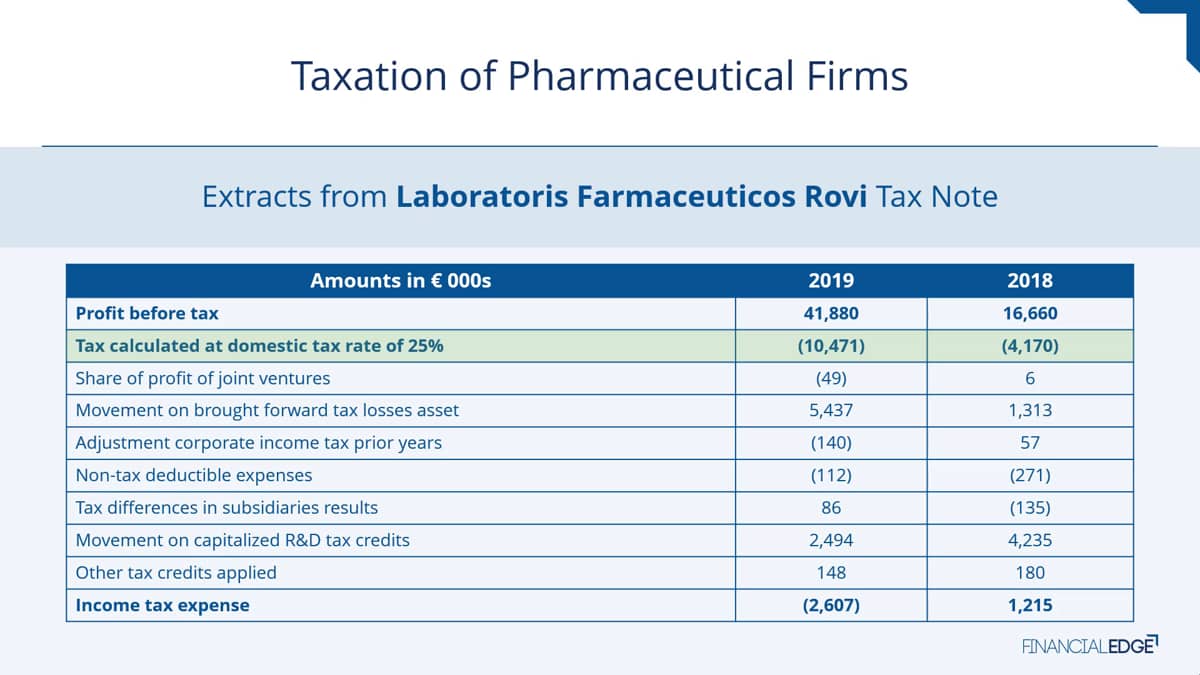
When the current spend on research and development is allowable as an r and d tax credit, as can be seen from the tax note of the financial statements of this example, pharmaceutical company laboratories, pharmaceuticals, RO V, the tax expense that would be expected at the statutory or domestic tax rate of 25% based on the company's reported profit before tax is much higher than the actual tax expense shown in the company's income statement.
These numbers are shown as negative balances within this tax note as they are expenses within the income statement, but these numbers are shown that for the 2019 year, the tax expense was only 2.6 million euros as opposed to the 10.5 million that you might have expected at the statutory tax rate.
This note explains that the difference is being driven by two major factors.
Firstly, a movement in the deferred tax asset in relation to prior year or brought forward tax losses despite the company being profitable this year, the reduction in the tax expense Has been driven by the greater likelihood of sufficient profits in the future against which the historic losses can be offset.
The second major factor is the movement on capitalized r and d tax credits, the reduction in the tax expense coming in this instance from an expectation that some current r and d expenditure will be able to be used in the future as an r and d tax credit to offset against the future tax liability.