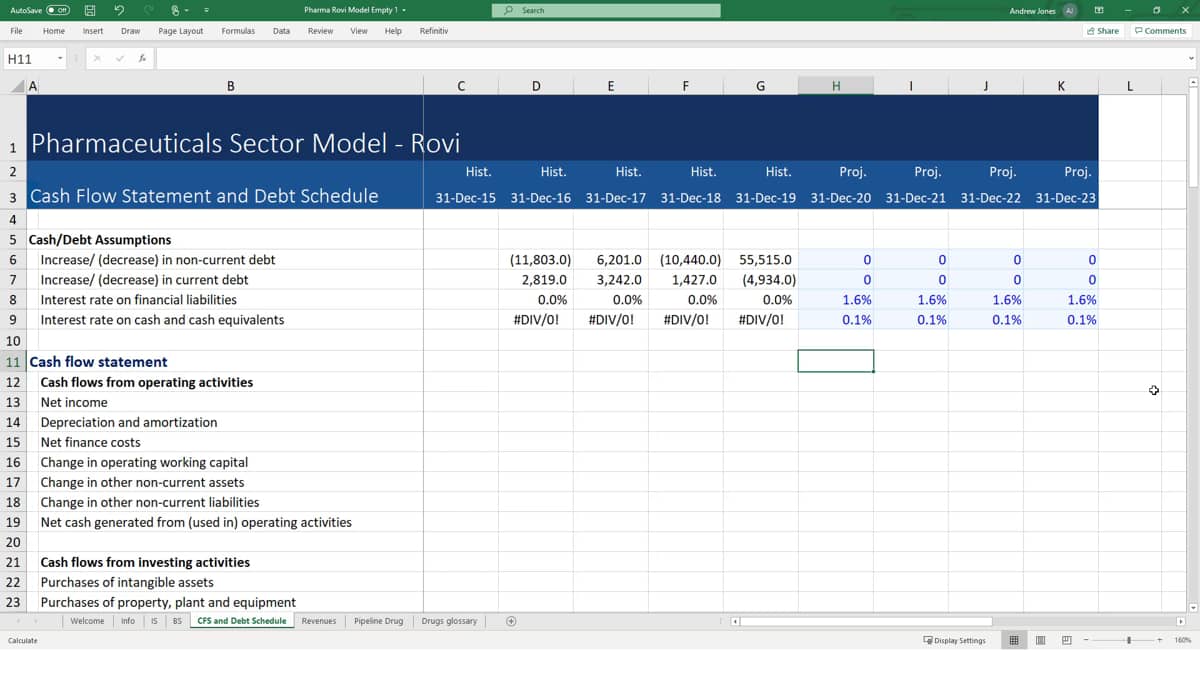
Next we can move on to building the cashflow statement.
The majority of this is pretty standard, but there are one or two things to be careful with in this model.
Firstly, within the operating cashflow calculation, we need to remove any share of profits from joint ventures.
This is an accrued income line in the income statement and needs to be dealt with separately from any dividend cash flows received in the cash flow statement.
It's easy to miss, especially here as it's forecast to be zero in this model.
Also, within operating cash flows, we're going to be adding back net financing costs because under Roy's financial statements, they are choosing to, as you can under IRS, show the interest received as an investing cash flow and the interest paid as a financing cash flow.
So we're removing it from the operating cash flow calculations to show it instead in investing and financing respectively.
So I'm gonna build the component parts of the operating cash flows, so it just needs to be careful here in terms of deducting profits from the joint ventures and adding back the net finance costs.
So we need to have a negative sign for both to flip the sign around in the cashflow statement so that any profits are removed as a negative adjustment and any finance expense is added back as a positive adjustment.
Next, we're moving on to the investing and financing flows.
Again, very standard here, just pulling numbers through from the areas where we've already calculated them, as we've seen previously.
One thing different here for a pharmaceutical company is that the need to spend money to develop new drugs to hopefully achieve new patents, is treated within our forecast cash flows.
That purchase of intangibles is spending money on That future development cost, and that's something we'd expect to see in the future, and therefore we do want to include in the forecast.
Next, we just need to put everything together to get our final cash balance, and then this can be populated into the balance sheet to give us a balance sheet, which now balances.
The only thing left to do now is to calculate our interest income and our interest expense.
So having pulled the historic debt balances and the historical cash balances from the balance sheets and the interest expense and the interest income from our income statements, we can now see in the assumptions that we have populated our historical interest rates, which are consistent with our forward assumptions.
And these forward assumptions then allow us to calculate the interest expense and interest income in our first forecast year.
And now finally, we can calculate our net debt.

 Cash Flow Statement Empty
