With the workings complete, the balance sheet can now be populated with those workings and our other assumptions.
So the pp and e balance on row 20, the intangibles balance comes from the working on row 26, and our investment in joint venture also comes from our working on row 32.
The defer tax asset we're gonna assume stays constant over time, as does the other non-current assets.
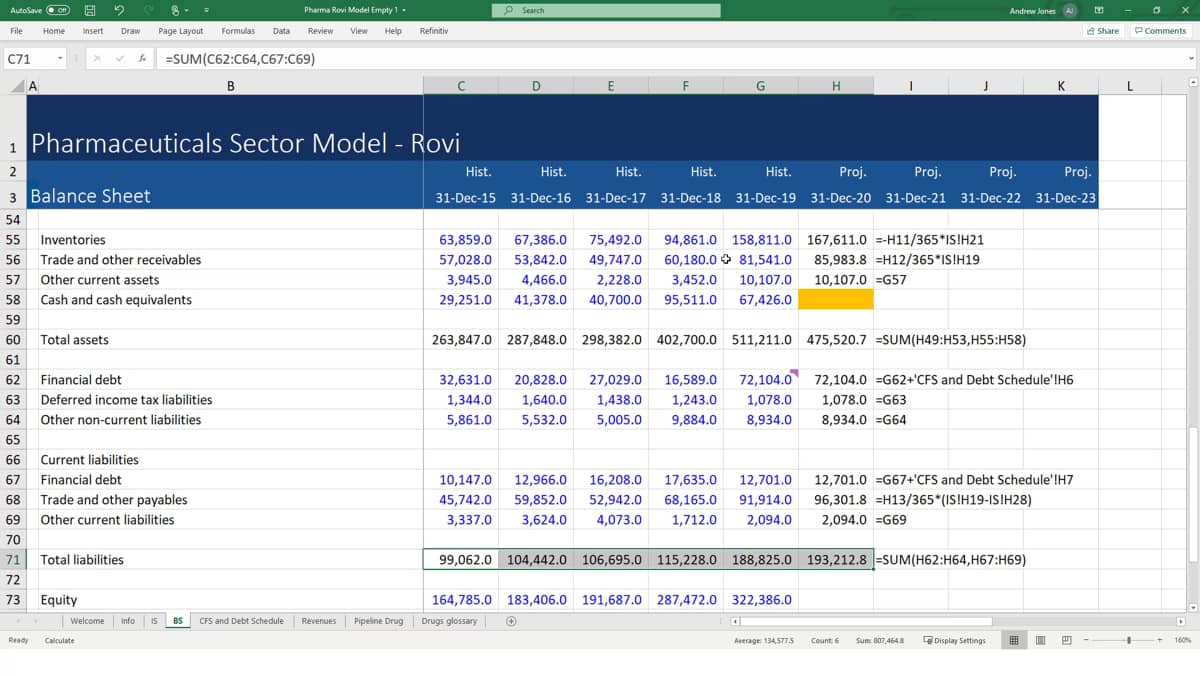
Moving on to our inventories, we've made our assumption on our inventories based on inventory days.
So our inventory days we're saying we're assuming that our inventory remains at that slightly elevated historic year number in comparison to previous historic years, but then recedes over time.
So 240 days, we divide that by 365 days and then multiply this by the cost of sales from our income statement tab.
Cost of sales is negative, so we need to flip the sign around this to get a positive balance for our inventories, trade and other receivables.
Again, we have a days ratio here, so the days of sales outstanding at the year end, 75 days worth of sales.
So divide that by 365 and then multiply that by the total revenue from the income statement tab to get our trade. Another receivables balance.
Other current assets we're gonna assume stays constant over time.
And then our cash and cash equivalents we can populate once we've completed the cashflow statement.
Our total assets, the sum of our non-current and current assets, which we can then copy into the forecast period.
Moving on to our liabilities, the non-current financial debt, uh, picks up the assumption from the cashflow statement and debt tab.
And the change we have here is that there's going to be no change in either the current financial debt or non-current deferred income tax liabilities.
We're just gonna hold constant for simplicity.
And the same for our other non-current liabilities.
The financial debt is gonna be as with our non-current financial debt.
In the current liabilities, it is gonna be the historic year plus from the cashflow statement tab, the change for this year, trade and other payables.
We've got a days ratio for our trade and other payables.
So we're gonna say that our payments to our suppliers outstanding at the year end are a hundred days worth. So a hundred out of the 365 days in the year multiplied by and here we do need to be a little bit careful.
All of our expenses are gonna be calculated by taking our revenue and subtracting from that our ebitda, other current liabilities we're going to hold constant and therefore we can calculate our total liabilities And roll forward into the forecast period.
Finally, equity needs to be pulled down from our calculations.
And then finally, our total for liabilities and equity needs to be rolled forward into the forecast period and our check balance of our assets minus our liabilities and equity put in place, not in balance in the forecast period yet, but we will populate the cash balance once we've completed the cash flow statement.

 Populating the Balance Sheet Empty
