I've taken a look at an extract from the balance sheet of our example company, laboratories Pharmaceuticals, RO V.
We can see that there are some substantial balances here.
Firstly, with regards to property, plant and equipment, which captures the technical facilities, machinery, and tools of the pharmaceutical company, as well as any land of buildings they might hold.
Next, we have the intangible assets that captures the capitalized development costs, uh, which are allowed to be capitalized under IRS of the patents and licenses that they hold for their pharmaceutical drugs.
Next, we have investments in joint ventures, which are set up to allow for the wider distribution and manufacture of products that have been developed by ROE V.
And then finally, within non-current assets, we have deferred tax assets created by prior year losses that have been brought forward and r and d tax credits that have not yet crystallized within the current asset section.
The largest balance is in relation to the company's inventories, pharmaceutical drugs, and products that have not yet been sold.
Moving on to the financing side of Roe v's. Balance sheets, we can see that the largest liability they have is in relation to trade and other payables, which relates to payments they owe to suppliers, but also to the Spanish government, which is a legal requirement for companies which supply into the Spanish National Health system.
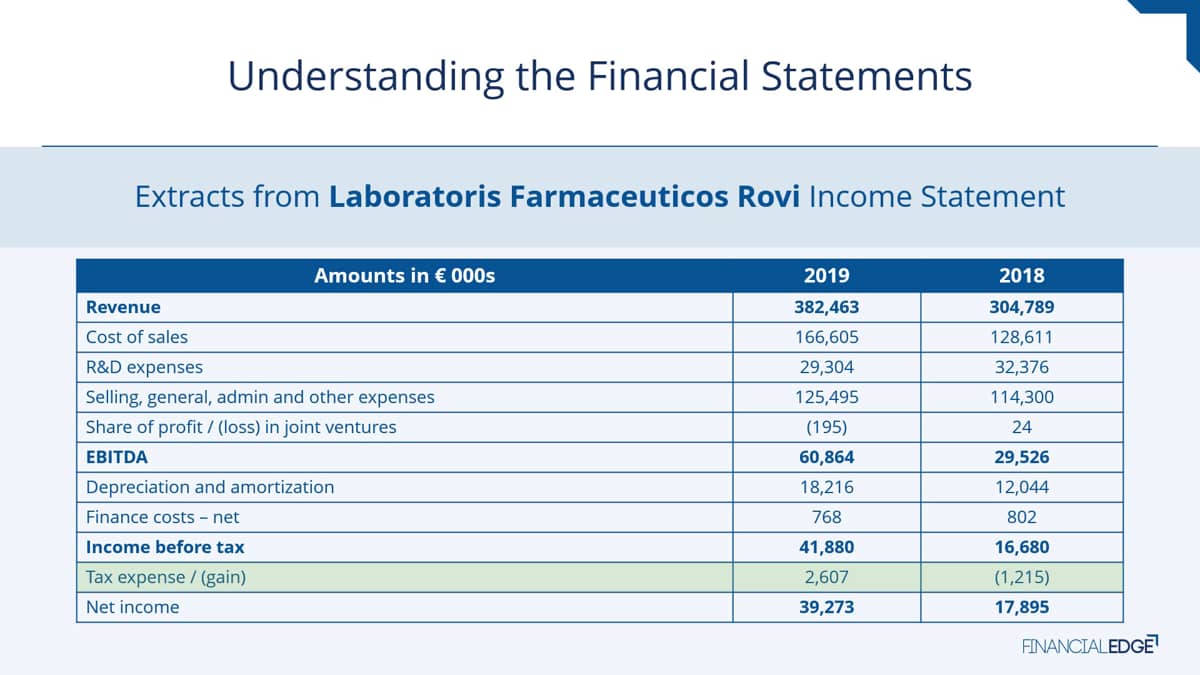
On the income statement, we have the revenue been driven by sales of pharmaceutical products, either directly or the license fees from indirect sales of these products, typically overseas, cost of sales, a substantial proportion of that as well, and then our r and d expenditure, spending money trying to develop future products, which we might be able to sell.
Next, we have depreciation and amortization, which captures the depreciation of production facilities, but also the amortization of the intangible assets.
These are amortized because the patents and licenses do have a finite life.
There will be an end point to those patents, at which point there will be increased competition, and as a result, the value of the patent will be zero.
So we amortize those intangible assets down to a zero value over the remaining time of the patent's life.
Finally, we have our tax expense, or for RO V in 2018, a tax gain arising from their r and d tax credits and also the impact from prior years brought forward tax losses.