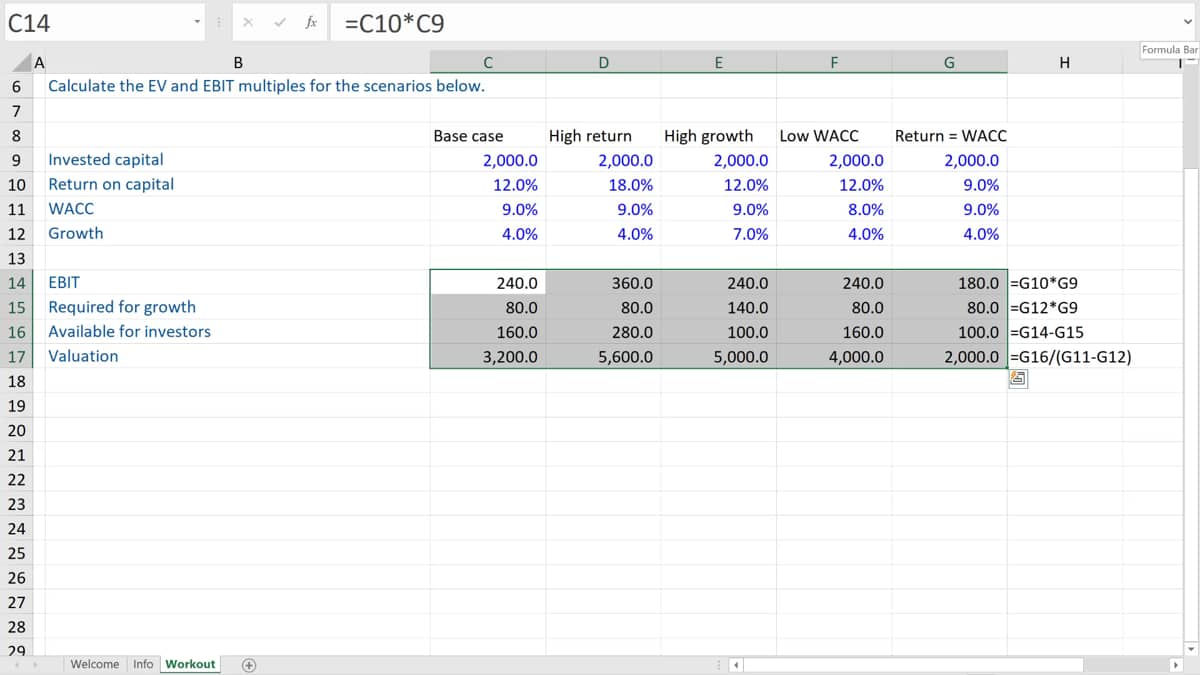
Okay, let's calculate EBIT for the base case company in this workout.
So if I know what the return on invested capital is and I know what the invested capital is, then I can calculate ebit.
Now, some of that EBIT is required for growth.
So if we take the growth of 4% and multiply that by the invested capital of 2000, then I know I need 80 for growth.
So if I take EBIT of two 40 and I subtract the 80 required for growth, I've got 160 available to investors, let's treat that like a perpetuity.
So if I take that one 60 and divide it by open bracket WAC minus the growth rate, then I get the company valuation of 3,200.
Now, what is of interest to me is if I take those numbers and I copy them out to the right to think about the relationship between WAC return on invested capital and growth and valuation.
So if we look at the second company here, the high return company, they've got the same invested capital, um, but they've got a higher return on invested capital.
It feels like return on invested capital should increase the value of the business, and of course it does.
It's at 5,600.
So what if we look at the high growth company compared to the base case? They've got the same invested capital and the same return on invested capital.
The wax the same. The only thing that's different here is the growth.
It feels like if a company's growing more, it should be worth more.
And indeed it is.
What about the business that has a low weighted average cost of capital? This is the hurdle rate that investors require as a return.
You'll notice that compared to the base case, it has the same invested capital, it has the same return on invested capital, it has the same growth, but it is got a lower wack hurdle.
And again, this increases value 4,000 versus 3,200.
What if we make the wack equal to the return on invested capital? Well, that what that means is that the company's generating return only sufficient to meet shareholders, uh, investors', minimum requirements.
Uh, and in that instance, you'll notice that valuation is lower than for our base case.

 Company Strategy Workout Empty