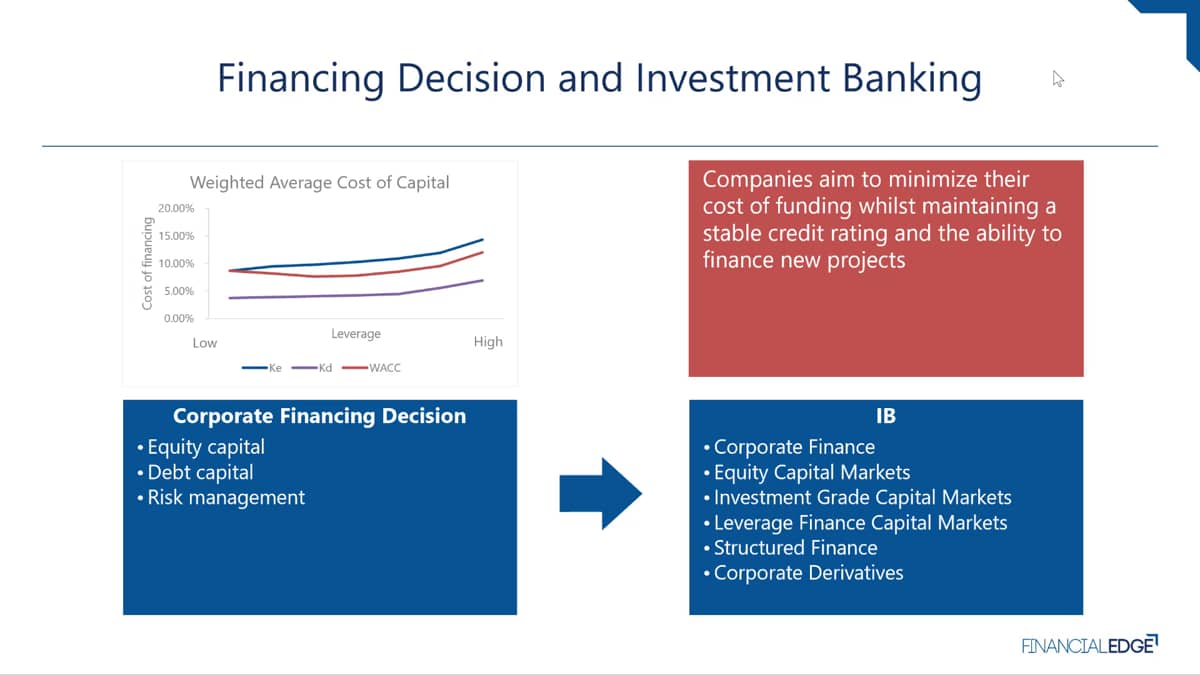
Okay, so let's take a look at the weighted average cost of capital as leverage increases.
So you'll notice, first of all, that the cost of debt in purple is lower than the cost of equity in blue.
But as we increase, leverage both the cost of debt and cost of equity increase, now if you focus on the red line, the weight of average, average cost of capital, you'll notice that as leverage increases as we start to switch our capital structure towards debt, initially, WAC falls.
And this is of course, because the cost of debt is lower than the cost of equity, but it reaches a point of inflection the bottom of the curve when you have so much debt that the weighted average cost of capital tends towards the cost of debt and follows the, uh, the the cost of debt and therefore starts to increase.
And that sort of suggests there's some kind of optimal capital structure.
So if you think about the box on the right, um, what a company's actually trying to do, well as companies launch new products and grow organically, or as they make acquisitions, they're gonna increase their invested capital, therefore they're gonna increase their capital.
So as they're increasing their capital, they're trying to minimize the cost of that capital, the wac.
And it'd be appropriate for us to think about how investment banking can help with that.
So when we, when the business looks to issue equity capital, it could turn to equity capital markets within the investment bank, and they can give advice on, for example, the IPO.
Um, debt capital markets can assist in investment grade and leverage finance capital markets.
And then risk management's also important.
Now I wanna focus here on, on financing.
So when we think about, uh, about capital, we need to think about foreign exchange. Perhaps we are raising capital in different currencies and we wanna think about interest rates.
So corporate derivatives can help with risk management, specifically managing foreign exchange and interest rates.
So moving forward, let's think a bit more deeply about the lifecycle and the role that investment banking can play as a partner throughout that lifecycle.
Well, in the first stage introduction at the beginning of the company's life, uh, it's gonna be principally equity financed.
Um, and as a consequence, it'll be mostly venture capital, uh, financing that will be attracted to the business at, at that stage moving forward, uh, as we hit, uh, growth, hopefully the business is, is successful enough to support an IPO.
So we could turn within the investment bank to equity capital markets as the business hits maturity.
And it relies more heavily on debt financing.
Um, we can look at debt capital markets.
We wanna maybe think about making the business As efficient as possible when it hits maturity.
We could look at restructuring, so divesting parts of the business, maybe, uh, moving into new markets, making acquisitions.
And then ultimately, if the business hits decline, uh, or eventually hits decline, then we need to turn to, again, capital markets and try and manage the reduced debt capacity for the business.
And perhaps leverage finance can help us there also.