Okay, so we're gonna overlay the lifecycle with the Boston box.
And a great place to start is introduction.
So if you introduce a product, you've got low relative market share initially, and hopefully you're entering a market with high growth.
Now, that is gonna require investment.
So if we thought about the cash flow statement, you'd have lots of CapEx, lots of investing, uh, negative investing, cash flow.
And also if you think about the operational part of the cash flow statement, you'd have lots of marketing spend, which would come through in net income at the top of your cash flow statement.
Um, probably at this stage you've got lots of fixed costs, uh, and your volumes are gonna be fairly low, so you've got negative profitability.
So what do we know about businesses when they, uh, have low margins and they're selling little relative to the amount of capital that's invested? Uh, we know that return on invested capital would be low, but hopefully we transition towards growth.
So as the product grows, it moves from being an introduction question mark to a growth star.
Cash flows possibly neutral because of course we're selling greater volumes.
Uh, we're benefiting from economies of scale.
So margins are going up.
We're selling more per dollar of invested capital.
So return on invested capital would be increasing, and then ultimately growth will slow.
Um, we'll hit maturity.
The product could be considered a a, a cash cow, highly profitable, positive cash flows, so very strong return on invested capital.
Great position by which to invest in future question marks.
So provide funding. So you wanna compliment that really strong operating cash flow.
With robust investing.
Cashflow divert some of those funds towards growth in the future, and the cycle continues.
Of course, we may, uh, identify eventually products that hit decline and have no real, real future.
And at that point, we might think about maybe discontinuing those.
We could maybe think about divesting.
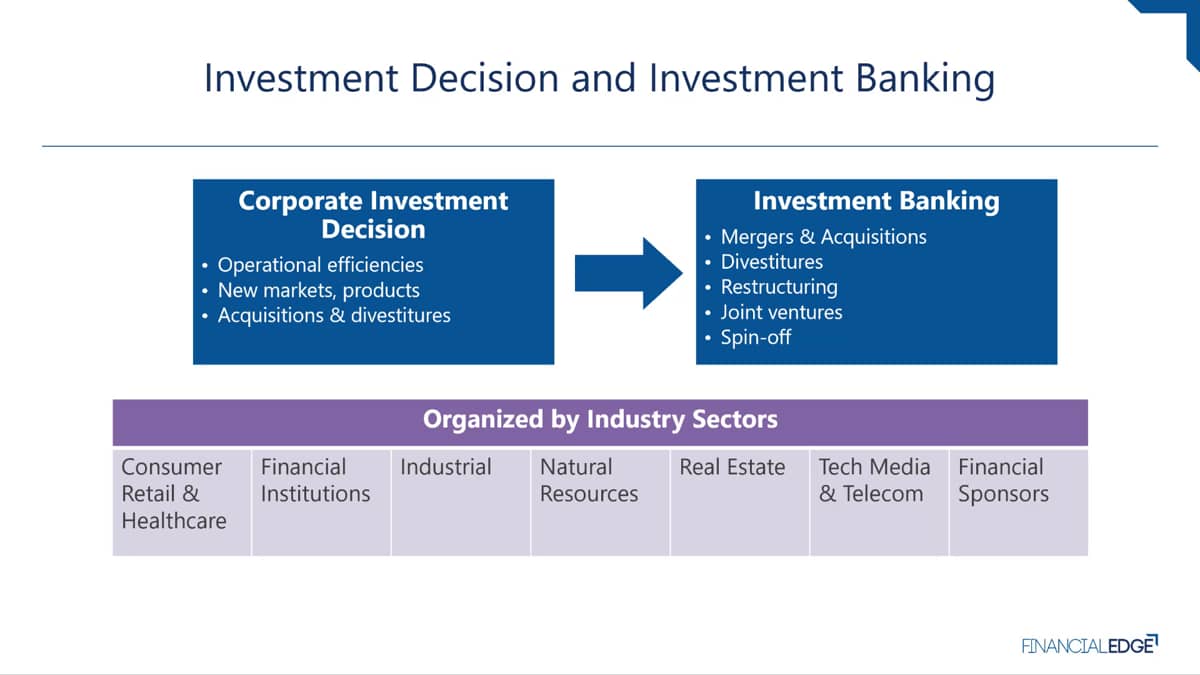
Now on the subject of divestment, we may consider the role that investment banking can play relative to the corporate investment decision.
So if we had, say, dog products that were hitting decline, we may choose to identify those divest, those spin them off.
We might find potential buyers that see more opportunity there in new markets or have certain distinct synergies that they can leverage.
We also need to identify, of course, uh, new stars, um, question marks that will become stars.
So there's a role there for investment banking to, uh, to play, uh, in identifying acquisitions, mergers, maybe moving into new growth markets Through joint ventures.
And as we are going through that process and transitioning from question marks to stars to cash cows, it's all about proving profitability, uh, benefiting from economies of scale and restructuring the business to make sure we, we get the most margins out of it.
Now, in terms of banking, investment banking, you'll typically find that broken up into different industry sectors. And of course, for our clients, it's really important that we have, uh, distinct, specific detailed knowledge on different sectors to help them leverage the most out of potential mergers, divestitures, restructuring.