Okay, let's calculate the weighted average cost of capital for Adidas. And you'll notice that we've been given the post-tax cost of debt and the cost of equity already.
We need to go and hunt for the share price.
So let's go and have a look at Adidas's Public Information Booklet.
And if we jump to page two, right at the top, you can see 1 9 9 5099 and 50 cents is the current market price of Aida's shares.
So let's go and put that into our model.
A hundred ninety nine fifty.
Now we wanna grab the number of shares outstanding.
So back to Adidas's pip.
We're gonna look here at page 14 of the pip, and we've got a table giving the number of shares right in the middle.
I'm gonna copy the current shares outstanding.
Let's go and put that back into our model.
And in fact, you know what, I'm gonna divide that by a million.
So let's show it in millions and we can now take the product of those two numbers and calculate the market value of equity.
I want the market value of debt, but what I do have at my disposal is the book value of debt. So I'm gonna use that as a proxy for market value.
They're not gonna be that far apart. Okay? So I want the market value of debt, but I'm gonna pick up the book value and use it as a proxy number.
So back to Adidas's pip.
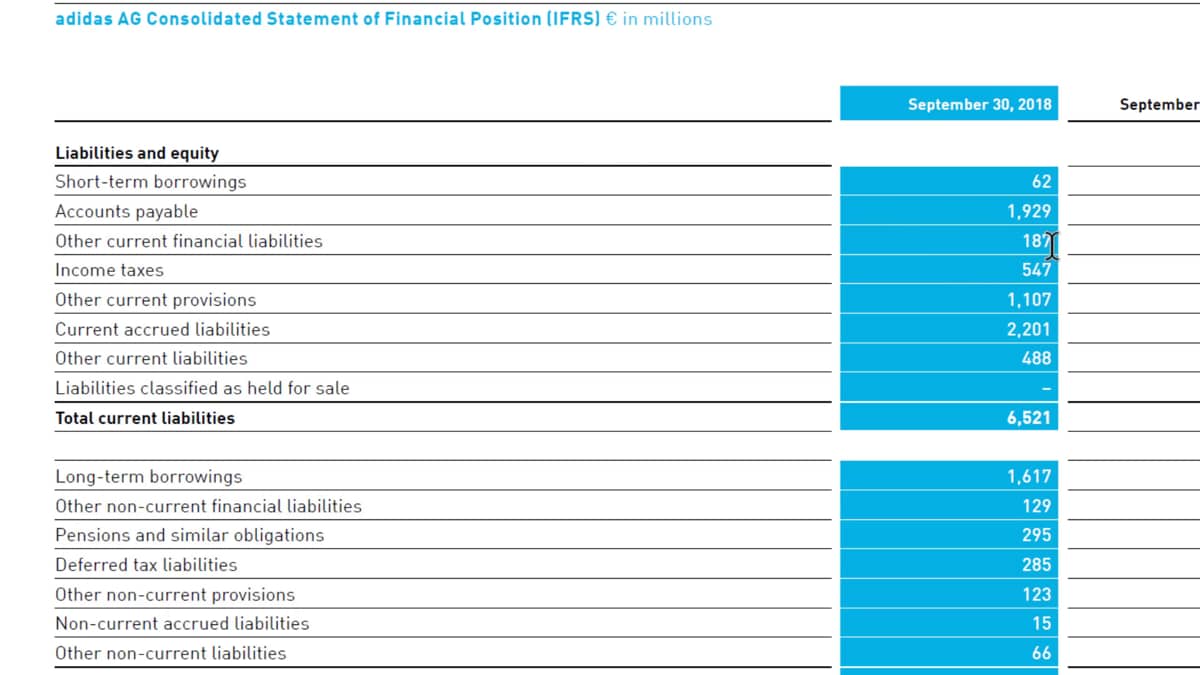
Let's take a look at their balance sheet on page 26.
And you'll notice they've got some short term borrows of 62.
They've got some other current financial liabilities of 1 8 7.
They've got long-term borrows of 1 6 1 7, and they've got some other non-current financial liabilities of 1, 2, 9.
So if I bring all those together in my model, so you pick up the 62, which is the short-term borrowings, and the 1 8 7, which is the current financial liabilities.
Let's pick up the 1 6 1 7, which is the long-term borrowings, and the 1 2 9, which is the financial non-current liabilities.
So that's it is the book value of debt, but I'm using it as a proxy for market value.
Now we can calculate the wac.
So I know what the cost of debt is and I know what the cost of equity is, but I just have to weight that based on market values.
So I'm gonna take the cost of debt, which is already post-tax, and I'm gonna multiply that by the book Value of debt divided by open bracket, the value of equity plus the value of debt.
And to that, I'm going to add, I'm going to add the cost of equity, and I'm gonna multiply that by the market value of equity divided by the market value of equity, plus the market value Of debt.
And that gives me a whack of 7.3%.
Now, the return on invested capital for Aidas is 23.9%.
We've been given that. So we just need to make sure that the return on invested capital is greater, is greater than the weighted average cost of capital, which of course it is.
Uh, 'cause in that instance, Aidas is adding value for shareholders.

 WACC - Adidas - Workout Empty