Okay, so let's think about the investment decision and specifically about the Boston box.
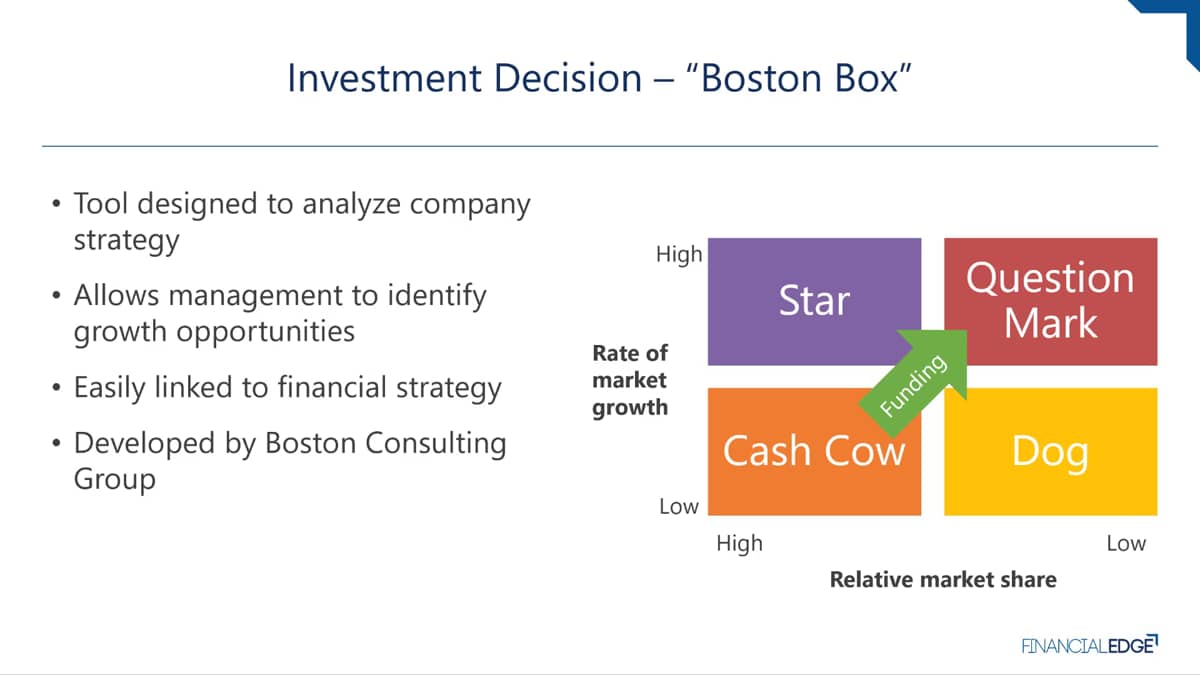
So it's a tool that helps us to identify investment opportunities in our product portfolio.
And we're gonna look at our product portfolio by looking at the rate of market growth and relative market share.
A great place to start is to think about question mark products.
So they have low relative market share, but exist in exciting high growth markets.
Now what we'd like to do is turn those into stars and they order to do that, we need to invest in them.
So we're gonna increase our invested capital.
What we need to think about, what impact that's gonna have on our return on invested capital.
So we need to think about margins.
If we're trying to penetrate that high growth market and improve our relative market share, then it's likely that our profitability is gonna take a hit.
So we'll be using a penetrative pricing strategy.
However, as that market matures, the growth rate slows and the expectation is those products become cash cows, which means that they generate cash surpluses.
Now let's just have a think about invested capital relative to sales.
At that point, if we've got high relative market share, we are trading really efficiently and it's likely that as we've saturated the market and we benefit from economies of scale, that we're trading really profitably.
So those surpluses allow us to invest in question marks. And so the cycle continues.
And fortunately, some products may be classified as dogs, which means that we have a low relative market share, uh, in a low growth market.
And they could be products that we consider to, uh, divest.
They might even be whole divisions We might consider divesting.