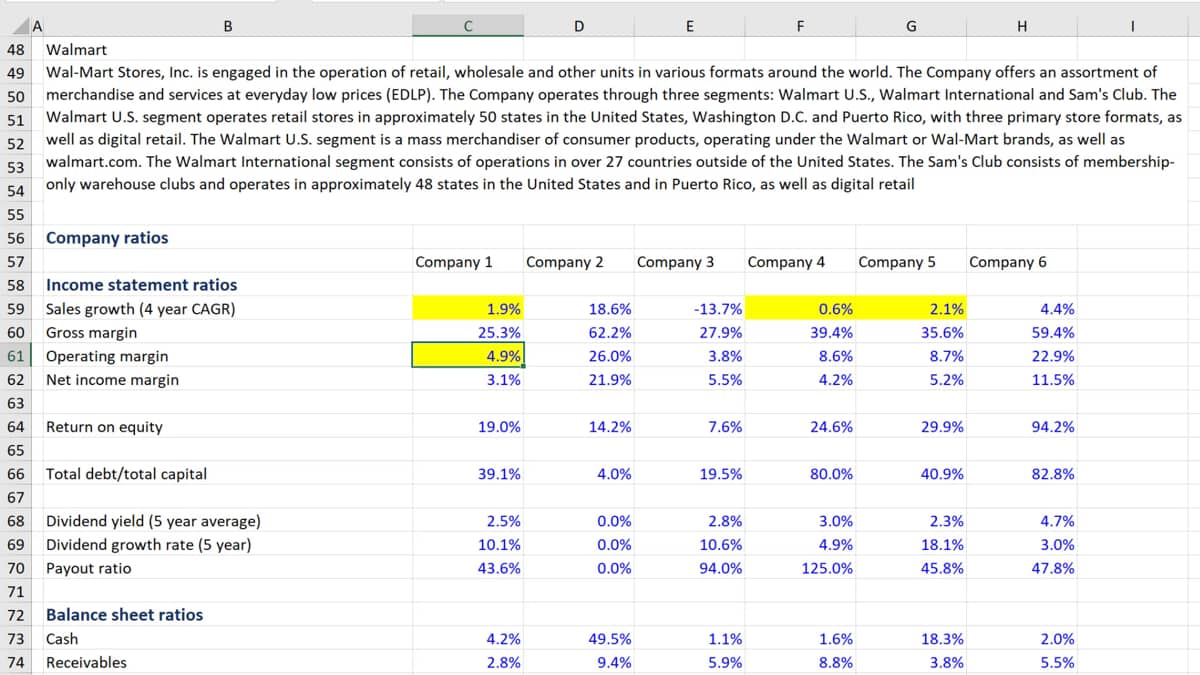
Okay, so here we have some company descriptions and the task is to match those descriptions with the ratios that sit below them.
I'm gonna focus on Walmart, and here we have a description of Walmart, but I think I know a bit about Walmart anyway.
So Walmart is a mature business, uh, and as a consequence, I'd expect the sales growth to be low.
What other features do we know of mature markets? Well, I'd expect the operating margins to also be low because it's a retailer, I'd anticipate that doesn't really have much in the way of receivables, but the inventory is likely to be high, followed by large amounts of property, plant and equipment.
And given the relative power of Walmart as a retailer, I'd expect their accounts payable to also be fairly significant.
So if we work through the ratios, I think I've identified three companies that have low sales growth and at least two companies that appear to have low operating margins.
So that would seem to be a feature of Walmart's market.
Let's move down and think about the balance sheet.
So I think I found a couple of businesses, company one and Company five that have low receivables, and also those same companies appear to have high amounts of inventory.
These would seem to be features of retailers.
Let's keep looking at the balance sheet and property, plant and equipment.
I think Company One and company three have high amounts of pp and E, and you'd expect that, you know, land and buildings, fixtures and fittings that Walmart would have.
High pp and E values.
Let's also have a look at the accounts payable.
Well, it looks to me like companies one and Company four and company five have high amounts of accounts payable.
And again, I would say I think that's probably a feature of the relative power of Walmart as a retailer.
So if we look at that as a whole, through elimination, it appears that Company one is in fact most likely to be Walmart.

 Company Strategy Workout Empty Walmart Complete