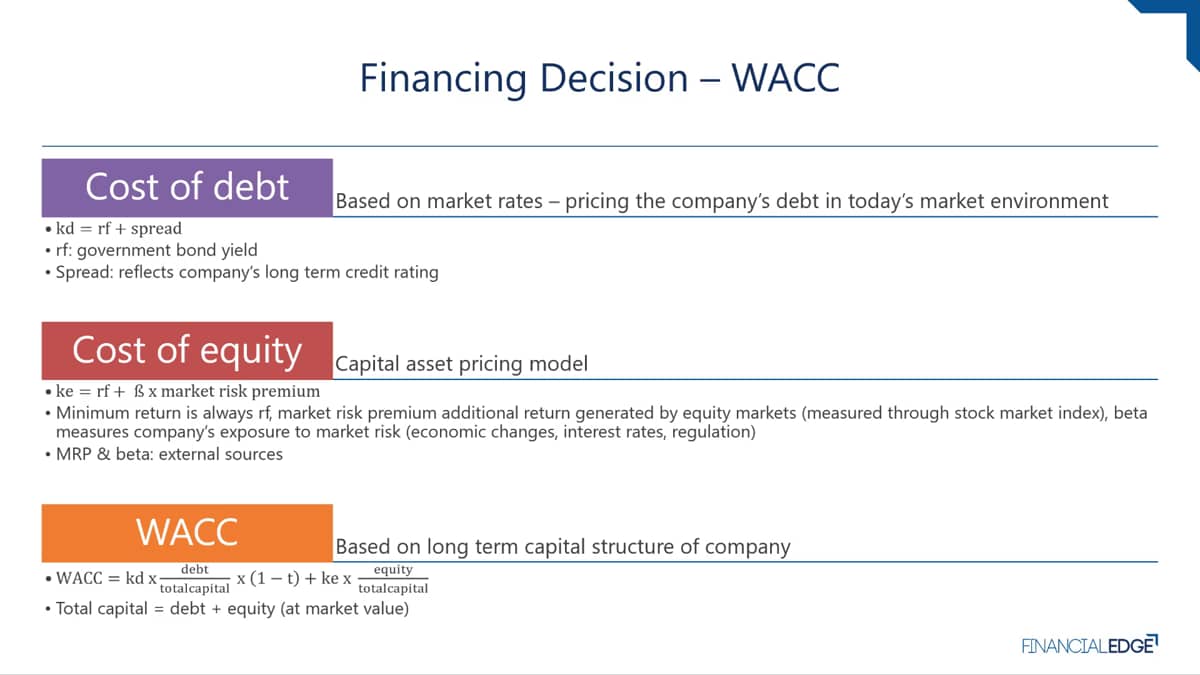
So in order to establish the weighted average cost of capital for a business, we need to think about the cost of debt.
So this is based on, on market rates.
And a great starting point is to pick up the risk-free rate, so the, the yield on government bonds.
And then we need to adjust that for the specific riskiness of the business.
So a business that has, um, a great credit rating will have a smaller spread, whereas a business that has a lower credit rating would have a greater spread.
Once we've established a cost of debt, we then need to think about the cost of equity.
So I guess one way of thinking about the cost of equity would be just be to go and speak to all equity investors and ask them what kind of return they're looking for, but that's obviously really impractical.
So in lieu of that, we would use something called the Capital Asset Pricing Model.
So the Capital Asset Pricing model, first of all says, Hey, we should start by looking at the risk free rate.
That's what, as a, as a, as a, a flaw, that is what equity investors are looking for.
But because they're invested in equities, they're going to want a premium.
So we look historically at the premiums that the equity markets have delivered, and we use that to calculate a market risk premium.
So we're gonna take a risk free rate.
We're gonna add to that a market risk premium, but then we need to look specifically at the business, specifically at the risk that relates to that entity and apply that to the market risk premium.
And we do that by multiplying the market risk premium by beta.
So if a company has a beta of one, then it is as risky as the market, but if it has a beta greater than one, then it is more risky than the market.
Once we've got those two components, we can bring them together to calculate the weighted average cost of capital.
So if you look at the WAC formula, you'll notice that we're taking the proportion of debt and we're taking the proportion of equity, and we're multiplying it by their costs respectively.
So if we take the cost of debt and we tax adjust that by multiplying that by one minus the tax rate, then we multiply that by debt over total capital, and then we take the cost of equity and we multiply that by the proportion of equity.
So equity over total capital that gives us the weighted costs of capital, the weighted average cost of capital.
When we think about the value of debt and the value equity and the value, therefore, of total capital, please note that we are picking those up at market rates.
So this wack calculation looks at the opportunity cost of capital.
It picks up market rates.