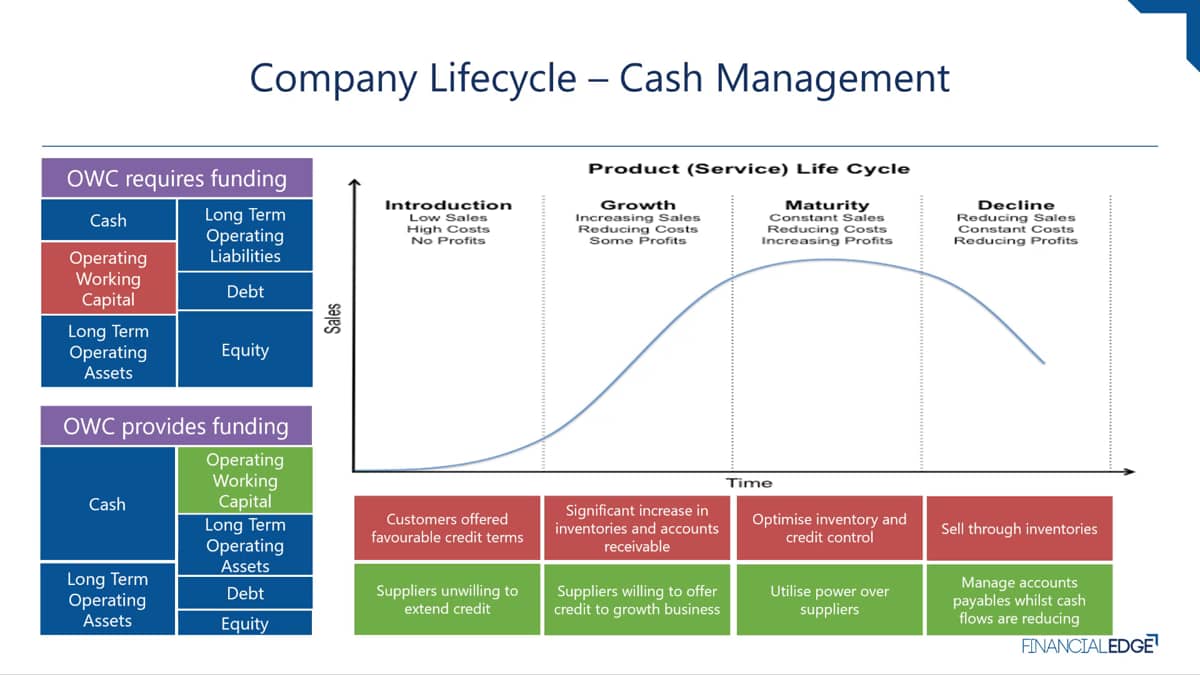
Let's think about the company lifecycle and specifically cash management.
Now I'm gonna look at operating working capital.
So if OWC is a net asset, then it requires funding.
Alternatively, if operating working capital is a net liability, then it provides funding.
Let's think about the impact on OWC across the company's lifecycle.
Add introduction. It's likely we want to penetrate markets, so customers will be offered favorable credit terms that will grow our accounts receivable.
Therefore, our operating working capital will tend towards being a net asset.
We may try and take credit from our suppliers, however, because we're a small company introduction, we may be unsuccessful in gaining, um, gaining attractive credit terms.
As we grow, then it's likely our sales will grow in, therefore our inventories and our accounts receivable grow in absolute terms.
However, to combat that, we can speak to suppliers.
We're a bigger, more important business.
We can take more credit from them to try and offset that increase in operating working capital assets.
As the business becomes more mature, it should focus on OWC assets, such as inventories and accounts receivable, and try and optimize those by using just in time inventory management and tight credit control.
Because you're a larger company, you can utilize more power over your suppliers and try and gain more attractive credit terms.
If the business falls into decline, then we need to carefully think about how we manage that decline and sell through our inventories.
Of course, as we sell through our inventories, that affects margins and ultimately that means that it has an impact on cash flows.
If we think about our accounts payable, we need to make sure we're generating sufficient cash as we sell through those inventories and the business goes into decline to manage winding down those payable balances.
I.