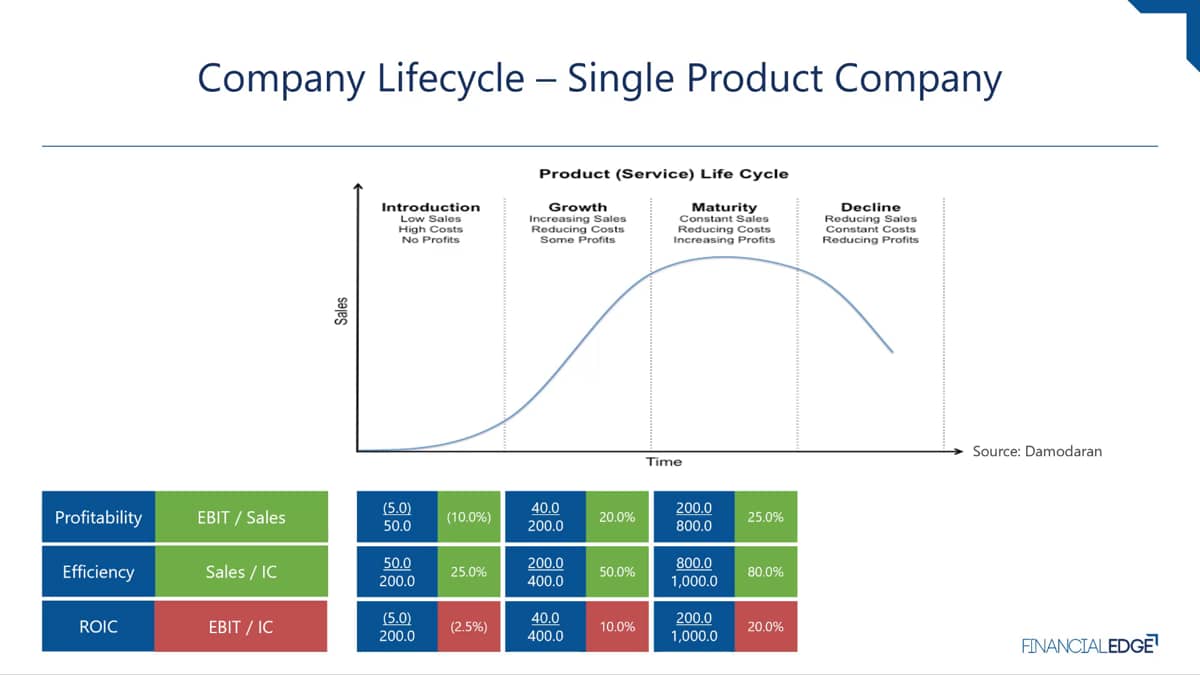
Okay, so let's have a look at the product lifecycle.
And I think it'd be interesting to look at the different stages of that lifecycle relative to the return invested capital generated by that given product.
Now, at the introduction stage of a product, it's likely that it'll be making a loss, perhaps because the selling price is particularly low to penetrate the market or because variable costs per unit are high initially.
So if we have a product that initially produces low profitability or negative profitability, and in terms of efficiency, if the sales are low relative to the capital invested to get that product launched, then you've got low profitability, low efficiency, you've got low return on invested capital.
As the product moves to growth, you hope that the profitability improves.
You hope that off of the invested capital base, you hope that the cells improve and therefore the efficiency improves.
So you should start to see at the growth stage, return on invested capital increasing.
And then once we get to maturity, much more profitability as we benefit from economies of scale.
Again, those scale economies help us in terms of efficiency.
Uh, you multiply those together, the product of those gives us a really strong return on invested capital.
Inevitably the product will hit decline.
It'll become maybe less fashionable or technically superseded by other products, and at that point, the profitability will suffer as we start to cut prices to clear inventories.
As the sales decline, efficiency decreases, and as a result, return on invested capital suffers.