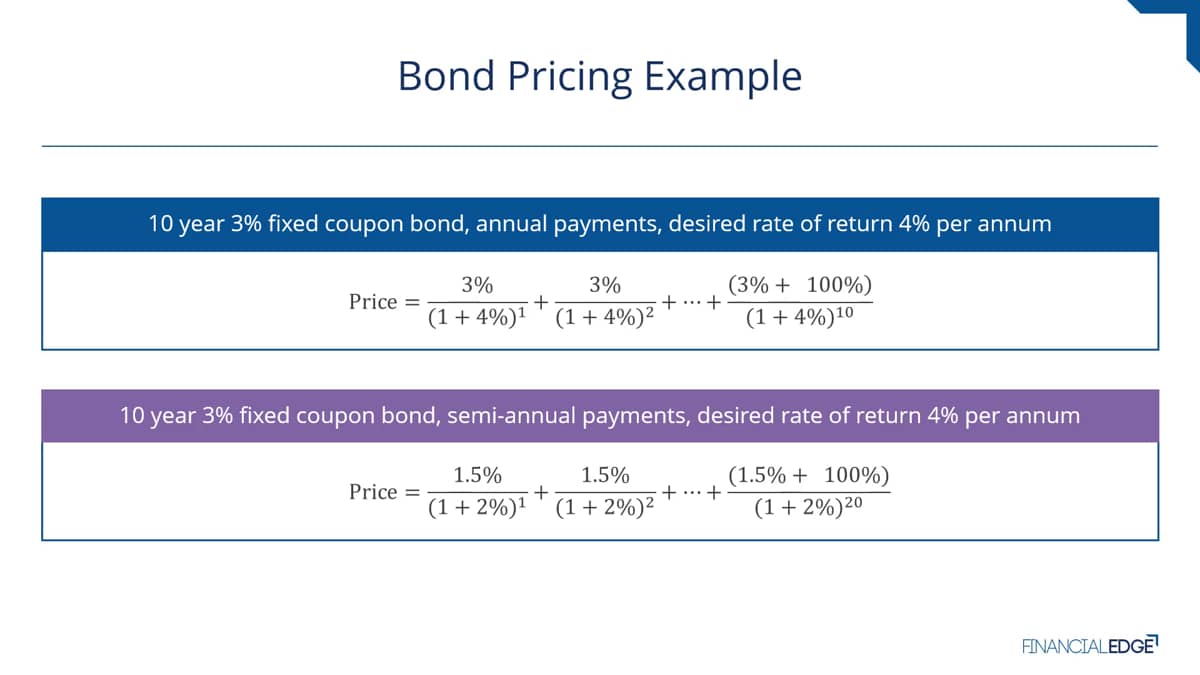
The coupon rate is the rate of interest regularly paid to the bond holder. In practice, market practitioners often discuss bond yields. So let's examine what the yield of a bond is and how it differs from the coupon. In general, the term yield describes the rate of return of a security over a particular period of time and is expressed as a per annum rate. So how does this differ from the coupon? Well, it does not only consider the coupon income but also potential interest on interest that will be received when coupons received prior to the maturity date are reinvested. And also gains or losses investors will realize by buying the bond at a price that differs from a hundred percent but will receive a hundred percent back at maturity of the bond. So the bond price plays an important role for the yield of a bond. But how do we price bonds? In case of a fixed coupon bond, cash flows over the life of a bond are known. However, these payments will occur in the future. And because of time value of money, we cannot simply add coupon and redemption payments to get to the bond price. Instead, we have to discount all outstanding coupon payments, as well as, the redemption payment first. Which is done by dividing each of these payments by one plus the desired rate of return per period to the powers a relevant number of the period. But let's have a look at a concrete example. First, let's examine a 10 year bond that pays an annual coupon of 3%. If the desired rate of return is 4%, we have to discount each of the 10 remaining coupon payments and the redemption payment with one plus 4% to the power of the period number. Which in this case, due to the annual payment frequency, is equal to the number of years until the payment is received. If the bond does not pay coupons annually, but for example, semi-annually, the calculation changes. First, the coupon amount per period will not be 3%. 3% is the coupon rate per annum but as coupons are paid every six months in this case, the actual payment amount is 1.5%. At least if we ignore decom conventions for simplicity. We also have to modify the desired rate we use for discounting. As mentioned on the previous slide, the desired rate of return used should be the rate per period, but the 4% given here is a per annum rate. Again, assuming that coupons are paid exactly every half year for simplicity, the desired rate per period is 2%. Which is half of the desired per annum rate of 4%. And of course, the total number of periods for a bond with semi-annual payments is going to be double the total number of the bond with annual payments. We can also use Excel to calculate the prices for bonds, for example, by using the PV function that is shown here on the screen. For this, we have to know the desired rate of return per period, the number of periods to maturity, the coupon amount per period, and the face value of the bond. And if we enter the relevant values for our 10 years 3% bond with semi-annual payments, Excel calculates a price of 98.82% for this.