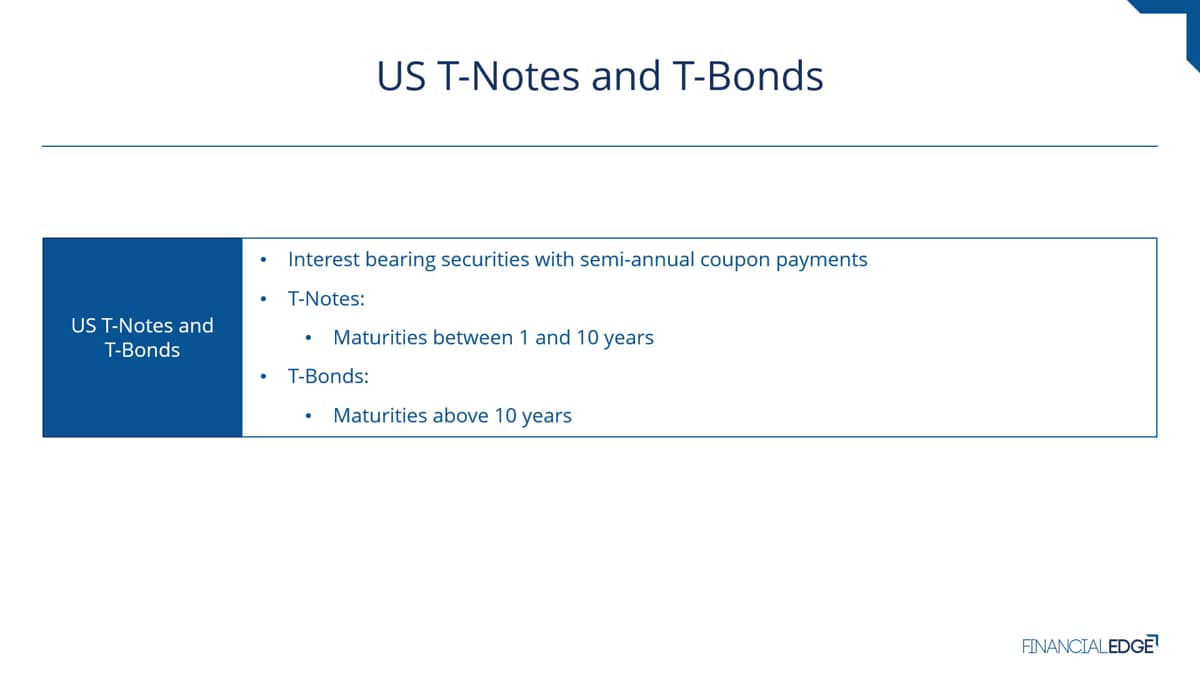
Government bonds usually are issued over a range of maturities, but a maturity is not the only differentiating feature. Let's have a look at the various types of US government bonds available and how they differ. US T-bills are short-term securities that have a maturity of one year or less when issued. The US Treasury regularly issues T-bills with maturities of 4, 8, 13, 26 and 52 weeks, and all of these bills are issued as discount instruments. That means there are no interim coupon payments and the interest earned is the difference between the purchase price and the face value or redemption amount of these bills. US T-notes and T-bonds are straightforward fixed coupon bonds. The coupon is fixed at issuance, does not change over the life of the bond, in case of US T-notes and bonds, is paid semiannually, and investors receive face value at maturity. The difference between T-notes and T-bonds lies in the maturity of the bonds at issuance. T-notes have maturities of between 1 and 10 years with regular issuance usually happening in two, three, five, seven, and 10 year maturities. T-bonds have maturities of above 10 years with surety bonds being issued very regularly. And then there are STRIPS. STRIPS are not really a separate type of government bond, but they are investment products that are created from other types of government bonds, mostly from T-notes and T-bonds. And STRIPS is an acronym for separate trading of registered interest and principal of securities, and this acronym is a very good description of what happens here. When, for example, a T-note or a T-bond is stripped, each coupon payment and the principal payment become a separate security. So for example, if a 10 year note is stripped, this will give 20 coupon payments and one redemption payment, and each of these components can be held and traded separately. As a result of the stripping process, all STRIPS just have one cashflow at maturity, which means they are effectively zero-coupon bonds with the price that is equal to the present value of this one specific cashflow. So the process of stripping basically creates longer dated zero-coupon bonds issued by the US Treasury that otherwise are not available, as T-bills are only issued with relatively short maturities. But while the stripping process is quite straightforward, the question is, why investors might prefer to buy STRIPS rather than the original notes or bonds? Now, there are several reasons and most of them will depend on individual investor circumstances. However, there are two aspects that immediately come to mind. The first one is reinvestment risk. If an investor, for example, has an investment horizon of 10 years and buys a 10-year T-note, every six months this investor will receive a coupon payment. As the investment horizon is 10 years, a rational investor will reinvest these interim proceeds. However, as interest rates change over time, it is not known at which interest rates these reinvestments will be made, which introduces a certain element of risk into fixed coupon bonds. In case of zero-coupon bonds, however, there are no interim coupon payments so that these bonds do not contain the reinvestment risk just mentioned. And the second aspect is that due to the different payment structure, there might be advantages for tax-deferred accounts, like for example individual retirement accounts.