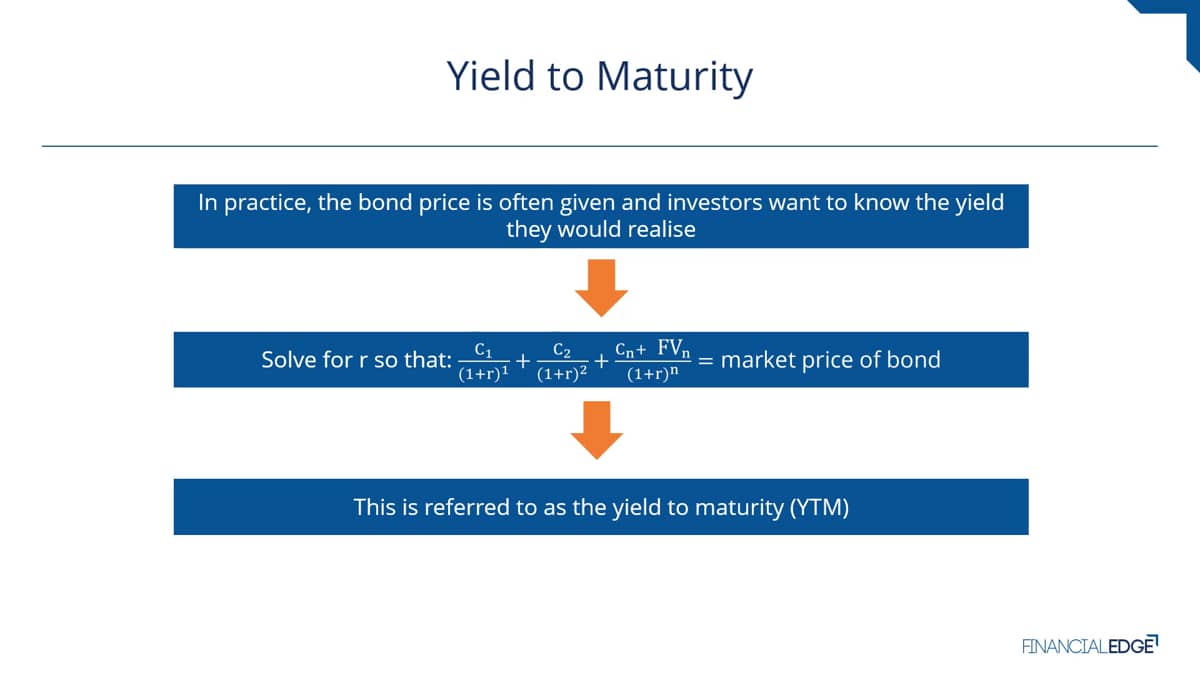
In practice, the bond price is often given and investors want to know the yield that an investment in a bond at the current market price would realize. Unfortunately, there is no direct formula to calculate the yield of a bond with more than one cash flow. In practice, we often calculate the yield of a bond via iteration. In other words, which change the discount rate until the sum of the present values of the cash flows equals the current bond price. And the discount rate at which this is the case is known as the yield to maturity, and this is one of the most commonly used yield types in the fixed income markets. As seen on the previous slide, there's a close link between bond prices and yields. Let's examine this relationship a little further. The yield of a bond does not only contain of coupon payments, but also of gains or losses investors will realize by buying the bond at a price that differs from 100%, but receiving a 100% back at maturity of the bond. Now, based on this, we can derive a simple rule for the relationship between bond prices and yields. When the price of a bond increases the yield of the bond falls and vice versa. Why is this the case? Imagine an investor bought a 10-year 3% fixed coupon bond at a price of 91.82%. In this case, the investor will not only receive the coupon of 3% per annum, but will also realize the capital gain of 8.18% by buying the bond at the price below 100%, but receiving a redemption payment of 100% at maturity. This capital gain leads to the yield of the bond being higher than the bond's coupon. And it's quite intuitive that the lower the purchase price of the bond is, the higher the capital gain and the higher the yield of the bond will be. And this brings us to the last concept we wanted to discuss in this video, the concept of real yields. The yields we looked at so far are nominal yields. They indicate by how much the amount of money invested in the bond will grow over time. However, due to inflation, the investor's purchasing power does not necessarily increase by the same rate. If inflation is positive, part of the nominal yield is eaten up by inflation and the real yield, which accounts for the inflation rate is lower than the nominal yield. The concept is straightforward and so is indeed the mass. If a bond has a nominal yield of 4% and the inflation rate is 2%, the real yield is also 2%. The main challenge in calculating the real yield lies in identifying the proper inflation rate to use. Inflation is not known in advance, and official inflation numbers published are always backward looking. In practice, we therefore use some sort of expected inflation and of course, realized inflation calculated in the future might turn out to be quite different from the expectation that has been used, which would lead to a real yield that is higher or lower than anticipated.