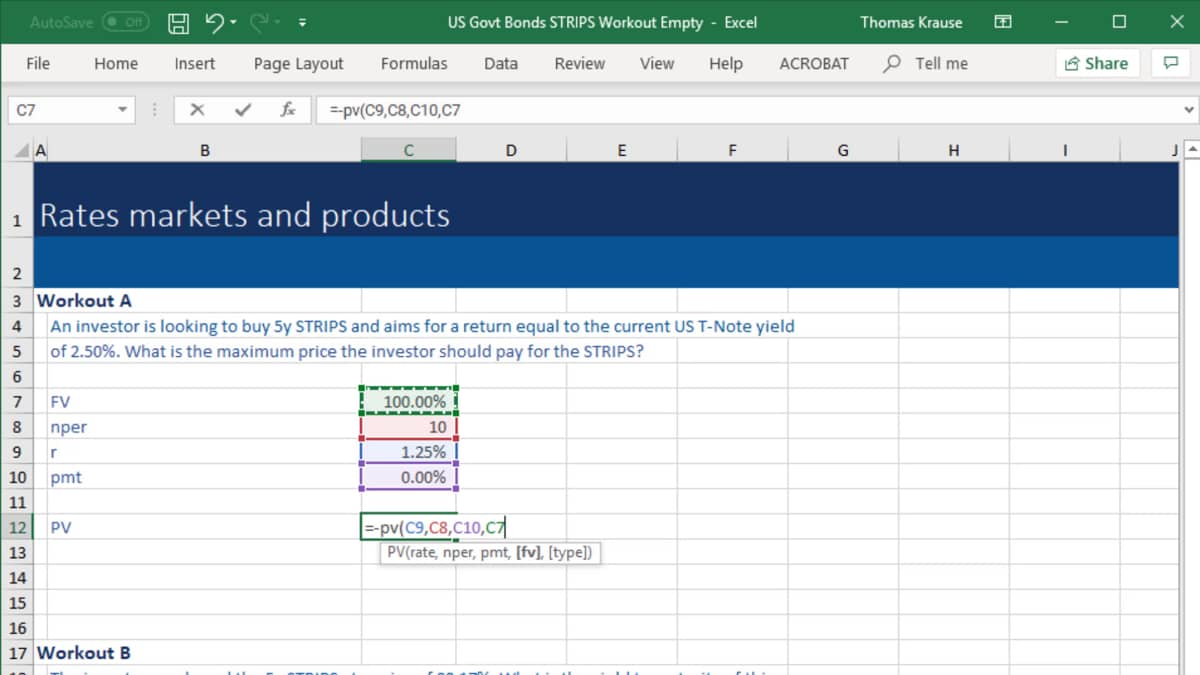
Let's go through these two STRIPS workouts. Now, workout A, we've been asked to calculate the maximum price an investor should pay for five-year STRIPS if the desired rate should be at least equal to the current UST note yield of 2.5%. And once again, we can do this using the PV function. Face value should be 100%. Number of periods in this case would be 10 as the desired rate is given as a yield for an instrument with semi-annual payments. And that means for a five-year bond, we have to consider 10 payment periods. The desired rate per period consequently isn't 2.5% but it's 1.25%. The payment per period in this case is zero as we're pricing a zero coupon bond here, and let's apply the PV function quickly here as PV, the rate, number of periods, the payment and the face value, and we get a maximum bond price of 88.32%. But there is a simpler way to do this in case of a zero bond. As we know, the zero bond only generates one single payment at maturity and so the price of the zero bond should equal the present value of exactly this payment. To calculate the PV, we simply can divide the face value by one plus the desired rate per period to the power of the number of periods. So let's do this quickly.
That's the face value. Divide that by one plus the desired rate to the power of the number of periods. As you can see, the result is the same. And the slightly simpler approach comes in handy in workout B, where we've been asked to calculate the yield to maturity of a five-year STRIPS investment when the purchase price was 88.17%. Now, of course, we could solve this using Goal Seek but as the bond only generates one payment, we can also rearrange the normal and slightly simpler PV formula and solve for the desired rate directly. For this, we need the face value, which is as always 100%. We also need the present value of the bond price, which is given to us with 88.17%. We also need the number of periods, which in this case is 10 as we would like the yield expressed as a return of a semi-annual instrument to make it directly comparable with the T note yield. Now, the desired rate can now be calculated as follows. face value divided by present value to the power of one over 10. So basically taking the 10th root and subtract one from the result gives us a desired rate of 1.27%. And once again, we have to multiply the desired rate by two to get to the yield to maturity, which is a per annum rate. So if the investor bought the STRIPS at 88.17%, the yield to maturity would be 2.53%.

 US-Govt-Bonds-STRIPS-Workout-Empty
