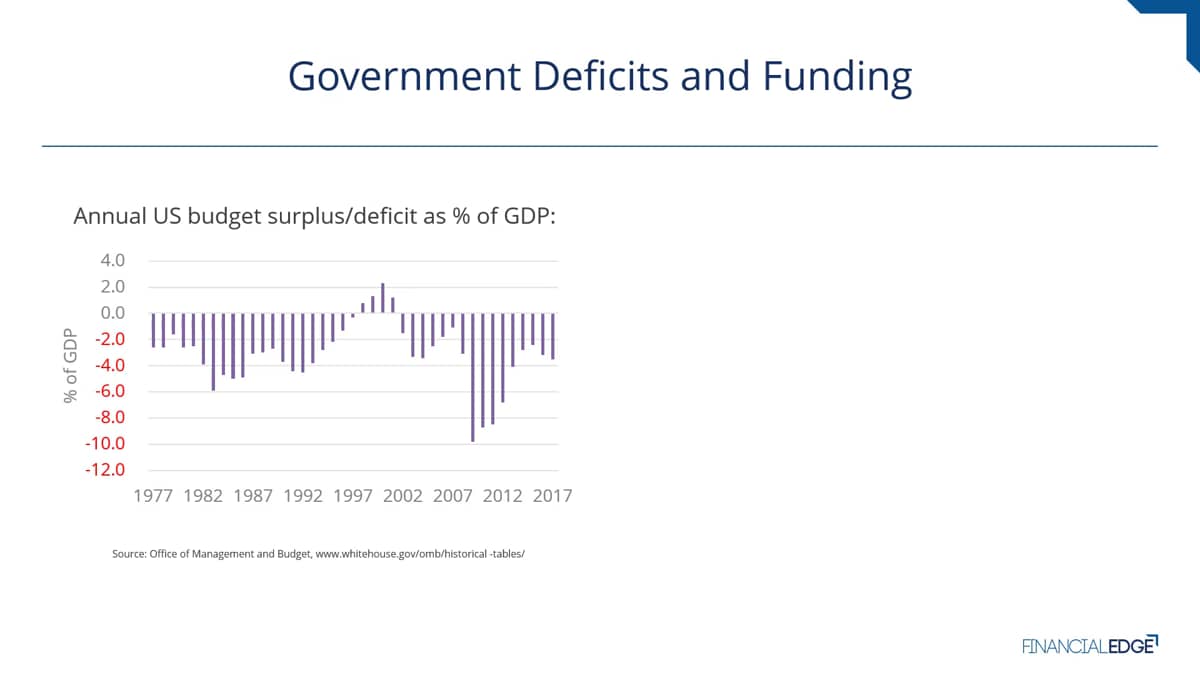
A key feature of a bond is the issuer as this determines the credit risk the investor is exposed to. In case of government bonds, also referred to as Govies, the issuer is a sovereign government. Govies are purchased by a broad range of investors, the institutional investors like pension funds, asset managers, and the like, banks, non-financial corporations, and by individuals as well. As a taxpayer though, you might wonder why governments need to borrow money at all. And you're right. The majority of the government's expenditures should be funded by government revenues like for example, income tax, corporate taxes, et cetera. However, in reality, the government expenses, for example, payments to develop and maintain infrastructure, pensions, et cetera, often exceed the government revenues. And the government then is said to run a budget deficit. In the rare cases where revenues exceed the expenses, the government is said to run a budget surplus. As an example, the graph here shows the annual budget surplus. These are the positive values and deficits of the US government as a percentage of the US gross domestic product, or GDP, from 1977 until 2017. As you can see, in most years over this time series, the US government ran a deficit, which would've been debt financed, and consequently, the amount of US federal debt held by the public, shown on the chart here, has pretty much constantly increased over time. Large proportions of these deficits are financed by the issuance of government bonds. So this chart also gives you a good indication about the significance of global government bond markets. Because government bond markets are so sizable, Govies are usually traded quite frequently, which means that government bonds are a very liquid product. It is relatively simple and cheap to trade in and out of government bond positions, which of course is a major advantage of this type of investment. But there are more advantages. And probably the most important one besides liquidity is the aspect that Govies, at least if issued by large developed economies, have very little credit risk. In fact, government bonds of these countries are often referred to as being credit risk-free, as it is assumed that due to the government's ability to increase the amount of tax collected and the potential backstop function of the country central bank, there is not going to be a default in these bonds. Closely linked to credit risk is a benefit that Govies generate a stable income stream. While all fixed coupon bonds have a fixed payment schedule by nature, only in the absence of credit risk these cash flows can be taken as guaranteed. So for investors that need a guaranteed income stream, government bonds play an important role in their investment portfolio. Individual investors will also have very different investment horizons, but as governments generally issue bonds of certain standard maturities on a very regular basis, a wide range of maturities is available for investors in the secondary market. So investors will most likely be able to find a government bond with a maturity close to the investment horizon. As mentioned, government bonds are usually the investment with the lowest credit risk in a particular country. And so consequently, government bond yields become the benchmark for all other bond investments in this country. As all other issuers, for example, from the corporate sector, will have a higher risk of default, investors will demand a premium above the government bond yield as compensation. And this premium is commonly referred to as the credit spread.