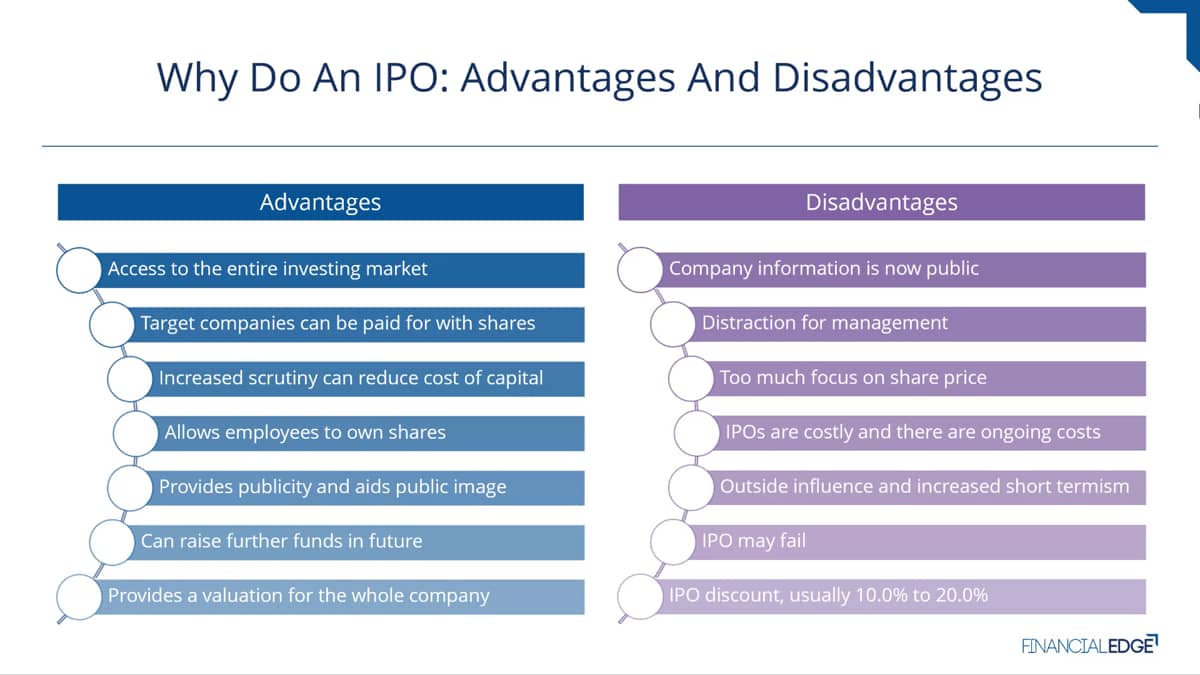
Why should a company do an IPO? Well, there are a number of advantages to it. Firstly, it gives access to the entire investing market. Instead of trying to tap just a few private shareholders for more money, I've now got the entire market to go to and are much more likely to get those funds that I want. Secondly, target companies can be paid for with shares. This means if the company that's doing the IPO in the future wants to make an acquisition that sees a company that it'd really like to buy, but unfortunately it doesn't have enough cash with which to do that. Well. Now we have publicly available shares and the acquiring company could issue shares to the target shareholders. So instead of paying with cash, you pay with shares.
Also, the increased scrutiny can reduce cost of capital. Increased scrutiny can give shareholders confidence that the company's being well run and well monitored.
It also allows employees to own shares. This can be very motivating for employees and can mean that they stay at the company for longer. It also provides publicity and aids the public image of the company. This in itself can lead to higher sales. It also means the company can raise further funds in the future. 'cause once you've accessed public markets, you can keep going back. And lastly, it provides a valuation for the whole company.
IPOs typically involve a sale of only 10 to maybe 25% of the company, so a minority stake. But once you've got a valuation for even just one share, that allows you to provide a valuation for the whole company.
So there are lots of advantages to doing an IPO, but what are the disadvantages? Well, first of all, the company information is now public. It may be that the company would prefer not to make its financial accounts public so often, and it wishes that people weren't asking questions about its operations and its new products. Being public can also be a distraction for management, constantly having to answer questions from analysts, journalists, and maybe activists shareholders. This can lead to too much focus on the share price. Instead of management thinking about what's going to happen in 2 years time, 5 years time, maybe 10 years time, they end up thinking what's going to happen to the share price in the next couple of months. IPOs are costly and there are ongoing costs, and the company may wish that it was avoiding those costs.
Being public can also lead to outside influence being greater than management would wish, and increased short-termism. Again, that focus on the share price. In addition, the IPO may also fail. We put a lot of effort in a lot of time and money, and unfortunately, we then don't raise the money that we need. And lastly, IPOs are normally sold at a discount, usually 10% to 20% of their full price. This is to try and encourage people to invest so that as soon as the share price goes public, there should be a little pop where the share price goes up by that 10 to 20%. This can leave the company thinking, maybe we've left some money on the table here. Maybe we sold ourselves a little bit cheap.