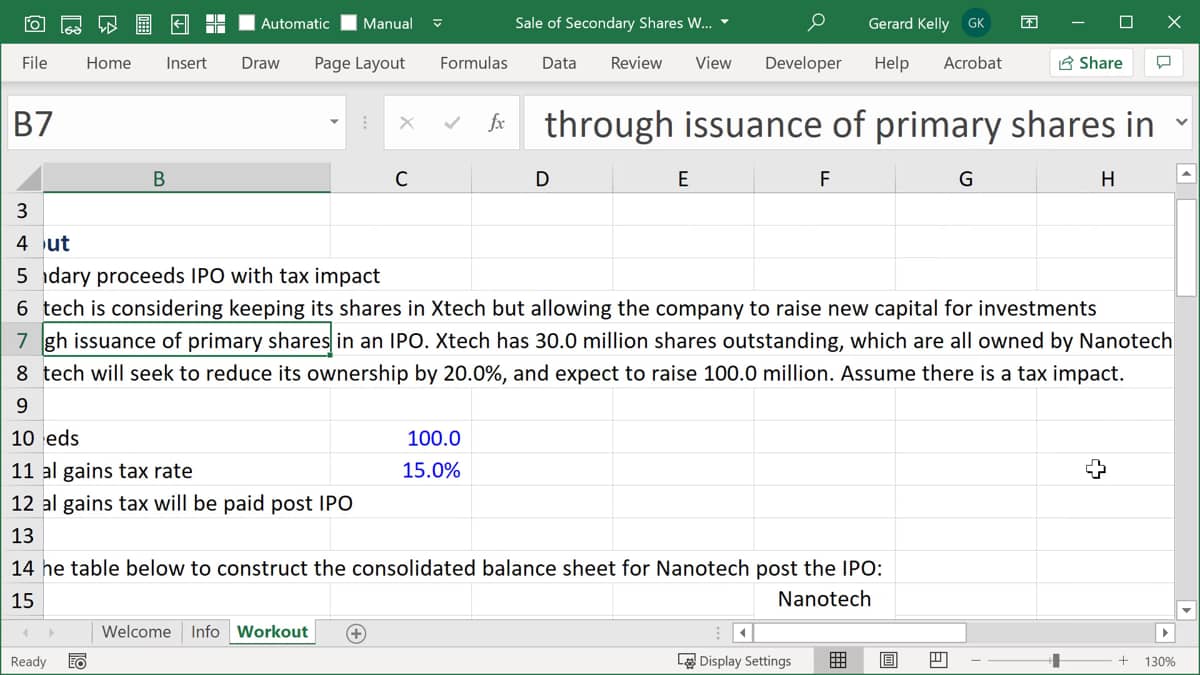
In this workout, the focus is on a secondary proceeds IPO with tax impact. So Nanotech is considering keeping its shares in X Tech, but allowing the company to raise new capital for investments through issuance of primary shares. In an IPO, X tech has 30 million shares outstanding, which are all owned by Nanotech as part of the IPO. Nanotech will seek to reduce its ownership by 20% and expect to raise 100 million, assume there is a tax impact. Okay, so we've got our proceeds of 100 here. We've got capital gains tax of 15%, and it needs to be paid. Post IPO.
We are asked to use the table below to construct the consolidated balance sheet for Nanotech post the IPO. So let's do that final column there. We're going to sum to the left, and I'm going to copy that down where it's in line with all of the blue numbers, the blue hard coded inputs.
and for the remainder, the subtotals, I will sum upwards.
Okay, 3,930 total equity in liabilities. And the same for total assets. We've got a balanced balance sheet. All right then. So we need to come up with a couple of different numbers here. We need to work out the proceeds that are coming in, but we'll then have to tax that. We'll then have to work out our capital gains tax payable.
We'll have to work out our non-controlling interests, and we'll have to work out the gain for Nanotech. All of these will have to go into the adjustment column. So how many shares are being sold? Well, remember this is a secondary share sale. So it is Nanotech that are selling their own shares. They're not issuing new shares of X Tech.
So we know that Nanotech want to own 80% of the shares outstanding at the end, and there's going to be 30 in total. So we're sending off 20%, so one minus 80%, that's 20% times where the 30 gets us to 6 Nanotech shares being sold. Now I need to start working out my tax payable, and for this, I'm going to have to start with the offer price per share. For this, I'll have to take the total proceeds all the way up at the top of 100 and divide that by the number of shares that are being sold, being 6. So 16.7, that's my offer. Price per share. My pre-tax proceeds, that's just the 100, again, up at the top.
And now I need the tax basis for one X Tech share. That's a bit like the book value of each of the shares being sold. Well, it's going to be the common stock plus the additional paid in capital. So those who added together, I'm just gonna put brackets around that And then divide that by the number of X Tech shares they were in total. So each X Tech share has a tax basis or a book value of 2. Now, I can work out that taxable gain. If I know each share's being sold for 16.7 and we've got a tax basis of 2, my taxable gain is 14.7, and now I can work out my total taxable gain. I take that, multiply it by the number of shares being sold, which is 6. Total taxable gain is 88. Great. So there was a little bit of work needed to get to that 88, but now we've got it. We can now tax that figure. So capital gain tax rates up at the top was 15%. Let me change that to a percentage. There we go. So the tax payable multiplied by the 15 gets me 13.2 tax payable. Now onto the NCI, well, I need X Techs net assets post IPO. So that's going to just be exactly the same as pre IPO. It's the 330 X Tech is not issuing any brand new shares, and X Tech is not receiving any proceeds. It's the parent company Nanotech selling out its shares. So my non-controlling interest is going to be the 20%. That's one minus the 80% times. By the three 30, there's our NCI 66.
So now we've got an intriguing situation here. We've got a gain for Nanotech that they will put in their own set of accounts of 34, but the tax authorities, they think they've got a taxable gain of 88, and you're going to have to pay tax based on that 88, not on the 34. So my gain for Nanotech post-tax will be that 34 but minus the 13.2 tax payable.
So the gain for Nanotech post-tax, 20.8.
Now we can put lots of those figures up into the adjustment column. We'll start by putting the proceeds. The proceeds were 100, but then lots of other figures need to come in. Now we had tax payable all the way down there, 13.2, we had NCI right down at the bottom of 66. And lastly, we had a gain that Nanotech itself wants to put through its accounts. It's not the 88, that's what the tax authorities use. It's the 20.8 that we've calculated here.
Now let's check that our balance sheet balances total equities and liabilities. 4,030, total assets 4,030.

 Sale-of-Secondary-Shares-With-Tax-Impact-Workout-Empty