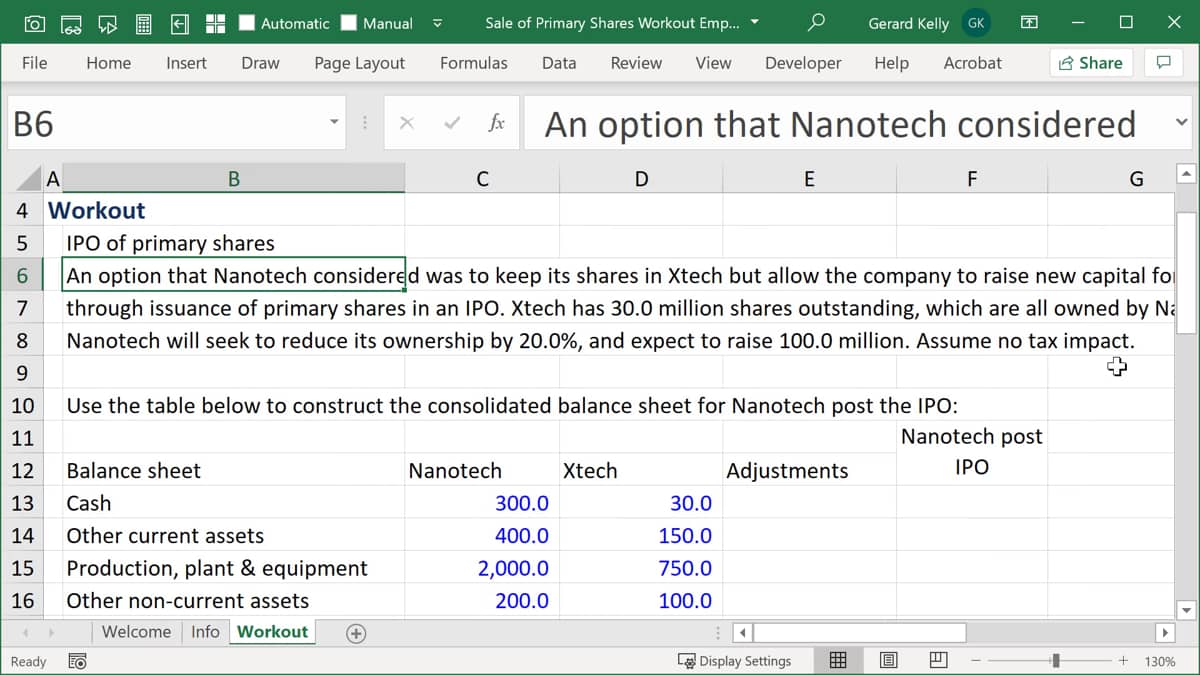
In this workout, we're looking at an IPO of primary shares. An option that Nanotech considered was to keep its shares in X Tech, but allow the company IEX Tech to raise new capital for investment through issuance of primary shares. In IPOX Tech has 30 million shares outstanding, which are all owned by Nanotech as part of the IPO. Nanotech will seek to reduce its ownership by 20% and expect to raise a hundred million, assume no tax impact. Okay, so a couple of questions for you. What's going to happen to the X Tech share counts? Well, it's going to increase, so that 30 million will only represent 80% of ownership later on. Also, if X Tech is raising this money through a primary share offering, then what's gonna happen to X Tech's net assets? They're going to go up. And why is this? Because X Tech gets the proceeds 100 from the primary shares and because then the assets goes up, that means NCI value is going to be higher than it would be otherwise. So let's start going through all of that. We're gonna start by putting in our nanotech post IPO column. Let's sum across, and I'm gonna copy that all the way down whenever there are blue numbers.
And for all of the subtotals, I'm going to sum upwards Total liabilities and equity. 3,930 total assets, exactly the same. We have a balanced balance sheet, right? Let's get into the sub calculations at the bottom of the page here, we've got number of X Tech shares pre IPO, and it's 30, but we know nano ownership will only be 80% post IPO. So how many X tech shares will we have post IPO? Well, that means I can take the 30 and divide it by the 80%. That then gives me 37.5 shares after the IPO. Now, because it's a primary share offering, that's really important. The number of shares has gone up. How many shares did it go up by? It went up by 7.5.
Now let's see what happens to XX net assets. Pre IPO, their net assets. Is that just the value of their equity? It's exactly the same figure. It's 330, but we're going to have new cash proceeds coming into the company of 100. So post IPO, their net assets go up to 430. Why did we say we cared about that? Because it impacts the NCI. Our NCI is 20% and I'm gonna take one minus the 80% to get to that. And I'm gonna multiply that by the new net assets figure gets me to an NCI of 86. Now that figure is much higher than if we had done a secondary sale. If nanotech had done a secondary sale, that NCI would be lower.
Who cares about getting that NCIA little bit higher? Nanotech do because nanotech have to pay a gain on the difference between the proceeds and the NCI. If they'd done a secondary sale, NCI would've been lower and their gain would've been higher. You pay tax on the gain. Great. So our gain here is 14. We now need to put all of these numbers up into our adjustment column, and the first one is going to be the cash. The cash proceeds were 100 that's flowing through. I now need to put in my NCI. My NCI was 86.
And then the last one is the gain. I'm gonna put that up into my equity 14. Let's double check that. The balance sheet balances 4,030 total equity and liabilities, 4,030 total assets. So again, the big differences there. A primary issuance here meant X tech was receiving proceeds. X techs net assets were going up X techs NCI was going up. That meant nanotech. NCI went up and it meant their gain went down. And normally you've paid tax on that gain. And so that's a big difference compared to secondary share sale.

 Sale-of-Primary-Shares-Workout-Empty