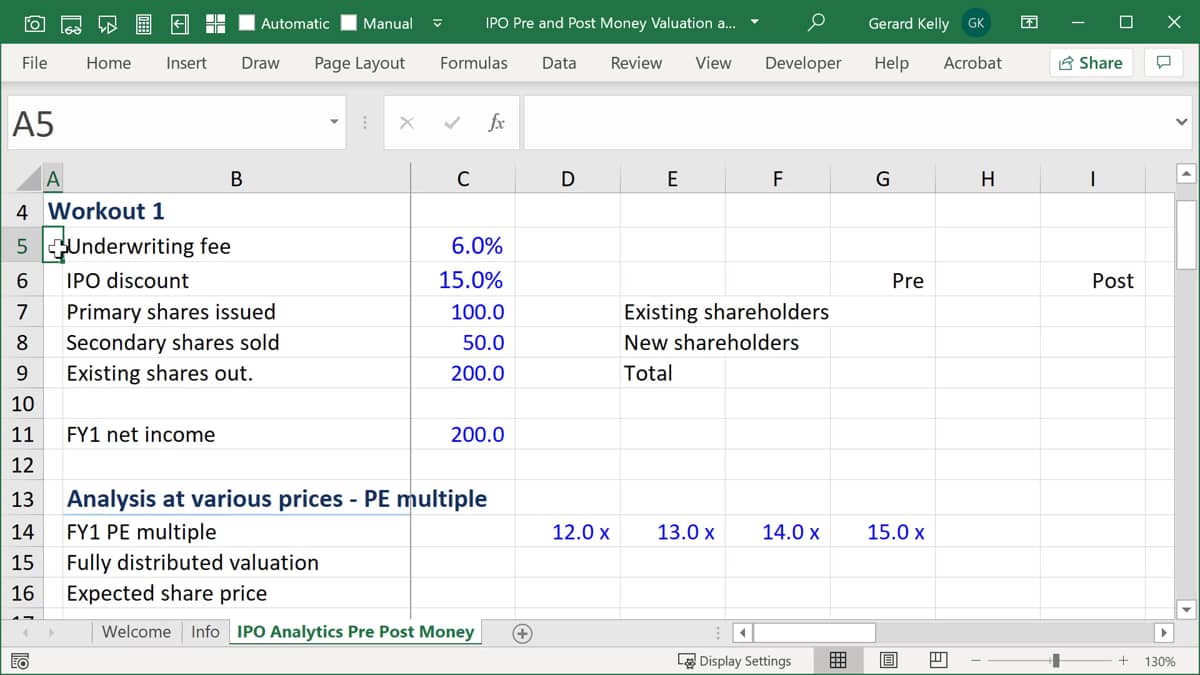
In this file, we have two workouts, workout one and workout two underneath it. Workout two is really a practice version of workout one. So once we've gone through workout one, you can stop the recording, have a go at practice two, and then have a look at the answer in the answer files. Okay, so in workout one, what do we need to do? Well, we are gonna have to come up with an implied pre-money valuation for a company, and then we'll go in reverse. We'll work out their implied fully distributed valuation as well.
So let's start by working out our number of shares. That's gonna be absolutely crucial to helping us work out all these different valuations. So my existing shareholders had 200 shares.
My new shareholders at the moment, prior to the IPO, they had nothing. So we just hard cut a zero in there and add those figures up.
But now we're gonna make an adjustment, and I'm even gonna label this up as an adjustment column. Our existing shareholders, if we have a look here, they're going to sell some of their shares. It says secondary shares sold 50, and then we're gonna have some brand new shares issued and new shareholders will be allowed to buy them. So in my adjustment here, I'm gonna take a minus 50 for my secondary shares, but new shareholders will be the 100 for the new shares issued and the 50 who have just bought up those shares that they were sold by the existing shareholders. So my existing shareholders will now own 150 of the shares post IPO, and the new shareholders will own 150 as well. Total up there'll be 300. And that makes a lot of sense 'cause we had 200. We're issuing a hundred new shares, we're going up to 300. So let's go down to the labels below and have a look at what we need to do. We're going to start with a fully distributed valuation and use that to come up with our expected share price. Then we'll take off the IPO discount and that'll get us to a post money valuation here. It's been called an implied Offer price value. We'll then do that per share. Then we'll take off the IPO proceeds and that will and the fees, and that will eventually get us down to a pre-money valuation. So let's go through that To come up with my fully distributed valuation, I've got a PE multiple here, and I'm gonna multiply that by my F 4G one net income. I'm gonna make sure I lock onto that and I'll be able to copy that to the right shortly. If that's my final fully distributed valuation, then I can divide that by the number of shares we'll have, which we earliest orders 300. I'm gonna log onto that as well to work out and implied share price after the IPO. But we know there's going to be a discount. There's got to be a discount to try and attract investors along. For the IPO, we're gonna have to take that off. So I take the fully distributed valuation and I'm gonna divide that by one plus the discount, And I lock that as well. And that gets me down to 2087. I need to do exactly the same for the share price. And I can just copy that down. And that gets me a figure of seven. I'm gonna show one more decimal place. It's 6.96.
So I've now got a fully distributed valuation and I've got a post-money valuation. The only thing missing is my pre-money valuation. In order to get to that, I need to work out the proceeds and the fees involved in the IPO.
How do I work out my proceeds? Well, first of all, I need to work out how many shares are being issued and we know that's going to be 100 and I'm going to lock onto that. And what price are they being issued at? They're being issued at the IPA price of 6.96. So we should get primary proceeds of 695.7. However, there are going to be some fees involved. If we go up to the very top, there's an underwriting fee of 6%. Again, I'm gonna lock onto that. What do we multiply that by? We multiply that by the primary proceeds.
Now we're gonna be using some of those proceeds to pay those fees. So we need to net the two of them off. So I'm gonna time's up by a minus one.
So my total proceeds that we'll actually get will be 653.9. Now I've got my post money valuation up here, 2087. I've got my primary proceeds and the two of them together will enable me to work up my pre-money valuation 1,433.
Now, let's just check that we can do that in the opposite direction as well. I'm going to use exactly the same 6.96 here as my offer price per share. And just to point out, that is exactly the same as the offer price that we had up here in D 19. So I've got my initial offer price per share. Let's work out our primary proceeds. That was the number of shares issued of a hundred.
And I then multiply that by the offer price per share, 695.7. Of course, we've got to take the fees off as well. So I'm just going to link up to the same figure that we used before.
Total proceeds the sum of the two items above 653.9. Now at this stage, you might think, hang on, we've done all this before, just in the opposite direction, what's the point? Well, the point is now that we've got a starting point for our share price, the 6.96, we can then do sensitivity on that. We can go up 5.5 0.5 0.5 and see what happens. Earlier we were doing similar sensitivities, but we were changing the PE multiple.
So now I'm gonna calculate my post money evaluation and my pre-money valuation. My post money valuation was the 6.96. The IPO offer price times my all of the shares. That's up in the top right hand corner, lock onto that. That gets me my post-money. And if I've got my post-money and my proceeds, then I can work out the net of those two to be my pre-money valuation. So now we need the expected share price. Well, we've already got the IPO share price of 6.96, but that includes the IPO discounts, the 15%. So let's add that discount back in or kind of unwind the discount, find the undiscounted value. That's up in the top right hand corner and it's 15% and I'll lock onto that and my expected share price after the IPO is eight. Now I've got my post IPO share price and I've got my post IPO shares, which is 300. Again, up in the top right hand corner. Lock onto that, we get to our implied fully distributed valuation of two 400. And as just a reminder, that was exactly the same figure that we started with earlier.
Now let's copy all of this to the right.
In the first scenario, we started at fully distributed valuation and worked to pre-money. And our big sensitivity here were PE multiples. We can now see various values along the way. We can look at expected share prices, inspected offer price per share, I-I-I-P-O pricing, and we can look at pre-money valuations. In the second scenario, what we were flexing here was that IPO share price and we decided we were gonna increase that by 0.5. Point five 0.5. If we copy those figures to the rights, again, we can see similar analysis, but from different starting points, I can now see what my total proceeds are going to be, my post-money, pre-money, and my fully distributed valuation.
Now I've got a number of different valuation points here, and we've got sensitivity around this. This is now the start of a discussion. What price should we price the IPO at.

 IPO Pre and Post Money Valuation and Modeling Workout Empty