Here we have an IPO prospectus document. What I'd like to do is go to page 11. So I'm gonna go up to the top here, type in an 11.
And here we have the details of the offering. We're gonna focus on pages 11 and 12. What I've now got are 4 questions. I'd like you guys to have a look through. The first one, how many primary and secondary shares are an issue? Then what proceeds will the company receive? Thirdly, what rights are attached to each share? And lastly, what reasons did the company give for the IPO? Now, the answers to these 4 are all given on pages 11 and 12. Pause the recording. Have a go at these questions by looking at pages 11 and 12. And when you're ready, unpause, we'll go through the answers.
So our first question, how many primary and secondary shares are in issue? Let's have a look. So right up at the top of page 11, we see class A common stock offered by us, which is 180 million shares, and by the selling shareholders, 241 million shares.
So interestingly, the majority of shares that were being issued up at the IPO were by the selling stockholders. This is an exit route for them, enabling them to, to cash in and all that work that they've been doing over the years.
Question two, what proceeds will the company receive? Well, we need to scroll down ever so slightly to find this, and it's in the first paragraph. We estimate that our next proceeds from the sale of the class ACOM stock that we are offering will be approximately $6.8 billion.
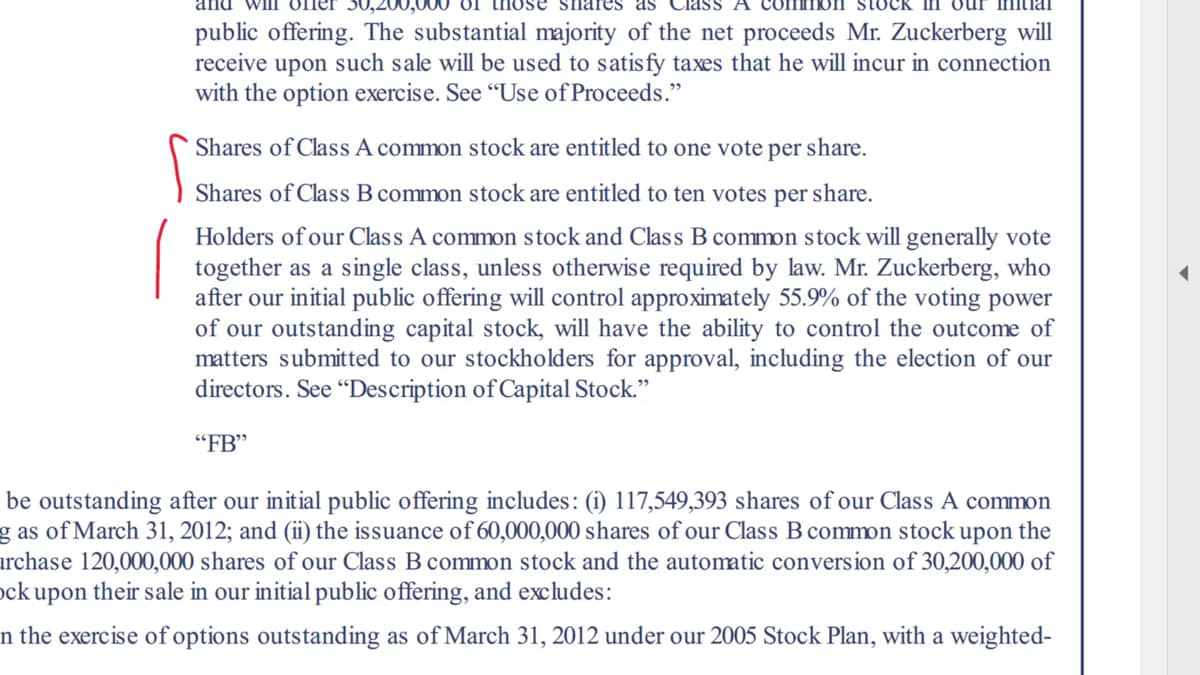
It carries on to say, based on the initial public offering price of $38 per share after deducting underwriting discounts and commissions. That's the fees, the fees they'd have to pay to their advisors and things. Question three, what rights are attached to each share? Now, for the answer to that, we need to carry on onto page 12, and we can see it's the voting rights. That's the thing that I find really interesting here. Shares of class A common stock are entitled to one vote per share, but shares of Class B comm stock are entitled to 10 votes per share, which class being offered in the IPO, it was just the Class A shares. Those one vote per share were being offered in the IPO Class B. Were not being offered in the IPO, and if we carry on down holders of a Class A comm stock and class B comm stock will generally vote together as a single class unless otherwise required by law. If we have a quick look back at the bottom of page 11, it says, we will not receive any proceeds from the sale of shares of class, a common stock by the selling stockholders in connection with our IPO offering. Mr. Zuckerberg, our founder, chairman, and CEO has exercised an outstanding stock option with respect to 6 million shares of Class B, and we'll offer 30 million Of those shares as Class A. So it seems that the founders, they're gonna be holding onto the Class B stock, whereas the Class A is being offered up for sale in the IPO, this means that the initial founders will retain control of the company or at least control the voting rights. Lastly then, question four, what reasons did the company give for the IPO? Well, we've got that on page 11. The principle purposes of our initial public offering are to create a public market for our class, A common stock, and thereby enable future access to the public equity markets by us and our employees. So that's great. So they want to make sure that they can get additional capital in the future when they want it.
It also says they want to facilitate an orderly distribution of shares for the selling stockholders. So they want to allow their selling stockholders to exit.
It then carries on. We intend to use their net proceeds to us from our IPO for working capital and other general corporate purposes. However, we did not have any specific uses of the net proceeds planned. Now, this is unusual. In an IPO. Most investors want to know, well, I'm putting money in. What are you going to use that money for? Is it going to get a 1% return, a 5% return, a 50% return? I want to know I'm investing in a company which is gonna use that money efficiently. It's gonna be generating high returns, and this is gonna be a good stop for me. So this is very unusual at Facebook. Didn't put any specific purposes for the proceeds in here.

 Facebook-Prospectus
 IPO-Prospectus-Example-Questions