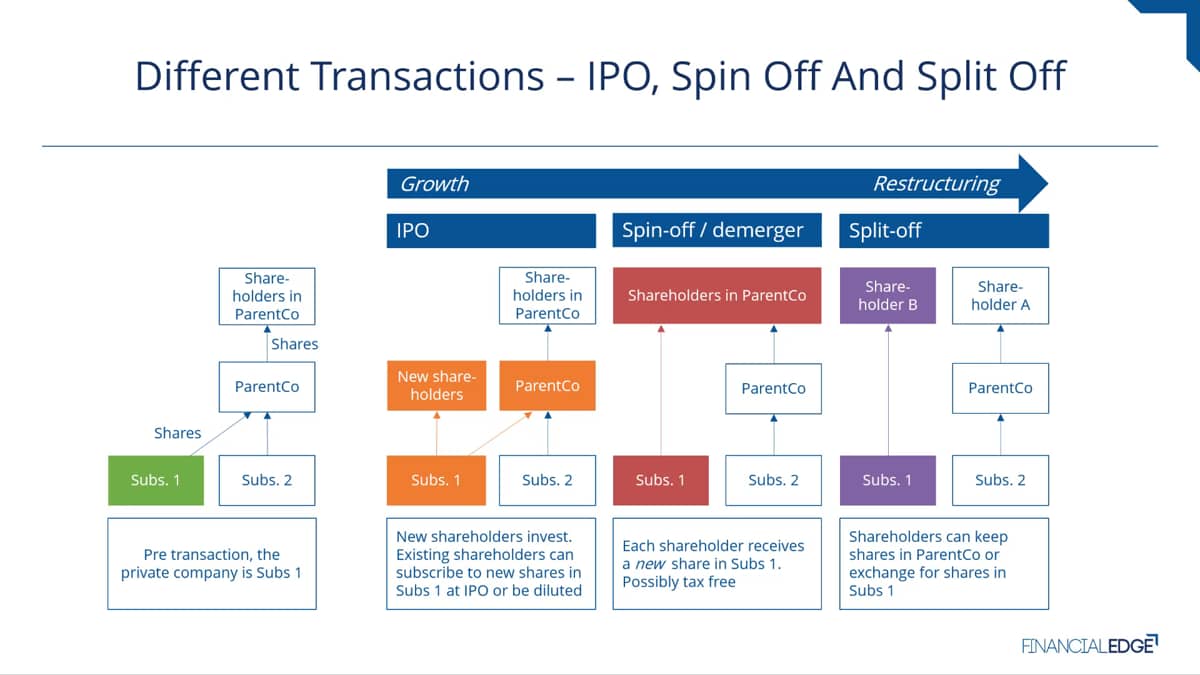
Here we have different types of transactions. We've got the IPO, but we're also going to look at spinoff and split off both of them. Very similar. Let's look at a scenario before an IPO spinoff or Split-Off has happened. Here we've got subsidiaries 1 and 2. They're both owned by Parent Co. And Parent Co is then owned by shareholders in Parent Co. So Parent Co owns the shares of Subs 1 and shareholders own the shares of Parent Co. We won't be looking at subsidiary 2 very much. So Pre-transaction, The private company of our focus is subsidiary one. Now we'll look at 3 different transactions that could happen to to that subsidiary. Some of them happen more towards the growth phase of their life, some more towards the restructuring phase of their life. The first one is the IPO. Here we've got new shareholders investing. The existing shareholders can subscribe to new shares in subsidiary one at the IPO, or they can be diluted. So the important point here is that we're going to have new shares being issued. Parent Co could try and get some of those shares if they want to, but ultimately there's probably going to be some new shareholders along the way. Now let's look at a spinoff or a de merger here. Our focus is on the subsidiary 1 and the shareholders in Parent Co, but it's not really going to include Parent Co so much. What we're gonna have is that each shareholder receives a new share in subsidiary one, possibly tax free, depending on how it's structured. This now enables subsidiary 1 to be separately listed, separate from subsidiary 2, separate from Parent Co, and it can find its own value. Then the shareholders in Parent Co and now shareholders in subsidiary one, they can decide maybe I want to sell some of subsidiary ones shares, maybe want to sell some of Parent CO's shares. I can treat them separately. Lastly, we look at the split off here. Again, our focus is on those top tier shareholders who were shareholders in Parent Co. But what's happening now? Well, those shareholders can keep shares in Parent Co or they can exchange them for shares in subsidiary one. So we'll now end up with two separate shareholder bases. Shareholder A, who will own shares in parent code, and shareholder B, who will own shares in subsidiary one. The big difference between the split off and the spinoff is that in the split off our shareholder group, separate into two. Whereas then our spinoff, our shareholders have shares in parent code and they have shares in subsidiary 1. It's still one group of shareholders, but with two separate shares.