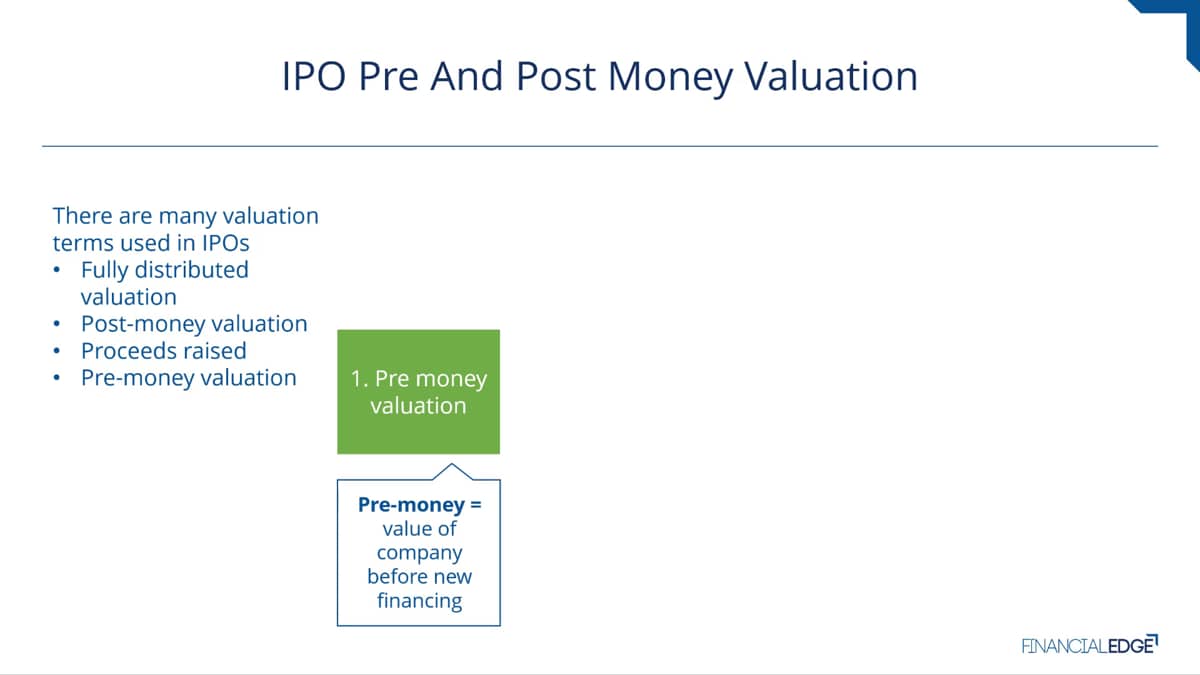
When it comes to IPOs, there are many valuation terms used. We see fully distributed valuation, post-money valuation, proceeds raised, pre-money valuation, and it's very easy to get confused by all of these. However, it is super important that we do understand which number we're looking at when someone quotes something to us. So let's understand each of these terms. The first one we're going to start with is the pre-money valuation, and that's the value of the company before new financing comes in. So before the proceeds of the IPO, let's assume that happens, proceeds come in, fantastic. That gets added on to the pre-money valuation. Adding those two together gets you your post money valuation, pre-money value plus proceeds from the share sale. But that post money valuation, that assumes that my IPO was sold at an discount. What I'd like to understand is what are my shares really going to be worth in the outside market once that discount disappears? So what I do is I add on the IPO pop or unwind the discount, and that gets me to my fully distributed valuation. So we've got lots of important different terms here. You've got your pre-money valuation, post-money valuation, fully distributed valuation, and you've got your IPO proceeds and IPO discounts along the way as well. Why is it important to understand them? Well, if an investor came along to a company and said, Hey, I value you at X, it's really important for them to understand whether that's a pre-money, post-money, or fully distributed valuation. Now, how could we get to that fully distributed valuation? If I wanted to do this calculation in the opposite direction, well, you can calculate it using standard valuation techniques, EEG trading comps, DCF, etc. So let's say I have done a DCF on my company and I've come to a fully distributed valuation. Well, why is that useful in this scenario? Well, the order in which a valuation model is built is the opposite to the order that we've shown here. You work backwards from the fully distributed valuation to the pre-money valuation. So let's start with that. DCF, we're assuming the company is now public. It's post IPO, the proceeds were invested. There's my DCF value. Now I'd like to take off maybe a 10% discount to try and attract customers along to the IPO. So take that off to our post money valuation. Then you work out what the IPO proceeds will be. Take that off, and that gets you to your pre-money valuation, and that's the value of your company before you've done any IPO or any investment.
So that's the way we need to do this. If we're going to model this, start with your fully distributed valuation and work your way towards the pre-money.
Here we have a pre and post money valuation example. A company is planning, its IPO. It has 350 Existing shares and we'll issue 50 new shares, and we're asked to work backwards from fully distributed value to pre-money value. So we're gonna start off using a PE multiple to come up with our fully distributed valuation. Our forward PE multiple is 10 times, and we multiply that by forward net income. That gets us fully distributed value of 1,920. So that's the value after the IPO. But in order to attract investors to the IPO, we're going to have to offer a discount from that share price. So we are going to offer a discount of 20%. So our post money valuations can be 1600. Now, some of you might be looking at that and thinking, hang on, 20% of 1,920. If you take that off, that does not get you to 1,600. Well, that's because the discount is always calculated as percentage of the post money value. So it's 20% of the 1,600 that comes to 320. And if you take that off 1,920, that gets you to 1,600. So you take it off the post money value rather than a percentage of the fully distributed value. Next, I want to work out my IPO proceeds. For that, I'm going to need to know some shares numbers. So my shares outstanding. They were 350 and we're issuing 50 new shares. So that's getting us to 400 shares. So my implied offer price is going to be my post money valuation of 1600 divided by the 400 shares. So that gets us to an IPO price or offer price of 4. Now I've got that IPO offer price. I can multiply that by the number of new shares we're issuing and that'll get us our proceeds. So issue price of 4 times by the number of shares being issued 50 gets us to 200. That's our proceeds. We're almost able to calculate our pre-money value. However, all IPOs are going to involve some fees being paid to advisors. Our fees here are going to be 5% of the IPO proceeds. So 5% times whether 200 is 10.
Now I can work out my net IPO proceeds of 190. Great, post money valuation was 1,600 IPO proceeds 190. The difference between them, it's going to be my implied pre-money valuation, and that's 1,410. One last note, just back at those multiples at the beginning, we should always use forward multiples and expected earnings of the company post IPO, and that includes the effect of the IPO proceeds being invested.