To understand the economics of a rights issue.
Let's have a look at an example.
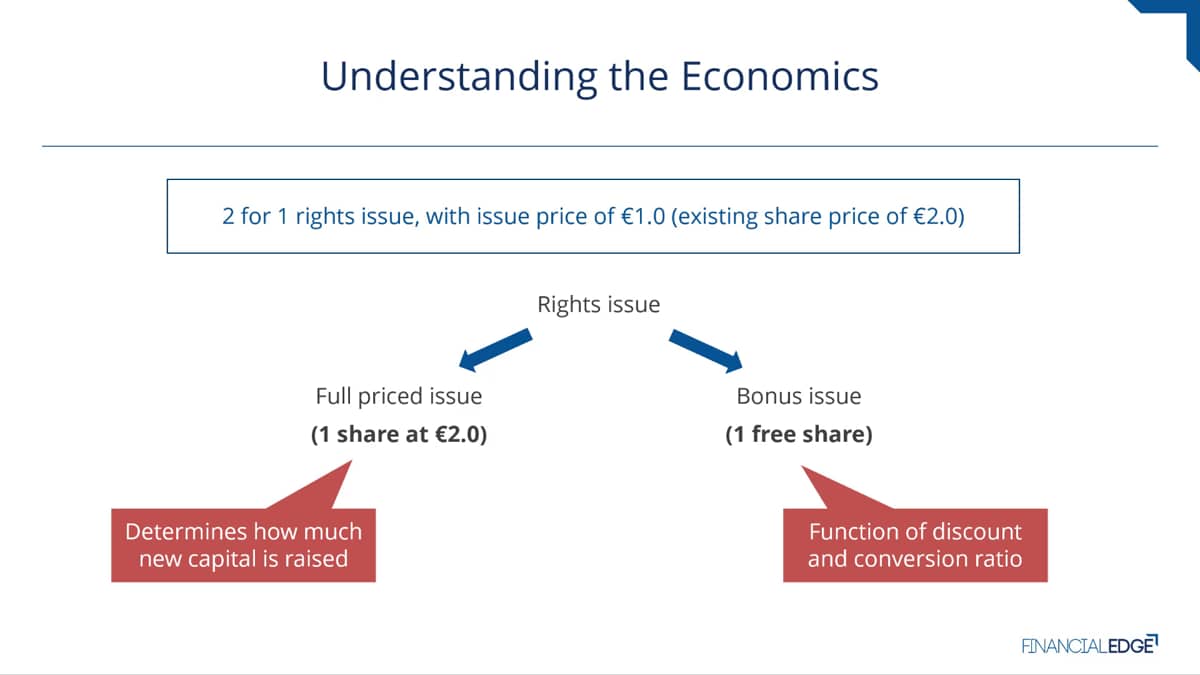
We've got here a two for one rights issue with an issue price of one Euro and the existing share price was two euros, the existing share price before the rights issue.
To help explain this, it's important to realize that there's going to be two new shares for every one share that's currently in issuance.
Now we can think of our rights issue as two things.
We could think of it as a full priced issue, IE one share being issued for two euros, the existing share price, and you can also add onto that a bonus issue, one free share being added on.
Now it's the full priced issue that gains more of my attention.
This one determines how much new capital is raised.
This is what's getting the money into the company.
Companies perform rights issues for many different reasons, but it may be the company's a little bit nervous.
Maybe there's a recession and they want to get a bit of extra money in as a safety buffer.
Alternatively, the company may be thinking about going on an acquisition spree, and so they want to get lots of money in to enable them to make those acquisitions.
The focus here is whether the proceeds are enough to cover the intended uses.
In this example, we'll have two new euros coming into the company, so that's our focus.
Do we have enough proceeds to cover whatever we want to do? We don't want to focus on the discount too much.
It's much more about the proceeds and that one free share, that bonus issue.
That's a function of your discounts and your conversion ratio, and it will add to the dilution.