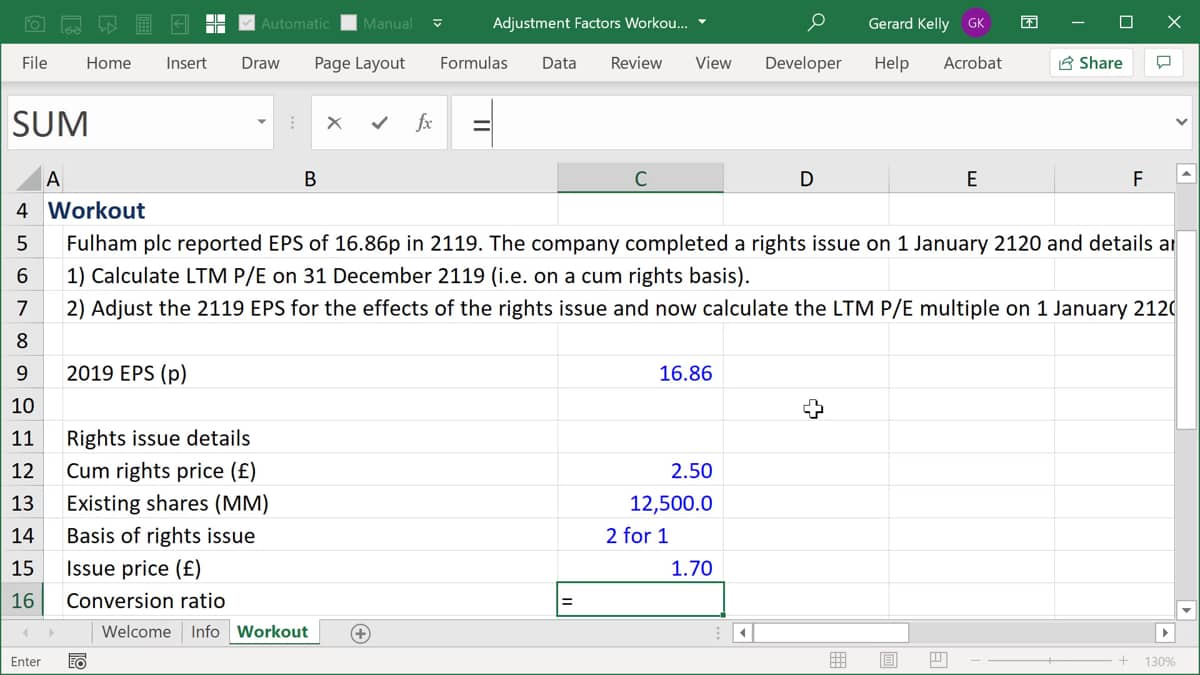
In this workout, Fulham has reported EPS of 16.86 pence in the year 2119.
The company completed a rights issue on the 1st of January, 2120.
And details are provided below.
We're asked to do two things. Calculate the L-T-M-P-E multiple on the 31st of December, 2119 on a come rights basis, IE before the rights issue, and then adjust the 2119 EPS for the effects of the rights issue.
And now calculate the L-T-M-P-E multiple on the 1st of January 21, 20 IE on an X Rights basis.
Or after the rights issue.
The rights issue is going to increase the number of shares and it's gonna make our EPS go all over the place.
It's going to reduce it, so we need to use an adjustment factor to try and correct for that.
Okay? What information will be given? Well, there's that EPS, again, 16 pence, 80.86, and we've got the rights issue details.
The come rights price is two point 50, existing shares, 12,500.
The basis of the rights issue is a two for one.
So in my conversion ratio here, I'm gonna go equals two divided by one.
And there we've got the conversion ratio of two.
The issue price of the rights issue is one pound 70.
Okay, so let's do our L-T-M-P-E multiple on the 31st.
December, 2119. Remember, this is before the rights issue, so it's relatively straightforward.
I need to take the share price of the company two pounds 50, but I'm gonna times that by 100 so that it becomes 250 pence.
I can then divide that by earnings per share, which is shown in Pence.
So the LTMP multiple is 14.8, and I have just made that a multiple by going to my home sell styles.
And then on multiple.
Now we need to work out what's gonna happen after the rights issue, and we know that that multiple's gonna go all over the place.
The EPS is gonna go down, multiple go up.
So we need to avoid that.
To do that, we need to come up with our adjustment factor, and in order to come up with that, we need a theoretical X rights price.
So I need to take existing shares times by the existing share price or the old prior to the rights issue, share share price.
Then I need to add onto that the number of shares that are gonna be issued at the new issue price.
The number of shares that's gonna be issued is 12,500 times by the conversion ratio.
And then I multiply all of that by the issue price of one pound 70.
Great. So that gets my new market capitalization of the company after the rights issue, but I need to divide that by the number of shares after the rights issue.
So it's going to be 12 500 Plus 12, 500 times two.
That's the number that we're gonna issue.
Put it all together. And I've just given myself an extra decimal place.
My theoretical XR price is one pound 97.
So my adjustment factor, this is where you have to take the com rights price or the share price prior to the right tissue, divide it by the turp.
And our adjustment factor, and again, I've just given myself an extra decimal place, is 1.27.
So now let's restate the 2019 EPS.
2019 EPS is right at the top, 16.86.
I divide that by the adjustment factor of 1.27, and it comes to 13.26.
Fantastic. Now, let's work out our multiple immediately after the rights issue.
If I look at it immediately before it was 14.8, the very next day, it should be the same thing. It shouldn't have changed dramatically.
So I'm going to use my new share price, which is the turp, and I'll need to times that by a hundred.
Just make sure that it's shown in pence, and then divide the whole thing by this new EPS.
Now, let's see what happened. Does it come to the same multiple that we had before? I really hope it will. I really hope it will. And it does.
So even though my share price has changed dramatically, it was at two pounds 50, and it's now come down to the TURP of one pound 97.
Whoa. That's gonna make my multiples and E Ps go all over the place.
Well, luckily it didn't.
Even though the price has come down, we've adjusted the EPS down as well.
It was at 16 pence, 86, we brought it down to 13 pence, 26, meaning that my multiple, which was 14.8, is still 14.8.

 Adjustment-Factors-Workout-Empty