In this workout, we're told that Wimbledon and Chelsea have both announced rights issues.
We are asked for both companies use the information below to calculate the new shares to be issued, the rights issue proceeds, and the issue price discounts is three things.
We're after that. It then says, consider whether the size of the issue price discounts is important.
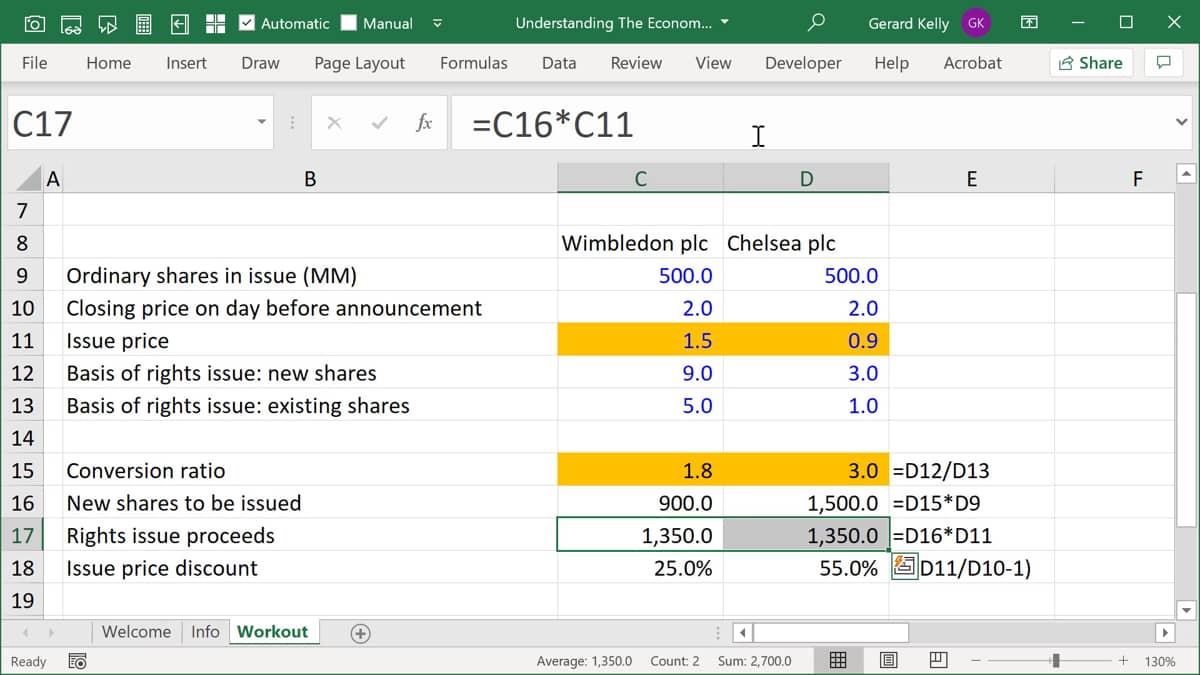
So let's have a quick look at these two companies here. We've got Wimbledon and Chelsea, and we can see they've both got 500 million shares in issuance.
And the closing price on the day before announcements is exactly the same. It's two. So before the rights issue happens, they've both got the same market capitalization.
Now let's have a look at their issuance.
Well, their issue price is going to be different for Wimbledon's, 1.5 for Chelsea, it's not 0.9.
And the basis of the rights issue. Wimbledon is going to issue nine new shares for every five existing shares.
Whereas Chelsea is going to do three new for every one old.
So let's just stop for a moment and work out the implications of this.
We've got two companies with exactly the same market capitalizations.
One of them is going to set a higher issue price, but it's going to issue less new shares.
It's not even two for one.
Chelsea's going to have a lower issuance price, but it's gonna issue many more shares, three for one.
So interestingly, it feels like the two of them are balancing off Wimbledon, high price, lower number of new shares, Chelsea, lower price, but higher new number of shares.
The two things seem to kind of offset each other.
Let's see what happens. So our conversion ratio is the number of new shares divided by the number of old shares showing us that we're gonna have about 1.8 for every one with Wimbledon.
If I copy that to the right, I can see that we end up with three for one for Chelsea.
We saw that earlier. Okay, so how many new shares are going to be issued? So I'm going to take that conversion ratio, 1.8 new for every old, and I'll multiply it by the number of old shares or the existing number of shares.
So 900 new shares for Wimbledon and 1,500 new shares for Chelsea.
They had 500 before. We're doing a three for one.
So they're gonna issue 1500.
Now that all important figure, the rights issue proceeds we, we've done requirement one, but I want to requirement two Now, rights issue proceeds.
That means I need to take the new shares to be issued.
But how much were they issued for? Well, for Wimbledon, they were issued at 1.5 each.
So the amounts of money raised is 1,350.
Again, I'm gonna copy that to the right for Chelsea.
Ooh, interesting.
Chelsea will be receiving the same proceeds as Wimbledon. So remember earlier When we said that Wimbledon had a higher issue price.
Interesting, but the number of new shares for every old one for Wimbledon was lower.
And we said that that might be offsetting.
That's exactly what has happened.
So with that in mind, how can I understand the issue price discount? Well, I want to take that issue price, and I want to divide it by the old original existing price.
Subtract one, make it a percentage, and I just want to make sure it's shown as a positive.
I can see that we've got a discount for Wimbledon of 25%.
If I copied that to the right for Chelsea, whoa.
Much greater discount. 55%.
Now upon first viewing the fact that Chelsea seems to have a bigger discount, we might start reading into that, but economically, it's made no difference at all.
The rights issue proceeds are the same for both companies.
One shows a higher price, but lower number of new shares, and the opposite for Chelsea.
So the issue price discounts. Why might it be important? Well, it's important only in ensuring that investors participate in the rights issue. We want to attract them along because if the share price fell below the issue, price investors would've no incentives to take up their rights.
Why would they? So I could just buy them on the open market at a lower price.
So we want to make sure that discount just ensures investors participate, but the size of that discount is not economically meaningful at all.

 Understanding-The-Economics-of-Rights-Issues-Workout-Empty