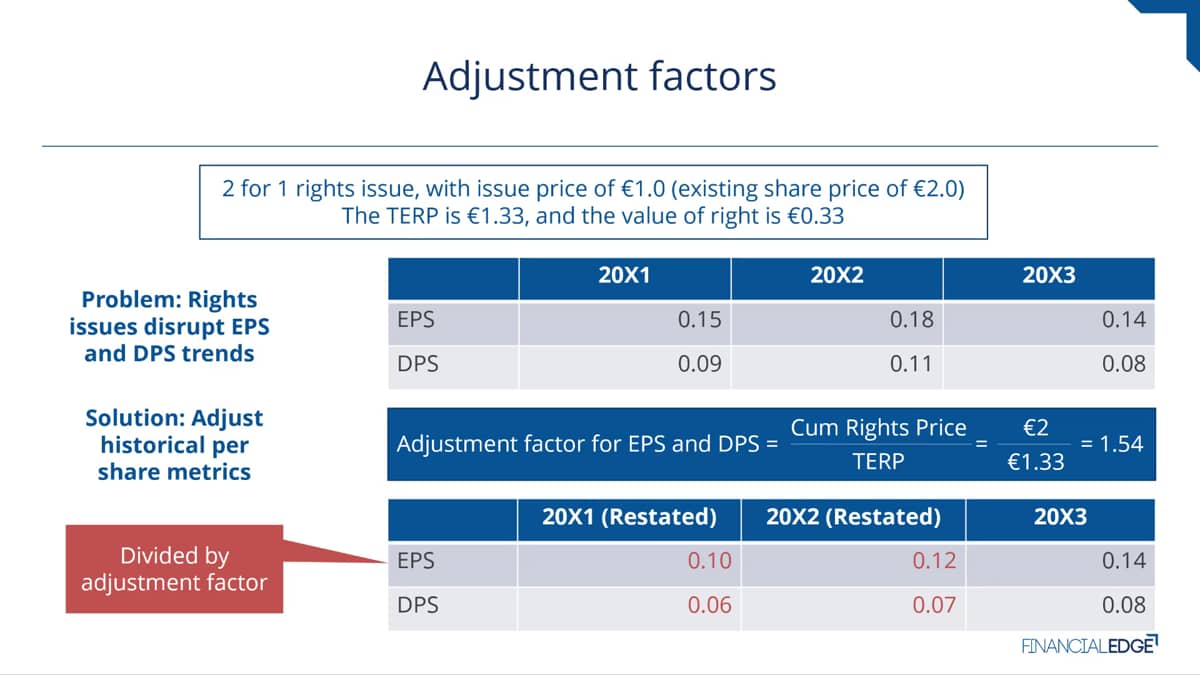
What are adjustment factors? Well, let's have a look Using an example here, we've got an EPS or earnings per share and A DPS dividends per share in 2000 x one, two, and three.
If we look at the EPS, we can see it was North 0.15 and then it went up to North 0.18, but then it very randomly dropped to nor 0.14.
This is because of a rights issue.
The earnings of this company have probably been growing nicely, even into 2000 x three, but because of the rights issue, the number of shares has increased.
So my earnings per share goes down and all of a sudden the trend looks broken.
We need to correct for this problem.
So the problem is rights issues disrupt EPS and DPS trends.
So what's the solution? The solution is to adjust the historical figures.
Those per share metrics, EPS and DPS.
They need to be adjusted in the historical figures.
To do that, let's look at an example.
We've got a two for one rights issue issue price of one euro existing share price of two euros, and we've been given a TURP of one Euro 33.
Now we need to put some of that information into a formula.
It says you need to take the common rights price of two euros and divide it by the turp, the one Euro 33.
So this gets us an adjustment factor of 1.54.
We'll use that 1.54 on the historical figures, the 2000 x one and the 2000 x two figures.
Let's see that happening here.
I can see my 2000 x one restated figures.
My EPS was naught. Point one five.
It's now gone down to naught. Point one. What have I done? I divided by the adjustment factor.
If we look at the EPS in 2000 x two, restated, well, it was N 0.18.
It's now gone down to N 0.12.
Let's look at EPS across the three years.
In the bottom box, it's naught. Point one oh goes up to N 0.12, and now up to N 0.14.
And I can now see that my EPS is gradually growing as the company's growing and the rights issue hasn't disrupted that trend.