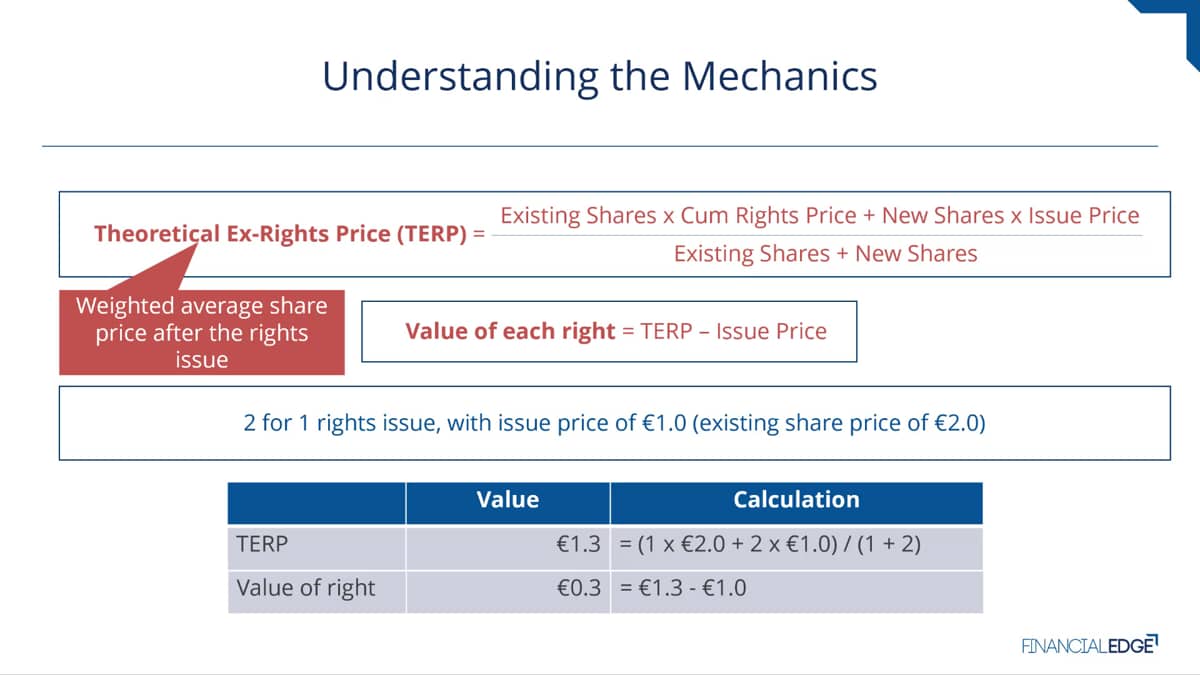
Understanding the mechanics of a rights issue really means understanding something called the turp, the theoretical X Rights price.
Now, this is just a posh way of saying the average share price after the rights issue.
So how can I work out this average share price after the rights issue? We need to use quite a complicated formula.
This says you need to take the existing number of shares times by the com rights price.
That's the share price before the rights issue.
And you add onto it the number of new shares tied by the issue price.
Now, what that really means is we're going to look at the market capitalization of the company after the rights issue, we'll then divide the value of all of the shares by the number of shares, and that will give me an average price per share.
So divide it by the existing shares plus the new shares.
Great, let's have a look at that in an example.
Here we've got a two for one rights issue with an issue price of one Euro.
The existing share price was two euros.
We can put those numbers into our TURP calculation.
So looking at the calculation in the bottom right hand corner there, I can see I had one existing share and I times that by the two euro come rights price.
Then I add onto that the two new shares times by the one Euro issue price.
So as a shareholder who previously had one share, and now I've got three shares, I've now got the value of all of my shares, I can then divide that by the number of shares I own.
My existing number of shares was one, I add on two new shares, so I divide it by three.
So my TURP or my average share price after the rights issue is one Euro 30 cents.
Now, there are two ways that shareholders might interpret this.
One Euro 30 cents. They might think, hang on.
The share price used to be two euros, and now it's gone down to one Euro 30.
I'm outraged. My one share that I owned, which was worth two euros, has gone down in value.
I'm outraged. But another way they might look at it is that they've just bought two new shares for one euro each.
And the value of those shares, which cost you one euro has just gone up to one Euro 30 each.
Fantastic celebration. I've got myself some free money.
Amazing. Now, the combination of those two effects you've lost on your original share, but the value of your new shares has gone up.
Those two effects actually offset each other, and it means our shareholders don't actually lose anything.
They just invest a bit more into the company.
But some shareholders, they may say, do you know what? I don't have the money unfortunately to invest in this company.
It's being used for other things At the moment.
I don't want to get involved in the rights issue, but these shareholders are gonna have their shareholdings diluted, so we need to compensate them in some way.
And we get that by calculating the value of each.
Right now, in this case, the TURP minus the issue price.
The turp is one Euro 30. The issue price was one Euro.
So the value of each right is 30 cents.
But hang on, I thought you said that the shareholder who doesn't get involved in the rights issue is getting diluted.
How are they being compensated? They can sell their rights.
They can sell that right to somebody else, that somebody else can get involved in the rights issue and buy shares.
They can sell it to someone else for a value of 30 cents, and that compensates them for the dilution of ownership.