In this workouts, we're asked to review the rights issue prospectus excerpt and complete the table below, assuming the shareholder holds 18 shares and sells all of their rights.
Okay, so let's scroll down.
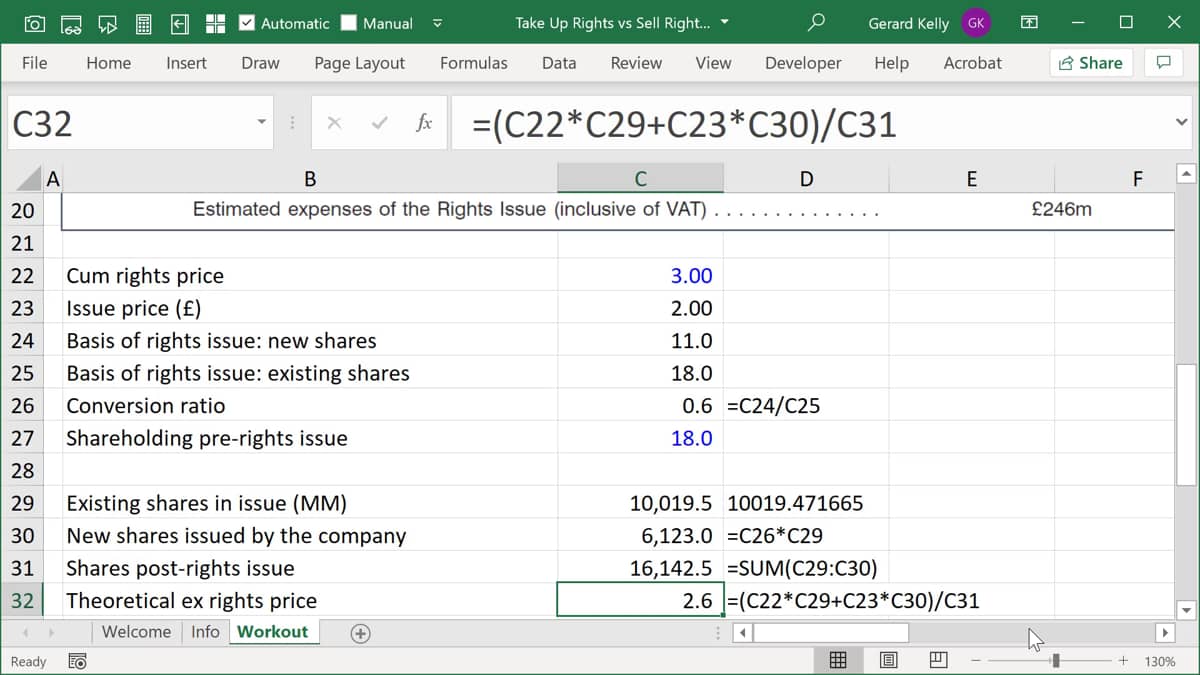
We can see there's a common rights price or share price before the rights issue of three pounds, and we're asked to find the issue price.
Well, that's in the prospectus.
We can see it's right up at the top there, 200 pence or two pounds.
Now we need the basis of the right tissue, how many new shares for each existing share? And we're told that there's going to be 11 new shares for every 18 existing shares.
So again, let's put that in 11.
For every 18, that will give us a conversion ratio.
11 for every 18 means naught. Point six new shares for every one whole share.
Now we're told the shareholding p writes issue was 18, and that's exactly what we had at the top of this workout.
Okay? Now what we're gonna try and work out is the total value of the shareholding com rights, and then compare that to the shareholder's wealth after the rights issue and see if there's been a change.
So let's start doing that by firstly working out the existing shares in issue.
Again, it's up in the prospectus.
We can see it's this 10 billion, 19 million, et cetera, et cetera.
So let's bring that down here. Put it into millions.
So 10,019 spots, 4, 7, 1, 6, 6, 5.
Now, how many shares are gonna be issued by the company? Well, we know there's gonna be naught, 0.6 new shares for every old share.
So I can multiply that by the old number of shares to get 6,123 new shares.
Thus, the shares post rights issue, if we add those up, it's gonna be 16142.5.
Next, my theoretical XY price. That's that big formula.
Well, firstly, I need to take the com rights price, the share price prior to the rights issue, multiply that by the existing shares prior to the rights issue.
Then I need to add on what's happening in the rights issue while we've an issue price of two.
I multiply that by the number of new shares being issued.
I'm gonna put brackets all around that.
I then need to divide that value by the number of shares, post rights issue, and that'll get us a price per share.
And it's 2.6.
Now, what's the value of each nil paid, right? The value is IE the value of the right itself.
Well, I take the 2.6 and subtract out the issue price of two.
That gets me a value for each one of naught. Point six, great.
Now we come to our comparison, the wealth of the shareholder before the rights tissue and the wealth of them afterwards. So what's their wealth Beforehand? That's their total value of their shareholding. Income rights. They had 18 shares and they were each worth three pounds.
So their wealth beforehand was 54.
Let's see how that changes.
We firstly need to work out the nil paid, right, sold, IE.
The number of rights sold or the number of shares sold through the rights issue.
Well, our shareholder, we know that they were getting naught. Point six new shares for every old share.
The number of shares they had, their old shares was 18.
They're going to be selling 11 rights.
So now the value of their shareholding X rights, well, they had 18 shares, but now they're each worth the theoretical X rights price of 2.60, no.
Oh no. The value of our shareholding was 54.
It's gone down to 47.20.
No, but the sale of the nil paid rights will compensate for that loss.
I sell 11 rights each of the value of naughts 0.6, and there's my compensation, the six point eights.
If I add the compensation up and the value of my shareholding after the rights issue, it comes to 54.
Exactly the same value as before.

 Take-Up-Rights-vs-Sell-Rights-Workout-Empty