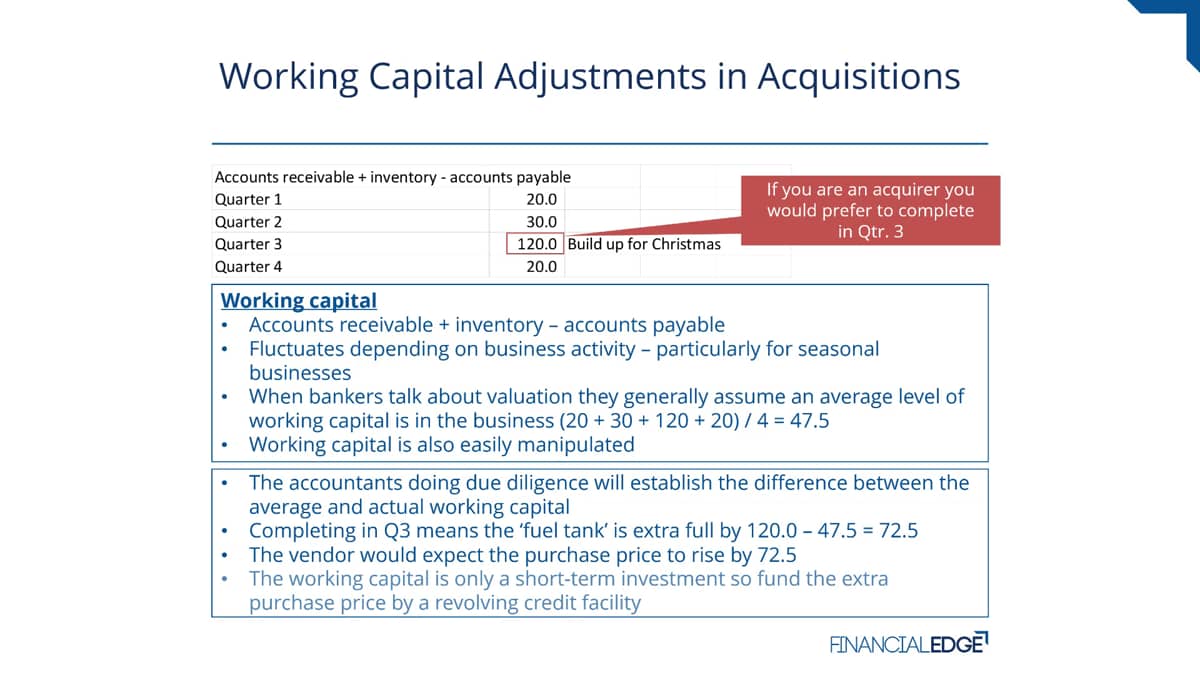
Working capital in its purest form is accounts receivable plus inventory minus accounts payable IE, the cash that's tied up in the business.
We might see this fluctuates depending on business activity, particularly for seasonal businesses.
So if we look at the example table at the top of this slide, we can see there's a big peak in working capital in quarter three.
They're building up their inventory for Christmas, so maybe this is a toy company.
When bankers talk about valuation, they generally assume an average level of working capital is in the business.
So again, taking the numbers from the top, I take the quarter one figure of 20, and then the quarter two, figure three and four, add them all up and divide by the four quarters to find an average figure of 47.5.
This is quite a long way from the outliers. Quarter one and four only had 20. Working capital quarter three had 120.
So the average doesn't really illustrate what's happening in the business.
Moreover, working capital is also easily manipulated, so we need to be somewhat wary of it in an acquisition.
So what can we do? Well, the accountant doing due diligence will establish the difference between the average and the actual working capital at agreement and completion dates.
Completing in quarter three here means that the fuel tank or the extra inventory, the extra accounts receivable that you are about to receive in an extra cash, well, that fuel tank is extra full.
It's extra full by 72.5 I above the average.
So the vendor would expect the purchase price to rise by 72.5 in this period in quarter three.
In addition, if you are the acquirer you'd prefer to complete in quarter three and maybe try not to pay that extra seven to 2.5.
So both parties have to be aware of what's happening to working capital in between the agreement and completion.
In terms of paying for this, well, the working capital is only a short-term investment, so you can fund the extra purchase price by revolving credit facility IE short-term funding for a short-term need.