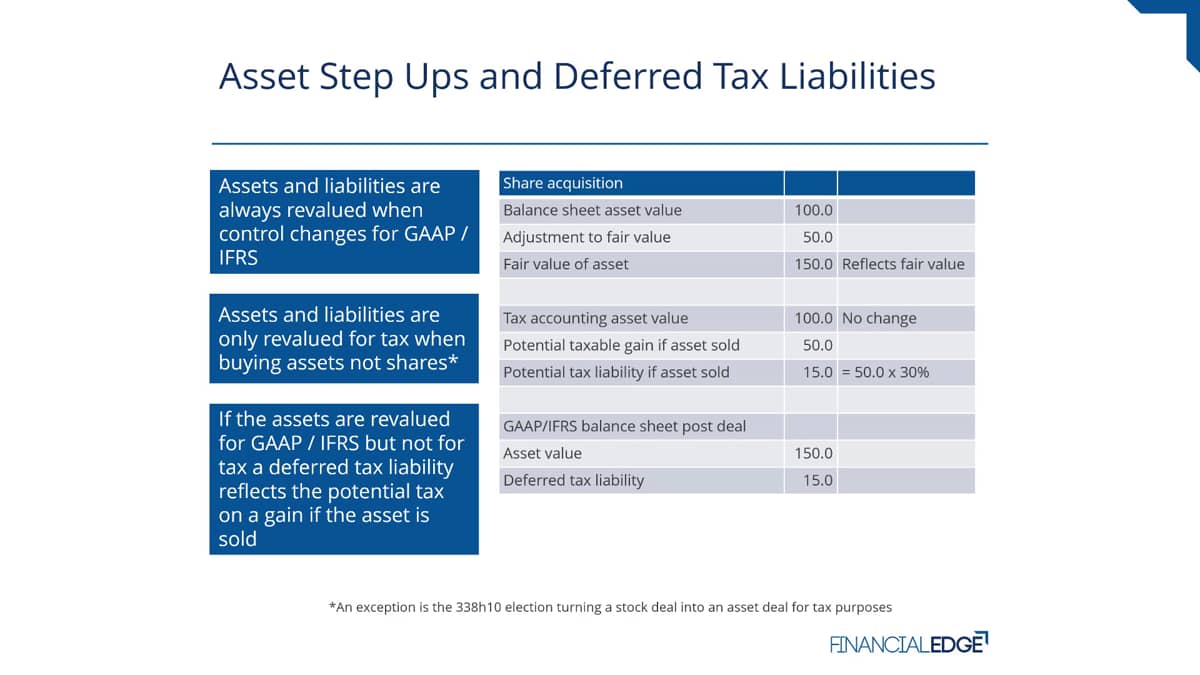
Assets and liabilities are always revalued when control changes for US GAP or IFRS.
So for accounting purposes, always revalued, but assets and liabilities are only revalued for tax purposes when buying assets, not when buying shares.
There is an exception to this.
So we may have a difference in our asset value for accounting purposes and the assets value for tax purposes.
If the assets are revalued for US, GAP and IRS, but not for tax purposes, then a deferred tax liability reflects the potential tax on again, if the asset is sold.
Let's have a look at this using some numbers.
Here we have a share acquisition.
The balance sheet's asset value was 100, but we're gonna make an adjustment to fair value putting it up by 50.
So the fair value goes up to 150, but for tax purposes, my tax accounting asset value stays at 100.
There is no change.
That means we've got a potential taxable gain if the asset is sold of 50, and that means we've got a potential tax liability.
If that asset is sold, I take my tax rate times it by the gain of 50 and that gets me to 15.
So under US Gap or I four s, my balance sheet post deal is going to show the asset value of 150, but we also have to show that deferred tax liability of 15 as well.