In this model, we have an asset step up of 500.
It's important to realize that's not the value of the asset itself, but the value that it has increased by, we've got a marginal tax rate of 30% and a useful life of that asset of five.
The first thing I want to try and model is the value of that step up itself.
It starts at the time of the setup at 500, the beginning next year, 500.
Again, I now want to model it going down through time, so I'm going to take the beginning amounts, lock that, and then divide that by five and then lock that again.
However, I want to make sure that as I copy this to the right, that it does actually stop in year five, so I'm going to change this so it's a min function.
I want it to be the minimum of what we've just calculated and the beginning value iu, when it gets to zero, it doesn't go below zero.
Well then times that by minus one, and the ending asset is the 500 you started with less than depreciation 400.
Let's copy that to the right and let's make sure that it stops, and it does indeed. Once it reaches zero, the depreciation stays at zero.
We now have some assumptions for an income statement and revenue, it's 500.
My costs are 40% of the revenue and are times up by minus one to make it negative.
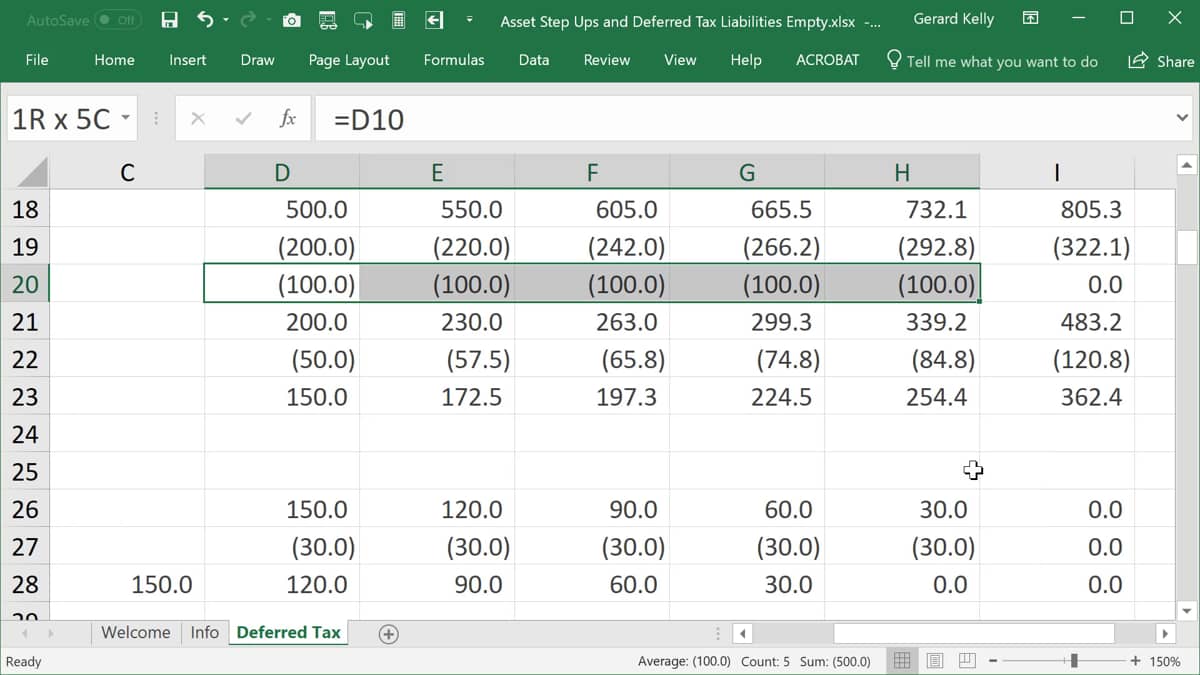
We've now got the additional accounting depreciation because of the step up and profit before taxes 200.
Now the tax expense is going to be on the profit before tax of 200, and I'll do that at the 25% tax rate here. That's my effective tax rate, not the marginal all times that by minus one to make it negative and my net income is the sum of profit before tax and tax expense.
Now, we've included the additional accounting depreciation in our set of accounts here, but in our tax form for tax purposes, this won't have been included.
Instead, for tax purposes, we'll be expecting some kind of gain on the asset in the future.
This means we need to create a deferred tax liability.
Now we start by calculating the ending deferred tax liability.
Now that's the 500 step up times by the marginal tax rate of 30%, and that's my beginning figure next year.
Now that goes up or down by the additional accounting depreciation, again times by the marginal tax rate of 30%.
The one change to make here is to make sure that I fix onto that marginal tax rate, so I log onto C six.
I now copy all of this to the right and we can see that in year six the depreciation goes to zero, and we can see that in year five the deferred tax liability goes to zero, and in year six is zero as well.

 Asset Step Ups and Deferred Tax Liabilities Empty
